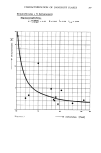
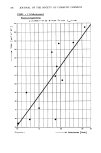
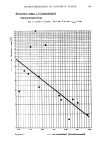
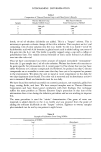
CHARACTERIZATION OF DANDRUFF FLAKES 211 ZUSAMMENFASSUNG Die Desaggregierung von Schuppen in einzelne Epithelzellen und Fetttri3pfchen per Ultraschall wurde mittels Streulichtmessung verfolgt. Das Verhiiltnis aus der Menge des zur Zeit t = 0 (rain) und zur Zeit t -= 10 (rain} gebildeten Verhiiltnisses - Streu- lichtindex, SI genannt - korreliert bei der Untersuchung der Schuppen von 13 Pro- banden gut mit der visuellen Klassifizierung nach Gri3f•e. SI korreliert mit dem Volumen der die Zellcluster bildenden einzelnen Epithelzellen, mit dem Fettgehalt und vermutlich mit dem TEWL. Zwischen TEWL und Zellvolumen besteht ebenfalls eine straffe Beziehung. LITERATURVERZEICHNIS (1) Kligman, A., et al., J. Soc. Cosm. Chem., 25, 73-91 (1974) (2) McGinley, K. J., Marples, R. R., and Plewig, G., J. invest. Derm., 53, 107 (1969) (3) Sauermann, G., und U. Hoppe, Arztliche Kosmetologie, 8, 99-107 (197.8) (4) Kabara, J., Anal. Chem. 48, 6, 814 (1976) (5) Operating Instructions for particle micro-electrophoresis Apparatus Mank II, Rank Brothers, Cambridge, England (6) Plewig, G., Arztliche Kosmetologie 1, 109-114 (1971)

J. Soc. Cosmet. Chem., 31,213-218 (July/August 1980) Clinical aspects of safety testing cosmetic products in the nineteen-eighties PAUL B. KOEHLER, M.D., Chesebrough-Pond's Inc., Trumbull Industrial Park, Trumbull, CT 06611. Received January 11, 1980. Presented at the Society of Cosmetic Chemists Annual Scientific Meeting, New York, New York, December 1979. Synopsis In the 1980s more reliance will be placed on human testing for establishing the SAFETY of NEW COSMETIC PRODUCTS. Additionally, consumer groups and regulatory agencies will impose greater responsibilities on manufacturers to assure the safety of newly marketed products. The end result will be more testing and greater expenditures of time and monies. The standard battery of tests will still include the twenty-one-day cumulative irritancy test, the Maximization or Draize-Shelanski Tests for sensitization potential and, on appropriate products, photopatch testing for phototoxic or photoallergic potential. Before entry in the marketplace, HUMAN USAGE TESTING will encompass longer time periods than previously used. Certain products will undergo exaggerated use studies or be placed with particular population groups (for instance, atopics) for assessing subjective irritation such as burning or stinging. Stricter attention, too, will be paid to the possibility of percutaneous absorption of cosmetic ingredients from different vehicles. OVERVIEW In my opinion, the 1980's will see a greater demand for, and reliance on, human testing, even though animal testing, despite adverse publicity, will continue to be used. The "Friends of Animals" are busy and actively promoting, not only in the United States but also abroad. In the United Kingdom, the Committee for the Reform of Animal Experimentation wants LD50 testing in animals abolished or phased out (1). The group claims that the use of the LD50 to get precise estimates is neither necessary nor helpful in evaluating human safety. The question is asked, "Why not give the animals a dose equivalent to the highest dose that a human is likely to ingest, a so-called 'limit test' ?" A rough estimate of the number of animals involved in LD50 tests in the United Kingdom in 1977 was 229,500--87% of this number were rats and mice, and most of the rest were fish and birds, as part of ecological testing programs. The perennial search for the animal whose skin mimics that of humans will continue even though the baby Yorkshire pig is currently being proclaimed as the animal species of choice. Nevertheless, between animal and human skin there will remain the 213
Purchased for the exclusive use of nofirst nolast (unknown)
From: SCC Media Library & Resource Center (library.scconline.org)