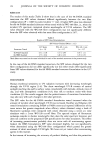
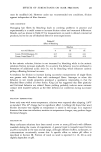
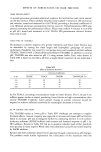
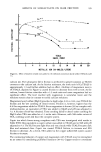
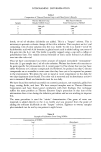
EFFECTS OF SURFACTANTS ON HAIR FRICTION 185 must be modified (26). However under our recommended test conditions, friction appears independent of fiber diameter. HAIR CONDITION Damaging hair fibers by bleaching leads to combing problems in practice and experimentally is a useful means to increase friction values and treatment differences. Results, such as shown in Table IV for measurements on wool in diluted commerical products, led to the use of bleached fibers for most experiments. Table IV Effect of Bleaching Bleaches 0.1% AI Dilutions 0 1X 3X Comm. TEALS Shampoo, F.C. 0.25 0.34 0.43 Comm. Creme Rinse, F.C. 0.22 0.19 0.19 In the cationic solution, friction is not increased by bleaching while in the anionic solutions friction increases markedly. To an extent this behavior may be attributed to formation of additional acidic sites (31, 32) by bleaching which enhances cationic pickup, offsetting frictional increase. A tendency for friction to increase during successive measurements of single fibers was greater with bleached than with undamaged fibers. Attempts to relate this behavior to wet tensile properties produced a qualitative relationship in that the bleached fibers yielded at lower forces. King (22) has suggested that fiber plasticity and frictional behavior are related. Easier yielding probably induces more intimate contact with mandrel surfaces as the fiber deforms (or conforms) during successive rubs. SOLUTION TEMPERATURE Some early tests with room temperature oolutions were repeated after adopting 110øF as standard. This 30 ø change had no significant effect. Lindberg (28) found that wool friction decreases very slightly as temperature is raised in this range. It is expected however that some test solutions, sensitive to temperature changes, may produce larger frictional changes. SOLUTION PH Many surfactant solutions have been tested at two or more pH levels with different mandrels during the course of experiments. A general trend is towards lower friction as pH is increased in the near-neutral range, although different buffers, surfactants, or concentrations occasionally reverse this. A specific effort to isolate pH effect is described in Section III. Friction of wool on wool is reported (12, 28, 30) as only slightly dependent on pH.

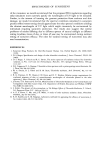
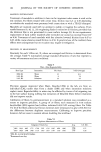
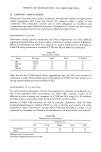
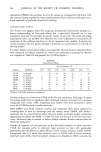
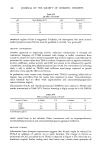
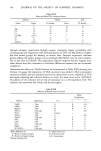
186 JOURNAL OF THE SOCIETY OF COSMETIC CHEMISTS MANDREL PRETREATMENT Treatment of mandrels in addition to hair can be important when water is used as the test medium. For fibers treated with creme rinse, friction was 0.21 or 0.38 depending on whether the mandrels were pretreated with creme rinse or with a TEALS shampoo. Mandrels are routinely used with no attempt to polish or roughen the surfaces. From textile literature (8, 10, 22, 25) roughening leads to reduction in friction provided that the lubricant film is not penetrated to cause surface damage (8). In our experiments, replacement of hard rubber mandrels after extended use caused an increase from 0.47 to 0.50. Treatment of used mandrels with fine abrasive lowered friction from 0.47 to 0.45, while coarse abrasive raised friction to 0.50. In practical use of the method, these effects seem unimportant but on occasion may require investigation. PRECISION OF MEASUREMENTS Routinely for each 5-fiber set, X2 values are averaged and friction is determined from the average. Table V summarizes average standard deviations of sets that represent a variety of treatments and test conditions. Table V Fiber--Fiber Reproducibility Hair Type Immersion No. Runs % SD (Average) DM, BL Water I0 10.3 LAL, BL Water 8 7.0 LAL, BL Solutions 39 2.6 Precision appears improved when fibers, bleached (BL) in the lab, are from an individual (LAL) rather than from a dealer (DM) and when immersion solutions replace water. Reproducibility in water may be affected by traces of oil migrating out to the hair surface during rubbing but extraction of bleached fibers before treatments did not improve results. Calibration of fibers by premeasurement in a standard solution was considered as a means to improve precision. A group of 25 fibers, each measured in 0.1% sodium laurylsulfate (SLS) against hard rubber, indicated 6.63% S.D. among fibers. For Table VI, 10 of the fibers selected at friction extremes were remeasured to give 2.82% S.D. for the differences between duplicate measurements. Calibrating to improve precision however did not seem to warrant almost doubling the workload. Table VI Duplicate Measurements of Fibers Integrator Values (g2) Avg. % S. Dev. t2082 1839 1807 1777 1768 1747 1715 1697 1681 1666 1778 6.77 22027 1820 1748 1708 1714 1710 1677 1707 1725 1636 1747 6.24 tDM, BL, in 0.1% SLS/H. Rubber. 2Remeasured next day.
Purchased for the exclusive use of nofirst nolast (unknown)
From: SCC Media Library & Resource Center (library.scconline.org)