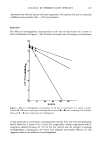
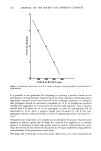
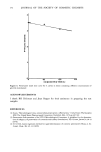
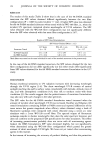
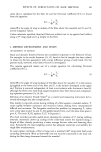
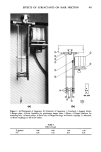
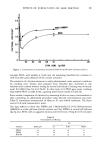
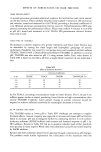
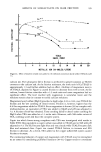
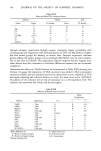
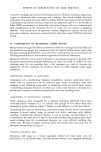
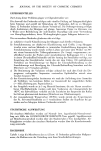
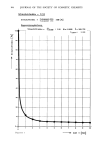
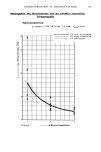
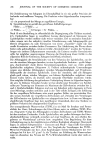
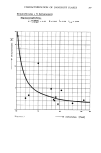
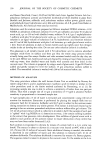
EFFECTS OF SURFACTANTS ON HAIR FRICTION 189 0.4 0.3 HARD RUBBER o WOOL 0.2 o.,[ 0 I I I I I I I I I I .02 .04 .06 .08 . I0 .20 CTAB CONC. (g/100] Figure 2. Concentration of cetrimonium bromide (CTAB) in 0.02 M buffer solutions at pH 3.6. example FPAC, sorb initially at levels near the measuring threshold but continue to sorb even after gross dilutions of the contact solutions. The existence of a friction minimum is easily substantiated under practical conditions by combing tests. Tresses were prepared from bleached hair, immersed in test solutions and combed without rinsing by several individuals. Combing was obviously easier for 0.001% than for 0.1% SAAC. In other tests, 0.1% FPAC gave easier combing than 0.001% FPAC or 0.001 SAAC, agreeing with friction results in Table IX. Since routine comparison of cationics by measuring friction at many concentrations is time consuming, an abbreviated procedure using selected concentrations was tried. Table X summarizes measurement of fibers at 0.1 and 0.001% surfactant. The fibers used at 0.1% were remeasured in water. The data suffices to show that DMSA and 2-Hydroxyalkyl (C15-18) diethanolamine (HADEA) at acidic pH have friction minima and that DMSA at neutral pH behaves like Q-18 or FPAC with no apparent minima and low friction. Using the 0.1% solutions Table X Concentration and Rinsing F.C. Cationic Buffer pH 0.! 0.001 Water DMSA 3.6 .39 .29 .25 DMSA 6.9 .20 .21 .22 HADEA 4.2 .35 .22 .25

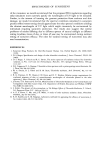
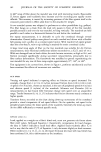
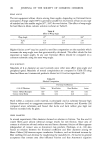
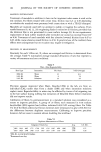
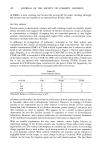
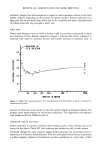
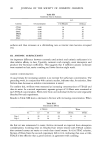
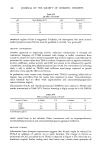
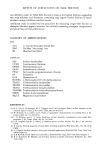
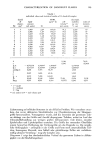
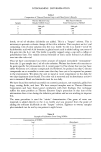
190 JOURNAL OF THE SOCIETY OF COSMETIC CHEMISTS of DMSA, a tress combing test favored the neutral pH for easier combing although the decision was not unanimous as expected from friction values. FRICTION MINIMA Friction values as determined correlate well with combing results on similarly treated tresses and both tests support the existence of friction minima for certain surfactants as concentration is changed. Accepting this, an important question is why higher solution concentrations and consequently higher fiber surface concentrations cause friction to increase rather than decrease. A difference in arrangement of surfactant molecules at the fiber surface was considered in the context of micelies absorbing at high concentrations. The critical micelle concentration (CMC) of CTAB is 0.03% in pure water and is reduced to about 0.02% in salt solutions. Above these concentrations in Figure 2, friction values appear high. Steigman, et al. (34) discuss change of CTAB CMC by salts. At 86øF and 0.03% CTAB, the CMC is exceeded in KBr solution and not yet attained in NH4Br solution of the same molarity. At 0.1% CTAB, the CMC is far exceeded with either of these salts but is not yet attained with tetraethylammonium bromide (TEAB). Friction was measured for CTAB under these conditions for the data in Table XI. Apparently, the presence or absence of micelles has no appreciable effect on friction. Table XI Tests for Miceliar Effects t F.Co % CTAB KBr NH4Br TEAB 0 .51 .55 .47 0.03 .31 .28 -- 0.04 .27 .31 -- 0.10 .29 .29 .29 •DM, BI./H, Rubber in 0.39 M salt solution at 86øF. Schwartz and Knowles (24) state that the surfactants of their experiments acted at best as boundary rather than hydrodynamic lubricants. However, an analogy of friction minima in our experiments and in other research is obvious. Roder (21) for example found that with increments of oil, friction decreases, passes through a minimum and then increases as more is applied. This appears to be a widely accepted general observation (8) and the friction increase is explained in terms of hydrodynamic lubrication. However, with cationic surfactants, as concentration increases, formation of the multilayers associated with hydrodynamic lubrication is disputed (6). With no tenable explanation for why more cationic causes higher friction, an interesting analogy to the friction minima was recollected from earlier static charge experiments (33). The method (36) employs an oscilloscope with camera for recording charge impulses from a hard rubber comb during strokes of a treated tress suspended in a low humidity cabinet. With cationic treatments the impulses can be reduced to negligible levels on the scope, i.e. static charge build-up is reduced. With additional cationic on the tress, the impulses again rise but with altered pattern. The hair fibers
Purchased for the exclusive use of nofirst nolast (unknown)
From: SCC Media Library & Resource Center (library.scconline.org)