J. Soc. Cosmet. Chem., 31,173-177 (July/August 1980) Sunscreen product effectiveness can vary with different simulated solar ultraviolet spectra GORDON J. LEVEE, ROBERT M. SAYRE, and EDWARD MARLOWE, Plough, Inc., P.O. Box 377, Memphis, TN 38151. Received December 5, 1979. Synopsis Two different short wavelength cut-off filters were used in a xenon arc SOLAR SIMULATOR employed in SUNSCREEN PRODUCT EFFICACY testing. Different efficacies were indicated for a standard formulation, depending on the filter used. These data document the importance of the short wavelength characteristics of the ULTRAVIOLET SPECTRUM used in tests for product labeling. A narrower definition of solar simulator specifications for sunscreen product testing may be necessary. INTRODUCTION In August of 1978 the United States Food and Drug Administration (FDA) published proposed rules to establish conditions for the safety, effectiveness and labeling of over-the-counter (OTC) sunscreen drug products (1). Included among the proposed rules and label requirements are methods for determining a Sun Protection Factor (SPF) which is a measure of sunscreen product effectiveness. An SPF value is defined as the amount of UV energy required to produce a minimal erythema dose (MED, that amount of energy which produces a minimally detectable redness) on sunscreen- protected skin divided by the amount of UV energy required to produce an MED on unprotected skin. In the case of solar simulators, where the energy emitted is assumed to be constant, exposure time is commonly used to determine the MED. A solar simulator is recommended as the preferred source of ultraviolet (UV) energy for these SPF determinations because natural sunlight is extremely variable and uncontrollable. The proposed rules specify that a solar simulator shall have a "continuous emission spectrum in the UV-B (290-320 nanometers) with less than one percent of its total energy contributed by ... wavelengths shorter than 290 nanometers" and "not more than five percent of its erythemically effective energy be contributed by nonsolar wavelengths" (1). Many commercial sunscreen products already bear SPF designations in anticipation of the finalization of these FDA rules. Recent observations made in our laboratory indicate that a narrower definition of the solar simulator specifications may be desirable. While testing a standard sunscreen formulation in connection with an international comparison of sunscreen testing methods, we found that the SPF values we obtained were only 70% as great as those obtained when this same standard had been tested in 173

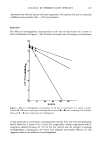
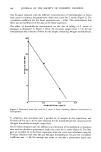
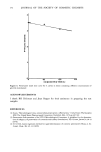
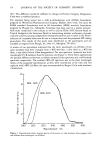
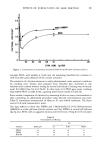
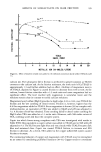
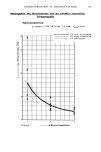
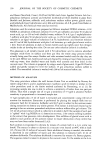
174 JOURNAL OF THE SOCIETY OF COSMETIC CHEMISTS 1977. This difference would be sufficient to change its Product Category Designation if this were a marketed product. The standard being tested was a 4.0% p-aminobenzoic acid (PABA) formulation prepared by Westwood Pharmaceutical Company, Buffalo, New York. The same 4% PABA standard formulation and an 8% homosalate (HMS) standard formulation prepared by Plough, Inc., Memphis, Tennessee had been used in a similar industry- wide study conducted in this country in 1977 to aid the FDA's OTC Review Panel on Topical Analgesics (the Sunscreen Panel) in determining whether uniformity of results could be achieved among independent testing laboratories and to assist in the Panel's selection of a standard sunscreen for use in conjunction with the proposed SPF testing procedures. The results of this study were distributed to the participants and are available on request from Plough, Inc., Box 377, Memphis, TN 38151. A review of our procedures indicated that the short wavelength cut-off filter of the solar simulator had been changed from a WG-305 filter, 2 mm thick to a WG-320 filter, !mm thick (Schott Glass designations). The new spectrum contained less short wavelength UV-B radiation than the previous one (Figure 1). These filters approximate the spectral differences between a southern (tropical) solar spectrum and a mid-latitude spectrum, respectively. The southern WG-305 spectrum was at the short wavelength limits of the proposed specifications as they were understood at the time and was replaced with a WG-320 filter, the type recommended by Berger (2) for solar simulator construction. 1.0 .2 WG- 305 WG-320 I I I I ! I I 280 300 320 340 360 380 400 Wavelength nm ! I Figure 1. Superimposed relative intensity spectra of the xenon arc solar simulator when equipped with two different short wavelength cut-off filters.
Purchased for the exclusive use of nofirst nolast (unknown)
From: SCC Media Library & Resource Center (library.scconline.org)