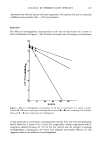
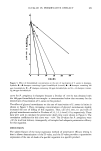
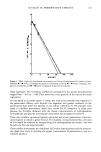
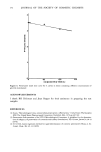
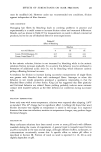
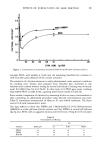
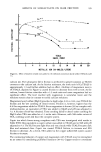
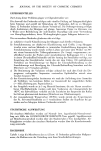
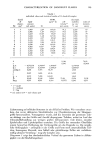
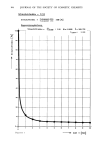
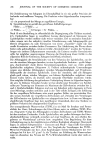
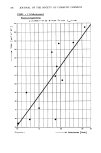
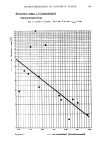
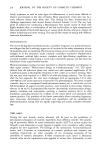
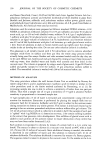
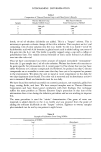
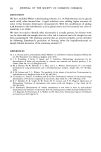
D-VALUE IN PRESERVATIVE EFFICACY 169 o o 5 lO 15 20 25 HOURS Figure 3. Effect of formaldehyde concentration on the rate of inactivation of S. aureus in shampoo. Symbols: • shampoo containing 0 ppm formaldehyde (control), • shampoo containing 100 ppm formaldehyde, ,•' •', shampoo containing 200 ppm formaldehyde, and © O shampoo contain- ing 300 ppm formaldehyde. curve for P. aeruginosa in shampoo because a D-value of 0.6 hr was obtained with the 100 ppm formaldehyde test sample--a concentration below that necessary for the desired rate of inactivation of S. aureus in this product. The effect of glyceryl monolaurate on the rate of inactivation of S. aureus in lotion is shown in Figure 5. Here, increasing concentrations of glyceryl monolaurate slightly increased the rate of killing of this organism. Thus, use of 0, 0.01, 0.1 and 0.2% of glyceryl monolaurate resulted in D-values of 3.5, 3.5, 3.4 and 3.1 hr, respectively. These data were used to calculate the preservative death time curve shown in Figure 6. The correlation coefficient for this curve was --0.97. The D-values for P. aeruginosa were 0.5 hr in all test lotions consequently, all samples had adequate preservative efficacy for this organism. DISCUSSION The salient feature of the linear regression method of preservative efficacy testing is that it allows determination of the D-value, and the D-value provides a quantitative expression of the rate of death of a specific organism in a specific product.

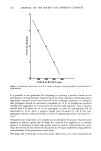
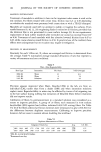
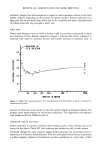
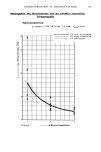
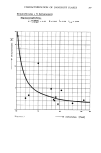
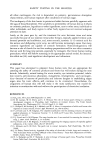
170 JOURNAL OF THE SOCIETY OF COSMETIC CHEMISTS 0 0 1•)0 200 3•0 4•0 CONCENTRATION (ppm) Figure 4. Preservative death time curve for S. aureus in shampoo containing different concentrations of formaldehyde. It is possible to set guidelines for accepting or rejecting a product based on the performance of its preservative system because the linear regression method provides a quantitative measure of the rate of die-off of the challenge organisms. It is believed that pathogens should be inactivated completely in 24 hr in multiple-use products intended for application in or around the eye and for baby products. Thus, a product should have a D-value of -4 hr for pathogens, so that 106 pathogens/g will be inactivated in 24 hr. Also, a product should have D-values of _28 hr for non- pathogenic bacteria, yeasts and molds, so that 106 organisms/g will be inactivated in 7 d(3). The preservative death time curve enables one to determine the amount of preservative required to obtain a given rate of death for a specific test organism in a cosmetic product. A minimum of three data points must be used in constructing this curve. Also, the desired D-value should be bracketed by D-values established using different concentrations of the preservative under study. The slope and Y-intercept of the preservative death time curve were determined by
Purchased for the exclusive use of nofirst nolast (unknown)
From: SCC Media Library & Resource Center (library.scconline.org)