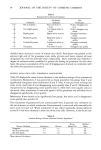
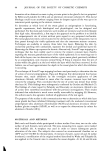
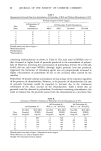
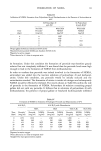
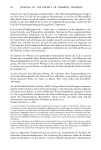
58 JOURNAL OF THE SOCIETY OF COSMETIC CHEMISTS Table I Rating Scales for Sensory Evaluations Stickiness/ Skin Greasiness Tackiness Penetration 0 l 1-- 2-- 3-- 4-- 5-- Not at all greasy Not at all sticky or Product disappears not tacky at all Very slightly greasy Very slightly sticky or Product disappears very tacky slowly Slightly greasy Slightly sticky or tacky Disappears somewhat slowly Moderately greasy Moderately sticky or Disappears somewhat tacky quickly Considerably greasy Considerably sticky or Disappears moderately tacky quickly Very greasy Very sticky or tacky Disappears very quickly distilled water received a score of almost zero (0.05). Petrolatum was graded at the extreme high end of the greasiness scale, while glycerin and heavy mineral oil were designated one and two intervals lower, respectively. These materials also imparted a degree of tackiness which paralleled in general the feeling of greasiness. On the other hand, the sensory assessments of the rate of disappearance showed no correlation with the other two parameters evaluated. SENSORY EVALUATION WITH COMMERCIAL MOISTURIZERS Table III displays the mean scores obtained in the attribute ratings of six commercial moisturizers. Moisturizer A was perceived as being somewhat less greasy than C and significantly less greasy than moisturizers E and F. Also, A was perceived as being less tacky to the touch than E and disappearing more quickly than E and F. Moisturizer A was perceived as disappearing more quickly than C, while both were equally tacky to the touch. Also, moisturizer A was rated equal to B for greasiness and tackiness, but it disappeared significantly more quickly. Moisturizer B was found to be significantly less greasy, less tacky, and it disappeared more quickly than product D. The evaluations of greasiness by the sensory panel were, in general, very consistent. In the two instances in which moisturizer B was assessed, it was rated with essentially the same score (1.0 and 1.2). When moisturizer A was tested repeatedly, almost identical scores (0.7-0.8) were obtained in three out of the four cells. However, in the fourth test Table II Attribute Ratings of Some Lubricant Cosmetic Ingredients' Sensory Attributes Heavy Distilled Petrolatum Glycerin Mineral Oil Water Disappears 0.4 2.1 2.2 1.5 Skin feels sticky/tacky 3.5 2.5 1.2 0.8 Skin feels greasy 4.9 3.9 3.0 0.05 'Mean values of 20 subjects

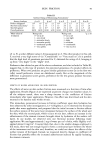
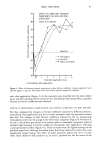
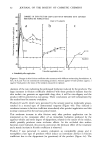
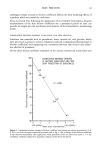
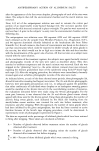
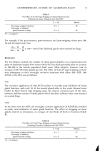
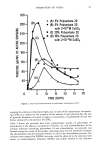
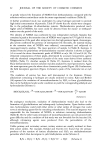
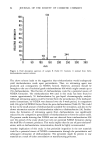
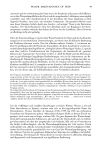
SKIN FRICTION 59 Ta'ble III Attribute Rating of Moisturizing Formulations • Sensory Attribute A vs B A vs C A vs E A vs F B vs D Product disappears 2 2.84 1.9 3.24 2.2 3.04 2.3 2.24 1.5 3.2 2.7 Skin feels tacky/sticky 3 1.! 1.! 1.4 1.4 1.5 2.0 2.1 2.2 1.14 2.0 Skin feels greasy 3 0.8 1.0 0.7 4 1.3 0.84 2.9 1.8 4 4.2 1.2 4 2.8 Overall preference 10/20 10/20 10/20 9/20 14/20 5/20 18/20 2/20 16/20 4/20 Mean values of 2 Rating scale: 3 Rating scale: 4 P _ .05 20 subjects 0--not at all 0--not at all 1--very slowly 1--very slight 2--somewhat slowly 2--slight 3--somewhat quickly 3--moderate 4--moderately quickly 4--considerable 5--very quickly 4--very much so (A vs. F), a rather different value (1.8) was assigned to A. The other product in this cell, F, received a very high score of 4.2 ("Considerable" to "Very much so"). It is possible that the high level of greasiness perceived for F, distorted the rating of A, bringing it up from "very slight" to the "slight" level. Preference data elicited as part of the above evaluations, and also included in Table III, suggest that, in this type of products the perceived greasiness of a product affects its preference. When two products are given similar greasiness scores (as in the first two cells), overall preference scores are distributed evenly. But as the magnitude of the difference in greasiness scores grows, preference for the less greasy product becomes more pronounced. EFFECTS OF WATER APPLICATION ON SKIN FRICTION The effects of water on skin surface friction were measured as a function of time after application. Results (Figure 2) are expressed as percent change over baseline values. In all the subjects tested, there was a sharp increase in the coefiqcient of friction immediately after water application. However, this effect was short-lived and the skin returned to its baseline state within 10 min. This immediate, pronounced increase in friction coefiqcient upon skin hydration has been observed by other investigators (1,3,5-7). Highley et al. (7) observed two frictional peaks after water application, and proposed that the initial increase in friction reflects the surface tension of the water layer interposed between the surface of the wheel and the skin, while the second peak, which occurs 10 min later, reflects an increase in the adhesiveness of the stratum corneum brought about by hydration of the surface cell layers. In our studies, we observed only one frictional increase following water application. We used approximately 2 mg of water per cm 2 of skin, while Highley et al. applied almost 8 mg/cm 2. It seems likely that, due to the smaller dosage employed in this study, there was not enough liquid to form a continuous layer between the wheel of the instrument and the skin and, therefore, we could not detect the effects of the surface tension of the liquid. Instead, we measured directly changes in coefiqcient of friction that possibly reflect the increased adhesiveness induced by rapidly hydrating the stratum corneum.
Purchased for the exclusive use of nofirst nolast (unknown)
From: SCC Media Library & Resource Center (library.scconline.org)