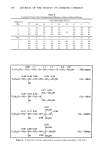
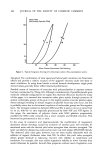
NEW NON-IONIC SURFACE ACTIVE AGENTS 265 SBA-DEA N w/o Ea Eb o, L •, -- sso L2 w/o L•\ w o Figure 3. Ternary phase diagrams. Transmittance (T) was measured with a cell of 0.15 mm thickness. .... :Limit of w/o emulsion region Ea: W/o, T = 0.01, stable Eb: W/o, T _- 0.01, unstable. aminoesters (HLB: 6-7.5), or to the bulkiness of SSO molecule which may interfere the molecular orientation. It is generally accepted that a surfactant with the higher hydrophile-lipophile balance tends to give normal miceliar and normal hexagonal phases rather than L 2 and M 2 phases. The occurrence of the latter two phases appears to be closely related to the aptitude of surfactants for w/o emulsification. In other words, it seems very likely that the surfactant having an appropriate hydrophile- lipophile balance for the formation of mesophases (M 2 and N) as well as the L 2 phase may be more suitable for w/o emulsification. As stated before, the emulsifying agents with double bond(s) in lipophilic chain were highly effective in w/o emulsification. We synthesized several triethyleneglycol (TEG, equivalent to 3 E.O.) esters of oleic (Z), elaidic (E), (Z)-9,10-methyleneoctadecanoic,

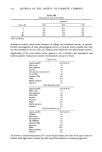
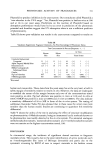
266 JOURNAL OF THE SOCIETY OF COSMETIC CHEMISTS n-octadecanoic (stearic), 2-heptylundecanoic and 2-hexyldecanoic acids as model compounds, in order to examine the structures of lipophilic groups in the surfactant molecules which affect their emulsifying properties and the stability of w/o emulsions prepared with them. These esters were prepared by usual esterifiaction of the corresponding acids with TEG in the presence of a trace amount of BF 3 at 100øC and purified by column chromatography. The structures, physical properties and purities, estimated by gas chromatographic analyses of the above esters, are summarized in Table VII. Table VII Triethyleneglycol (TEG) Fatty Acid Esters GC State Purity No. Compound Structure (mp, øC) (%) 1 TEG oleate 2 TEG elaidate 3 TEG (Z)-9,10- methylene- octadecanoate 4 TEG n-octa- decanoate 5 TEG 2-heptyl- undecanoate CO2R L 97 ß /CO2R L 97 CO2R CO2R C 97 (42-43) CO2R L 97 6 TEG 2-hexyl- CO2R L 97 decanoate ] The first three esters readily afforded good w/o emulsions with considerable stability, and no appreciable disparites were observed among them. The similarities in their emulsifying properties can be evidenced by the following facts: The proportion of emulsified layer of the emulsion [TEG ester (5%)-liquid paraffin (28%)-water (67%)] observed after 72 hr (stored at 45øC) was %.9, 94.9 and 94.9 (volume %) for TEG oleate, -elaidate and -(Z)-9,10-methyleneoctadecanoate, respectively. In addition, absorbance at 450 nm of the diluted emulsion (500-fold dilution with liquid paraffin) measured 0.38, 0.40 and 0.41 for the above three compounds. In contrast, w/o emulsions produced with TEG n-octadecanoate, -2-heptylundecanoate and -2-hexyldecanoate were all labile and separated into two or three layers in a short time, as shown in Figure 4. These results obviously indicate that neither the presence of double bond(s) nor the peculiar cis-configuration is a principal factor involved in the stabilization of w/o emulsion with which oleyl system, for instance, is concerned. Moreover, surfactants
Purchased for the exclusive use of nofirst nolast (unknown)
From: SCC Media Library & Resource Center (library.scconline.org)