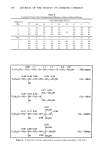
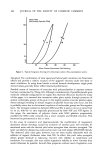
NEW NON-IONIC SURFACE ACTIVE AGENTS 267 ß • . .• .-, k% -• . . .. • ? • •. : .. . Figure 4. •/o emulsification with TEG esters. A: Right after preparation B: After 1 month. Numbers given to each bottle correspond to those in Table VII. possessing a relatively long side chain at •-carbon in lipophilic group are very likely to fail of good w/o emulsification, probably owing to the steric hindrance in orientation of surfactant molecules at interface. The dynamic behavior of these model compounds in reversed micellar state was examined by •3C-NMR spectroscopy to find an explanation of the peculiar nature of the former three compounds. Since the relaxation of a nuclear spin is efficiently caused by the fluctuation of surrounding magnetic field brought about by molecular motion, the dynamic behavior of mobile molecules can successfully be interpreted on the basis of •3C spin-lattice relaxation times (T•'s). Observed T• values are able to yield information on the rate and anisotropy of overall molecular tumbling of a rigid carbon framework in solution. They also effectively probe detailed internal motions along aliphatic chains, which in turn monitor the anchoring of ionic or polar sites together with the segmental motion of long carbon chains. As the •C spin-lattice relaxation of

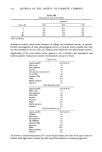
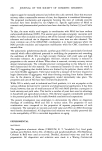
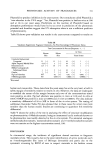
268 JOURNAL OF THE SOCIETY OF COSMETIC CHEMISTS protonated carbons in large and intermediate sized molecules is reported to be in general predominantly governed by •3C-•H dipolar interactions with the attached hydrogens (5), no attempt was made to evaluate the nuclear Overhauser enhancement factors, from which T•a a (T• for dipole-dipole relaxation, being theoretically and quantitatively relevant to effective correlation time) can be calculated. If the rotational reorientation of a molecule is such that satisfies the condition of 'extreme narrowing limit,' then, T• of a carbon is given by 1/T• = N h 2"¾C2"¾H2rCH --6Teff , (3) where N is the number of directly bonded hydrogens, h is Planck's constant, q/c and qri• are the gyromagnetic ratios for 13C and 1H, rcx• is the internuclear distance (1.09 •), and reft is an effective rotational correlation time of the C--H vector. Validity of the above condition was confirmed by the measurement of line width which is related to spin-spin relaxation time (T2). The width of each signal was found in the range of 3 to 4 Hz, thereby corroborating its validity. CMR parameters of TEG esters and Inversion Recovery Fourier Transform (IRFT) spectrum of TEG (Z)-9,10-methyleneoctadecanoate are shown in Table VIII and Fig. 5, and also T•, NT 1 and calculated reft are given in Table IX. For a rigid molecule rotating isotropically, reft is equal to the correlation time for overall molecular reorientation. If internal motions are present or if the overall reorientation is anisotropic, (reft) -• is represented by a sum of rates for internal and overall rotation: (reft) -• = (r•) -• + (rg) -•, (4) where r, is the correlation time for overall reorientation of the molecule, and rg is that for internal motion due to rotation about individual carbon-carbon bonds in the chain. Although r, is not yet available, ref t data can be analysed by using a self-consistent Table VIII CMR Parameters of TEG Esters a 19 17 15 13 11 8 6 4 2 1' O 4' 5' OH Compound Chemical Shift (ppm) No. 18q b 17t c 16t 15t 14t 13t 12t lit 10t/d d 19t 1 14.1 22.7 32.0 29.1 29.1 29.3 29.6 27.2 129.9 2 14.1 22.8 32.0 29.0 29.2 29.2 29.6 32.7 130.4 3 14.1 22.7 32.0 29.4 29.4 29.7 29.7 28.8 15.8 4 14.1 22.7 32.1 29.4 29.5 29.6 29.7 29.7 29.9 11.0 9t/d 8t 7t 6t 5t 4t 3t 2t is e 1 129.6 27.2 29.7 29.7 29.6 29.3 24.9 34.1 173.5 2 130.1 32.7 29.8 29.8 29.6 29.4 25.0 34.1 173.9 3 15.8 28.7 30.3 30.2 29.5 29.2 25.0 34.2 173.9 4 29.9 29.9 29.9 29.9 29.6 29.2 25.0 34.1 173.8 •CDCI3, 0.5M. bQuartet. CTriplet. dDoublet. eSinglet.
Purchased for the exclusive use of nofirst nolast (unknown)
From: SCC Media Library & Resource Center (library.scconline.org)