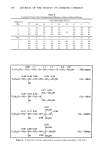
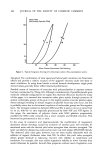
OPTIMIZATION TECHNIQUES 291 I Figure 2. A three-factor composite design. (o• = axial point distance.) Table II A Three-Factor Composite Design Factor Level Trial x, x 2 x3 1 --1 --1 --1 2 1 --1 --1 3 -1 1 -1 4 1 1 -1 5 -1 -1 1 6 1 -1 1 7 --1 1 1 8 1 1 1 9 --a O O 10 a O O 11 0 --a 0 12 0 a 0 13 0 0 --a 14 0 0 a 15 0 0 0

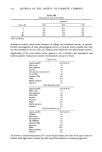
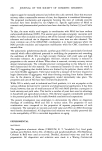
292 JOURNAL OF THE SOCIETY OF COSMETIC CHEMISTS different, differing in many cases by only a small quantity of an ingredient, or a very small change in a process variable. Translating such a design into physical units, or, in fact, selecting the variables to study and measure, requires some expertise and there is no substitute for experience. Experienced formulators have been selecting factors for study as a routine matter, and it should be pointed out that, anything which can be quantitated and controlled may be selected. PHYSICAL SYSTEMS The majority of the products to which these techniques have been applied are in the pharmaceutical category rather than cosmetic science, and to solid dosage forms, in particular. But the techniques are applicable to any multivariate system, and one example involving a suspension may be of interest (7). The independent variables selected are shown in Table III. Four of these are formulation variables and one is a process variable. Table III Independent Variables (Suspension) x•--Veegum K Level (colloidal aluminum magnesium silicate) x2--Keltrol Level (xanthan gum) x3--Water Level (above a minimum 20% level) x4--Citric Acid Level xs--Time of Mixing (to wet active component) The most difficult thing about most products, pharmaceutical or cosmetic, is to select and determine those dependent variables (properties) upon which to base one's decision. In general, categories for the dependent variables can include any physical, chemical or biological property of the system, but the exact choice is more difficult. Any property which can be quantitated may be included as a dependent variable. Several of those selected for the suspension under study are listed in Table IV and several other possibilities are shown in Table V. Table IV Dependent Variables (Suspension) y•--Sedimentation Volume at Time, t y2--Viscosity y3--pH y4--Resuspendability ys--Specific Gravity y6--Zeta Potential y7--Flocculation/Monodispersion (agglomerates/particles) Once the variables are selected, the experimental design must be translated into physical units as shown in Table VI. As mentioned previously, there is no substitute for experience in this task. (It should also be noted that the value of alpha changes with the number of independent variables and that in this system with five independent variables, alpha equals 1.547). At this point, the experimental trials can be performed and the dependent variables (properties) can be measured.
Purchased for the exclusive use of nofirst nolast (unknown)
From: SCC Media Library & Resource Center (library.scconline.org)