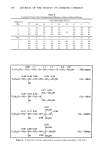
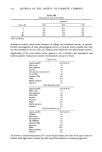
NEW NON-IONIC SURFACE ACTIVE AGENTS 261 Table II Physical Properties of Aminoester Compounds (2) Type of Compound R•CO State • Emulsion Appraisalb BEA--DEA Behenic C W/O G STA--DEA Stearic C W/O G ISTA--DEA Isostearic L W/O N.G. OLA--DEA Oleic L W/O V.G. PAA--DEA Palmitic C W/O G LAA--DEA Lauric L O/W SBA--DEA Soybean L W/O V.G. Oil F.A. OLA--AMPD Oleic L W/O V.G. OLA--AEPD Oleic L W/O V.G. OLA--TMAM Oleic P W/O V.G. SBA--AMPD Soybean L W/O V.G. Oil F.A. SBA--AEPD Soybean L W/O V.G. Oil F.A. SBA--TMAM Soybean P W/O V.G. Oil F.A. STA--AMPD Stearic C W/O G •C: Crystal L: Liquid P: Paste. bG: Good N.G.: No good V.G.: Very good. Table III HLB Values of W/O Emulsifiers Compound HLB Compound HLB OL--DEA 6 OL--AMPD 7 OL--AEPD 5 OL--TMAM 9 OL--MG a 11 POE--OLE 9 STA--DEA 7 OLA--DEA 7 OLA--AEPD 6 OLA--TMAM 7 SBA--DEA 6 SBA--AMPD 7 SBA--AEPD 6.5 SBA--TMAM 7.5 SSO 5 aThis gave o/w emulsion. Table IV Water Numbers of W/O Emulsifiers Compound W.N. Compound W.N. OL--DEA 20 OL--AMPD 23 OL--AEPD 23 OL--TMAM 21 POE--OLE 15 OLA--DEA 24 OLA--AMPD 22 OLA--AEPD 29 SBA--DEA 25 SBA--AMPD 20 SBA--TMAM 22 SSO 14

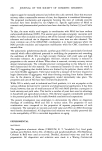
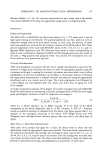
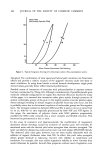
262 JOURNAL OF THE SOCIETY OF COSMETIC CHEMISTS W.N.'s of the new surfactants, which range approximately from 20 to 30, evidently surpass that of SSO (ca. 14) or POE-OLE (ca. 15) and manifest one of their distinctive features. This prominent water-retention capacity implies superiority in emulsifying power and may facilitate the formulation of w/o emulsions with a large water content which would be far preferred by most consumers. Another investigation was undertaken on their dispersive ability in liquid paraffin, using titanium dioxide as a dispersoid. The new surfactants displayed excellent dispersive power (Table V). Interaction of metal with a lone pair of a nitrogen atom (a Table V Dispersion of TiO2 in Liquid Paraffin in the Presence of W/O Emulsifiers Absorbance Compound (at 300 nm) OL--DEA 1.41 OL--AMPD 1.59 OL--AEPD 1.51 OL--TMAM 1.50 POE--OLE 0.01 Absorbance Compound (at 300 nm) OLA--DEA 1.32 OLA--AEPD 1.05 OLA--TMAM 1.01 SBA--DEA 1.10 SBA--AMPD 1.64 SBA--TMAM 1.21 SSO 0.10 stronger electron-donor than an oxygen atom) present in the hydrophilic group, seems to account for such property. Participation of a nitrogen atom may also be one of factors responsible for their large water number. These results suggest some measure of success in formulating w/o cosmetics containing pigments and large amounts of water. The stability of a w/o emulsion composed of surfactant (5%), liquid paraffin (28%) and water (67%) was also evaluated in terms of the degree of oil-phase separation with the lapse of time after preparation, along with the change of the particle size of water droplets. W/O emulsions obtained with the new emulsifying agents exhibited better storage stability, as shown in Table VI and Figure 1, which, taken in conjunction with Table VI Stability Evaluation of W/O Emulsions (at R.T.) Volume (%)a Compound 48H b 10D c 1Y • Volume (%) OL--DEA 94.4 91.2 80.8 OL--AMPD 100 97.0 93.9' OL--AEPD 96.6 91.1 86.4' OL--TMAM 100 95.0 73.3 POE--OLE 93.9 90.9 63.6 Compound 48H 10D 1Y OLA--DEA 100 95.0 83.9 OLA--AMPD 100 99.5 75.0 OLA--AEPD 99.5 92.9 OLA--TMAM 100 97.1 74.2 SBA--DEA 97.5 93.5 76.7 SBA--AMPD 100 94.1 74.4 SBA--TMAM 100 100 78.9 SSO 99.0 90.6 73.7 aRepresents the proportion of emulsified layer. bHour. CDay. •Year. 'Two months later.
Purchased for the exclusive use of nofirst nolast (unknown)
From: SCC Media Library & Resource Center (library.scconline.org)