NEW NON-IONIC SURFACE ACTIVE AGENTS 263

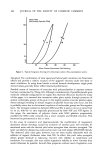
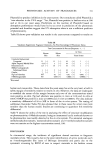
264 JOURNAL OF THE SOCIETY OF COSMETIC CHEMISTS the results derived ,from the measurements of water number and dispersive power, will undoubtedly enhance their practical acceptability. Although stability of an emulsion is known to be affected by viscosity of the system, one can readily realize from Figure 2 that it is not reasonable, in regard to the new emulsifiers, to attribute stability of the w/o emulsions concerned to the emulsion viscosity alone. Contribution of other significant factors may well be anticipated. x1o 3 2.0' 1.5' 0 1•) 2'0 3'0 4'0 Temp.(øC) Figure 2. Temperature dependence of viscosity of w/o emulsions. 1: OL-DEA 2: OL-AMPD 3: OL-TMAM 4: SBA-DEA 5: SBA-AMPD 6: OLA-AEPD 7: POE-OLE. The viscosities of emulsions prepared with SSO at 10, 21 and 40øC were 38 x 10 3, 16.8 x 10 3 and 12.9 x 10 3 cps, respectively. Figure 3 shows the phase diagrams for SBA-DEA-liquid paraffin-water and SSO- liquid paraffin-water ternary systems. Another system containing OLA-DEA was also examined. With SSO, (w/o q- o/w) or o/w emulsions were formed in the case where the relative ratio of water was rather high. In contrast, the maximum water content of w/o emulsion prepared with SBA-DEA or OLA-DEA reached up to 85% or 72%, respectively, which appears indicative of their strong tendency to produce w/o emulsions. It should also be noted that an estimated value of the minimum surfactant concentration needed to obtain a stable w/o emulsion was only 4% for SBA-DEA, and 18%, for SSO. The maximum amounts of water solubilized in L2 phase by SBA-DEA and OLA-DEA were considerably larger (27% and 28%, respectively) compared with SSO (2%). Furthermore, the combination of SBA-DEA (or OLA-DEA), liquid paraffin and water gave three mesophases, ie., reversed hexagonal (M2), lameliar (N) and cubic (V) phases, but no mesophases appeared where SSO was used. These differences may be due to the disparity between the polarity of SSO (HLB: 5) and the
Purchased for the exclusive use of nofirst nolast (unknown)
From: SCC Media Library & Resource Center (library.scconline.org)