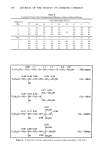
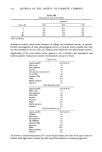
NEW NON-IONIC SURFACE ACTIVE AGENTS 257 The following synthetic scheme for OL-DEA is representative: molecular C•,H35OCH2C H C H 2 HN(CH2CH2OH)2 distillation • / + 70øC, 3-4 hr 0.05 To, O below 160øC column chromatography Residue •' C•8H350CH2CHCH2N(CH2CH20H)2 I OH OL-DEA (pale yellow viscous liquid) Examples of the synthetic procedure for a few surfactants are described below: OL-DEA--To glycidyl oleyl ether (325 g) kept at 70øC was added 160 g of diethanolamine with vigorous stirring at a rate to maintain the same temperature. After the addition of diethanolamine, the reaction mixture was held at that temperature with stirring for an additional 3 hr. Subsequent molecular distillation (0.05 Torr, below 160øC) of the crude product and purification of the residue by column chromatogra- phy gave almost pure OL-DEA (350 g). OL-TMAM--A mixture of glycidyl oleyl ether (325 g) and trimethylolaminomethane (170 g) was heated at 120øC for 4 hr with continuous stirring. After the reaction, the reaction mixture was left standing at 90øC without stirring for 5 hr. The upper layer was skimmed out by decantation, dissolved in 1000 ml of acetone, filtered at 50øC, cooled to -5øC and stored in a refrigerator overnight. The precipitated pale yellow crystals were collected, washed with two 500 ml portions of cold acetone and dried in vacuo to yield colorless crystals, OL-TMAM (305 g). Other compounds were prepared by an analogous method. Identification of their structures was tentatively based on mass spectral data of their TMS or TFA derivatives and confirmed by •3C-NMR information. EMULSIFICATION TEST Emulsions composed of three components, surfactant (5%), liquid paraffin (28%) and water (67%), were prepared by the following procedure: In a 50-ml glass bottle, 1.5 g of surfactant was dissolved in 8.5 g of liquid paraffin usually at room temperature or at an elevated temperature when necessary. Then, 5 g of water (20øC) was added to the solution, and the bottle was shaken well until the liquor assumed an appearance of homogeneous, milky fluid. Another 5-g portion of water was added again with powerful shaking, and successive stepwise addition of two 5-g portions of water and similar shaking resulted in the formation of a slightly viscous, milky emulsion. The amount of water added was 20 g in total. The stability and viscosity of the emulsion thus obtained and particle size of water droplet in the emulsion were examined in order to evaluate the properties of surfactants as emulsifiers. Emulsion particles were observed with an optical micro- scope (magnification: 400 x ).

258 JOURNAL OF THE SOCIETY OF COSMETIC CHEMISTS HLB VALUE HLB values of new surface active agents were evaluated by a method similar to that reported by Ohba (1), using sorbitan stearate (N-SS-10 ©, Nikko Chemicals Co. Ltd.), which has an HLB of 4.7 and polysorbate 60 (N-TS-10 ©, Nikko), which has an HLB of 14.9. WATER NUMBER (W. N.) To a well-mixed oil phase consisting of an emulsifier (0.5 g) and liquid paraffin (4.5 g), water was added dropwise with vigorous mechanical stirring (900 rpm) at 20øC until the emulsified system could hold no more water. The maximum quantity of emulsified water was recorded, and this quantity referred to as the water number (W. N.) defined by the expression, W. N. = V/5, where V denotes the maximum volume (ml) of water that can be emulsified. DISPERSIVE POWER Dispersive power of the surfactants was evaluated on the basis of dispersion of titanium dioxide (TiO2, ca.30 m•t, as a dispersoid) in liquid paraffin. The experimental method is as follows: A mixture of a surfactant (0.1 g) dissolved in liquid paraffin (9.8 g) and TiO2 (0.1 g), contained in a 25-ml test tube, was shaken 100 times at room temperature. After standing for 18 hr at ambient temperature, 0.5 ml of the supernatant liquid was carefully skimmed out and diluted to 50 ml with liquid paraffin with vigorous shaking. Absorbance of the resulting suspension in which TiO2 particles are still dispersed was measured at 300 nm. PHASE DIAGRAM Phase diagrams for ternary system, surfactant-liquid paraffin-water, were obtained according to the method of Tsugita, et al. (2). X-RAY ANALYSIS The structures of emulsions were examined by means of X-ray small-angle diffraction with a Geigerflex 2027 (Rigaku Denki Co. Ltd.) X-ray diffractometer. NUCLEAR MAGNETIC RESONANCE (NMR) CMR spectra were recorded on aJEOLJNM-FX 100 Spectrometer with tetramethylsil- ane as the internal standard. The chemical shifts were represented by 8 unit. Spin-lattice (longitudinal) relaxation times (T•'s) of carbons were measured by means of inversion-recovery technique [(T-180ø-t-90ø)/pulse sequence]. MASS SPECTRA GC/MS measurement was carried out with a JEOL JMS-D 300 Mass Spectrometer interfaced to a JEOL JGC-20KP Gas Chromatograph.
Purchased for the exclusive use of nofirst nolast (unknown)
From: SCC Media Library & Resource Center (library.scconline.org)