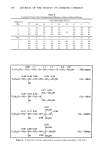
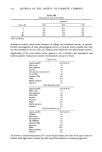
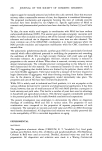
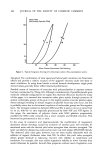
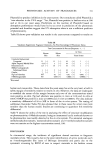
NEW NON-IONIC SURFACE ACTIVE AGENTS 271 definition). The right side of Eq. 6 involves only internal correlation times, which enables us to make quantitative evaluation of internal motion. Table X summarizes r(18, j) values of several carbons of four TEG esters. In every compound, r(18, 2), r(18, 1') or r(18, 2') is the smallest of all, which indicates the motional restriction of C2, C•, and C2, carbons due to the anchor effect exerted by micelie formation. With respect to TEG n-octadecanoate (compound 4), r(18, j) values are increasing as one moves away from the anchored lipophile-hydrophile boundary. This implies that the lipophilic alkyl chain has large segmental freedom. In contrast, the r(18, j) values of Cs-Cn carbons of the compounds 1-3, which are smaller than the corresponding r(18, j) values of the compound 4, demonstrate substantive restriction of segmental mobility around the double-bonded or ring carbons, though similar increment of r(18, j) is prominent as one moves toward the terminal methyl. Therefore, the restriction of segmental motion at a certain position of lipophilic chain appears to be one of dominant contributors to the stabilization of w/o emulsions mentioned before. Moreover, T• values of the carbons in hydrophilic groups (Figure 6) of the new compounds were also indicative of respectable reduction of internal mobility of the carbon chain probably due to intermolecular hydrogen bonding and/or steric hindrance. This marked motional restriction was characteristic of the new series of surface active agents and may be associated with their outstanding emulsifying properties. The knowledge that the mobility of surfactant molecules may correlate with stability of w/o emulsions should lead to a more comprehensive understanding of these emulsions. Also, the surfactants which exhibit more dilatory molecular motions seem to be of greater advantage to the formulation of w/o emulsions. Some results of safety evaluation tests carried out on OLA-DEA are shown in Tables XI-XIII and LD50 of this compound was estimated at more than 24 (g/Kg). These new Table XI Primary Skin Irritation Test of OLA-DEA Conc. (%)a p.i.i.b Appraisal 0.0 0.0 mild 0.2 0.0 mild 2.0 0.9 mild 20.0 1.1 mild aOlive oil solution. bPrimary irritation index. Table XII Sensitization Test of OLA-DEA Appraisal 24 hr 48 hr Treated 0/10 0/10 Control 0/10 0/10

272 JOURNAL OF THE SOCIETY OF COSMETIC CHEMISTS Table XIII Phototoxicity Test of OLA-DEA Appraisal Conc. (%)1 24 hr 48 hr 72 hr 0 0/6 0/6 0/6 5 0/6 0/6 0/6 50 0/6 0/6 0/6 100 0/6 0/6 0/6 •Olive oil solution. substances neither caused skin irritation or allergy nor exhibited toxicity in animals. Further investigation of their physiological action on human body revealed that they are also harmless to human skin, elucidating more definitely their physiological safety. Application of the new surface active agents to w/o cosmetics was attempted, and some examples of practical cosmetic formulations are given below: Cream (w/o) Liquid paraffin 10.0 (w/w %) Micro wax 2.0 Butyl paraben 0.1 Lanolin 2.0 Octyldodecyl myristate (7) 3.0 OLA-DEA 4.O Sorbitol (70%) 8.0 Water 70.5 Methyl paraben 0.1 Perfume 0.3 Fluid Emulsion (w/o) Liquid paraffin 22.0 (w/w %) Micro wax 1.0 Butyl paraben 0.1 SBA-DEA 4.0 Lanolin 2.0 Glycerin 8.0 Water 62.5 Methyl paraben 0.1 Perfume 0.3 Fluid Foundation (w/o) Liquid paraffin 10.0 (w/w %) Vaseline 2.0 Micro wax 2.0 Butyl paraben 0.1 OL-TMAM 4.0 Sorbitol (70%) 5.0 Pigments 12.0 Water 64.5 Methyl paraben 0.! Perfume 0.3 As shown in these formulations, we could readily obtain not only w/o type creams or lotions with high water content but also liquid foundations containing pigments.
Purchased for the exclusive use of nofirst nolast (unknown)
From: SCC Media Library & Resource Center (library.scconline.org)