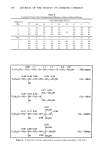
OPTIMIZATION TECHNIQUES 289 place. The first type is represented by EVOLUTIONARY OPERATIONS (EVOP) and the SIMPLEX METHOD, which I will mention only briefly and the second by the more classical MATHEMATICAL and SEARCH METHODS. Although there are really no limitations to the area of applicability, my feeling is that the first type is more applicable to a production environment and the second is more applicable to a research environment. In the EVOP and Simplex Methods, the process and formulation are allowed to evolve to the optimum by small changes made from batch to batch. At no time, however, is the product allowed to be outside of specifications. The EVOP procedure has been applied to a tablet formulation by Rubinstein (2) and the Simplex Method has been applied to an analytical method by Demig and King (3) and to a capsule formulation by Shek, Ghani and Jones (4). For the techniques of the second type, the experimentation is completed before optimization takes place. In this type of method, the objective is to be able to predict properties of the product, and to do this, a model (or an equation) is required. Because equations to predict most properties for drug and cosmetic products are not known, and cannot, at present, be generated from first principles, it is necessary to generate these equations empirically. The steps involved in this type of optimization procedure are listed below: 1. Select variables (independent, dependent) 2. Perform set of statistically designed experiments 3. Measure properties of interest (dependent variables) 4. Generate predictor equation (statistical model) 5. Optimize (with or without constraints) a. mathematical calculations b. graphical observation c. searches EXPERIMENTAL DESIGN The second of these steps requires some form of experimental design. Experimental design covers a whole field, available in the literature (5) and I will mention only one type but in selecting the appropriate design, in general, one must choose experiments such that: 1. The entire area of interest is covered and 2. Analysis of results allows separation of variables. The method of experimentation is usually some form of factorial design i.e., it is not sufficient to change one variable at a time. We need to be more efficient, and we need to see interactions between factors. It should be noted that the experimental design is dependent on the number of independent variables one has chosen to study. These are the factors--those things under the formulators control. Table I shows a full 2 3 factorial experimental design (3 factors, 2 levels) and there are 8 possible trials i.e., all possible combinations of the high and low levels of the factors, designated as + ! and -1. Geometrically this can be represented by a cube (Figure 1)

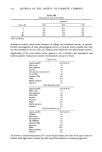
290 JOURNAL OF THE SOCIETY OF COSMETIC CHEMISTS Table I A 2 3 Factorial Design Factor Level Trial x• x= x 3 1 --1 --1 --1 2 1 --1 --1 3 --1 1 --1 4 1 1 --1 5 --1 --1 1 6 1 --1 1 7 --1 1 1 8 1 1 1 where the coordinates of the vertices represent the individual trials. In this case, the area bounded by the cube is being studied. A modification and expansion on this design, proposed by statisticians Box and Wilson (6) involves the question, "Suppose we want to cover more territory than the cube." In that case, (Figure 2), we select an axial point, some distance from the center of the cube, take a point (a trial) outside each face and one in the center. Such a design is shown in Table II where 15 experiments are required. (The first eight represent the full factorial design the next six represent two extremes for each axis and the last represents, the central point with coordinates [0, 0, 0]). This is called a "three factor, orthogonal, central, composite, second order design." Each trial represents a formulation, all qualitatively identical, but quantitatively Figure 1. Graphical representation of a 2 3 Factorial Design. (Eight experimental trials required.)
Purchased for the exclusive use of nofirst nolast (unknown)
From: SCC Media Library & Resource Center (library.scconline.org)