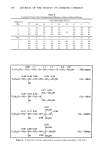
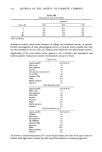
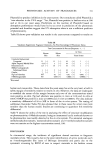
272 JOURNAL OF THE SOCIETY OF COSMETIC CHEMISTS Table XIII Phototoxicity Test of OLA-DEA Appraisal Conc. (%)1 24 hr 48 hr 72 hr 0 0/6 0/6 0/6 5 0/6 0/6 0/6 50 0/6 0/6 0/6 100 0/6 0/6 0/6 •Olive oil solution. substances neither caused skin irritation or allergy nor exhibited toxicity in animals. Further investigation of their physiological action on human body revealed that they are also harmless to human skin, elucidating more definitely their physiological safety. Application of the new surface active agents to w/o cosmetics was attempted, and some examples of practical cosmetic formulations are given below: Cream (w/o) Liquid paraffin 10.0 (w/w %) Micro wax 2.0 Butyl paraben 0.1 Lanolin 2.0 Octyldodecyl myristate (7) 3.0 OLA-DEA 4.O Sorbitol (70%) 8.0 Water 70.5 Methyl paraben 0.1 Perfume 0.3 Fluid Emulsion (w/o) Liquid paraffin 22.0 (w/w %) Micro wax 1.0 Butyl paraben 0.1 SBA-DEA 4.0 Lanolin 2.0 Glycerin 8.0 Water 62.5 Methyl paraben 0.1 Perfume 0.3 Fluid Foundation (w/o) Liquid paraffin 10.0 (w/w %) Vaseline 2.0 Micro wax 2.0 Butyl paraben 0.1 OL-TMAM 4.0 Sorbitol (70%) 5.0 Pigments 12.0 Water 64.5 Methyl paraben 0.! Perfume 0.3 As shown in these formulations, we could readily obtain not only w/o type creams or lotions with high water content but also liquid foundations containing pigments.

NEW NON-IONIC SURFACE ACTIVE AGENTS 273 ACKNOWLEDGEMENTS We are grateful to Dr. T. Abe and Mr. H. Nagasawa for their collaboration on our study, and to Mr. H. Futagoishi, Executive Director of Kanebo, Ltd., and Mr. M. Yamagishi, Manager of our Laboratory, who permitted the submission of this paper. REFERENCES (1) N. Ohba, Hydrophile-lipophile balance values for oil-water emulsions stabilized by nonionic surfactants. I. Hydrophile-lipophile balance values of nonionic surfactants determined by emulsifica- tion, Bull. Chem. Soc. Jpn., 35, 1016-20 (1962). (2) A. Tsugita, Y. Nishijima and T. Sasaki, Stable emulsion regions of surfactant-oil-water and surfactant-oil-water-long chain alcohol systems, Yukagaku, 29, 227-33 (1980). (3) J. H. Draize, Appraisal of the safety of chemicals in foods, drugs and cosmetics, Assoc. Food & Drug O•cials, U.S. 46-53 (1959). (4) B. Magnusson and A.M. Kligman, The identification of contact allergens by animal assay. The guinea pig maximization test,J. Invest. Dermatol., 52, 268-76 (1969). (5) K. F. Kuhlman, D. M. Grant and R. K. Harris, Nuclear Overhauser effects and carbon-13 relaxation times in •3C-(H) double resonance spectra,J. Chem. Phys., 52, 3439-48 (1970). (6) J. R. Lyerla, Jr., H. M. Mcintyre and D. A. Torchia, Carbon-13 nuclear magnetic resonance study of alkane motion, Macromolecules, 7, 11-4 (1974). (7) MOD ©, product of The Shin-ei Kagaku Co., Ltd., 1-19 Doshomachi, Higashi-ku, Osaka, Japan.
Purchased for the exclusive use of nofirst nolast (unknown)
From: SCC Media Library & Resource Center (library.scconline.org)