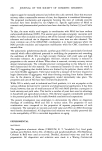
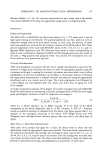
RHEOLOGY OF MAS/XANTHAN GUM DISPERSIONS 277 Blender (Model 31 L 41). All viscosity determinations were made with a Brookfield Viscometer (Model LVT) using the appropriate single point or helipath spindle. PROCEDURE Dispersion Preparation The MAS, XG, or MAS/XG dry blend was added to 23 -+ 2øC water with 3 min of high speed mixing in the blender. The paraformaldehyde was then added at 0.2% on dispersion weight with brief slow speed mixing. In each case, the amount of water used was adjusted to account for the moisture content of the MAS and/or XG. Three percent dispersions were made with MAS:XG ratios of 29:1, 19:1, 9:1, 4:1, 2:1, and 1:1. Separate MAS dispersions and XG solutions were made at solids corresponding to those in each combination. Separate 3% MAS and XG preparations were also made. In all cases, a 750g quantity was prepared which was poured off immediately into one 16-oz. and two 4-oz. glass screw cap jars. Viscosity Determinations After each dispersion was poured off, the 16-oz. sample was allowed to stand for five minutes. A single point viscosity was then run with the appropriate spindle using the viscometer at 60 rpm. A reading for viscosity calculation was taken after 6 min to allow equilibration of structure breakdown and buildup in thixotropic systems. Following the single point determination, a helipath viscosity was obtained using the appropriate attachment and a one minute run at 6 rpm. The 6-min single-point run followed by 1-min helipath run was repeated after one, seven, and thirty days of aging for each 16-oz. sample. A simple comparative measure of the degree of viscosity synergism for each MAS/XG blend was determined by calculating a viscosity synergism factor (VSF) for both single point and helipath viscosities of each 3% dispersion according to: VB• 3% VSF = (1) V,•Z%+ V,, (• (3 -- Z)% ' where V• is blend viscosity, V,• is MAS viscosity, Z is the level of the MAS component in the blend dispersion, and V,, is XG viscosity. A VSF of 1 indicates merely an additive viscosity is obtained from the blend. Any figure greater than 1 is a measure of the synergism occurring in the blend. VSF (Single Point) and VSF (Helipath) were calculated from viscosity figures after one, seven, and thirty days of aging. Shear Stress vs. Shear Rate Determination After each 16-oz. sample had aged for 11 days, the shear stress vs. shear rate was determined using the appropriate single point spindle. The shear stress, represented by the numerical viscometer dial reading, was recorded at shear rates of 0.6, 1.5, 3, 6, 12, 30, 60, 30, 12, 6, 3, 1.5, and 0.6 rpm in succession. The dial reading was recorded after one minute of shear at each rate. The shear stress (dial reading) vs. shear rate (rpm) was plotted to determine thixotropy, pseudoplasticity, and presence of yield value.

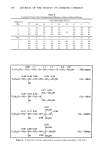
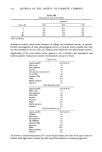
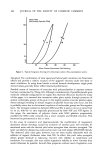
'278 JOURNAL OF THE SOCIETY OF COSMETIC CHEMISTS Yield Value Determination After 7 days of aging, yield value measurements were made with the two 4-oz. samples of each dispersion using a modification of the procedure of Bowles, Davie, and Todd (9). Seven days of aging were allowed to insure that the colloidal structure in thixotropic systems was well established. A single point viscosity at 6 rpm after a 6-min run was made for one sample of each dispersion, with viscosity at 12 rpm after a 6-min run for the other. By using separate samples not previously sheared, and 6-rain runs to allow structure equilibration with the rotating spindle, thixotropy-induced errors in the original computations should be minimized. Better reproducability is therefore ascribed to the yield value computation: (W - Yield Value (dynes/cm 2) = , (2) 100 Where V6' is the viscosity at 6 rpm and V•2' the viscosity at 12 rpm. Due to the nature of the viscometer used and the non-Newtonian rheology of the aqueous systems evaluated, yield value figures are considered relative rather than absolute. Analagous to the VSF figures, yield synergism factors (YSF) were calculated according to: YB (• 3% YSF = (3) YMz+ Y,, (3 - z)%' where YB is the blend yield value, YM is the MAS yield value, Z is the level of the MAS in the blend dispersion, and Yx is the XG yield value. A YSF of 1 indicates an additive yield value is obtained from the blend. Any figure greater than 1 is a measure of the synergism occurring in the blend. RESULTS AND DISCUSSION Apparent synergism in viscosity and yield value have been observed when formulating with magnesium aluminum silicate/xanthan gum combinations. This has occurred with even small additions of the gum. Relatively low levels of the gum have also been used to modify the thixotropic nature of the MAS. Smooth flow on extended storage has in this way been maintained by a reduced increase in viscosity on aging. In order to better characterize this MAS-XG interaction, a series of blends was prepared and evaluated at various concentrations. The 3% level is presented as a matter of convenience for subsequent evaluation of the separate MAS and XG dispersions. Unless otherwise indicated, results at 3% are representative of the general behavior observed even to the lowest practical usage levels. Figure 1 shows the aging curves for the MAS/XG blends compared to MAS alone at 3% solids. These demonstrate the flattening or stabilizing effects on MAS viscosity over time of progressively higher levels of XG. This corresponds to the rheological profile derived from plotting shear stress vs. shear rate as in Figure 2. A blend was considered to provide a thixotropic dispersion if producing a characteristic hysteresis loop as in Curve A of this figure. It was considered to provide pseudoplasticity without thixotropy if producing a curve similar to Curve B. At the 29:1 and 19:1 MAS:XG
Purchased for the exclusive use of nofirst nolast (unknown)
From: SCC Media Library & Resource Center (library.scconline.org)