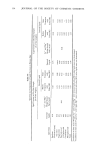
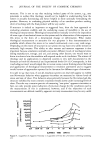
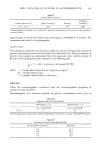
HAIR OILINESS 339 Table VIII Total Lipid Quantity in Ether Extracts A of Unwashed Hair CHClcExtracts G of Washing Solutions Ether Extracts H of Shampooed Hair Washing Solutions F (Calculated From A) and G)) Variable No. a 44 45 Total Lipids [% of Hair] in Extract Sample No. A G H F 45/2 229/1 58/1 114/2 37/1 264 / 1 110/1 163/1 149/1 148/1 62/1 171/2 189/1 14/1 127/1 183/2 155/2 257/3 120/2 239/2 2.80 3.33 1.52 1.28 7.02 3.19 1.41 5.61 3.40 1.79 2.56 0.88 2.62 1.90 1.27 1.35 3.32 1.81 1.56 1.76 2.66 2.53 0.97 1.69 3.41 1.81 1.40 2.01 2.56 0.62 0.56 2.00 2.20 1.04 0.53 1.67 1.21 1.15 0.37 0.84 2.33 1.49 1.71 0.62 1.40 0.73 1.04 0.36 1.94 0.47 1.44 0.50 1.23 0.60 0.77 0.46 0.47 0.30 0.01 0.46 1.45 0.65 0.43 1.02 2.26 0.83 0.80 1.46 0.95 0.84 0.18 0.77 1.31 0.56 0.68 0.63 1.51 0.70 0.75 0.76 aCf. footnote, bTable I. series of data to infer a strict correlation. The identification of some real among such a large number of potential factors of influence on hair greasiness can, therefore, only be achieved by means of statistical methods. A statistical method for solving such a problem is the factor analysis, which is done by computer. Such an analysis can be described in mathematical terms as follows: A number of objects (20 hair samples) is given, each of which is characterized by a vector consisting of 45 variables. The objects are, by subjective assessment, separated into classes of different oiliness (very dry, dry, medium, oily, very oily). The question then is, which of the components of the vector (which analytical data) are necessary for correctly classifying as many objects as possible, that is, which chemical components of the sebum have the strongest influence on the oily appearance of the hair. After a preliminary analysis a number of variables were omitted which -- had obviously no influence on the classification (e.g., No. 8, 17), -- had been influenced by the selection of the test panel (e.g., No. 2, 3), -- seemed to correlate with hair oiliness but cannot be influenced by cosmetic means (e.g., the age of the test persons) or -- were linear combinations of other variables and thus could not yield additional information (e.g., "% lipid in ESM" can be calculated from "% lipid in hair"). Thus 28 variables were left for the statistical treatment. With only 4 of these remaining

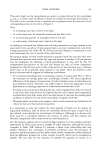
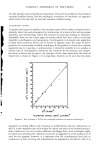
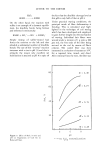
340 JOURNAL OF THE SOCIETY OF COSMETIC CHEMISTS variables, 19 out of 20 test persons could be classified correctly. Only one of the "very oily" test persons was classified as "oily." This satisfactory result was achieved with the following variables (in the sequence of their importance): x•5: % wax ester of total lipids X37: ratio of saturated: unsaturated FFA x28: % monoglycerides of hair x•0: % cholesterol ester of total lipids From these variables 2 new variables y• and Y2 were obtained by linear combination (cf. Figure 2). 1.0 0.8 dry ß 189/I medium 0.6 ß 14/I • 0.2 '•. '• 0.0 õ -o. 2 ß 171/2 I,•e/I very greasy J X37 ß I•9/I • ß 163/I 229/I e• 17•/2 e•5/2 I83/2 ß 257/3 ß 239/2 127/1 155/2 ß37/I -0.6 very dry greasy ß58/I I!0/I 264/I -0.8 ß 120/2 -I.0 -I. 0 -0.8 -0.6 -0.• -0.2 0.0 0.2 0.,• 0.6 0.8 1.0 canonical variable Y• Figure 2. Computer-classification of 20 hair samples w.r.t. oiliness according to analytical data of the variables No. 28, 30, 37, and 45. (The arrows in the centre indicate the expected direction of a change in oiliness upon alteration of the variables.) x35 = % wax ester of total lipids x37 = proportion of saturated:unsaturated FFA x28 = % monoglycerides of hair x30 = % cholesterol ester of total lipids y• = 0.067 x•5 - 1.31 x37 -[- 13.29 x28 - 0.376 X•o + 0.1 y2 = 0.0213 x35 + 1.80 x37 -- 5.90 X28 '4- 0.086 X30 -- 2.1.
Purchased for the exclusive use of nofirst nolast (unknown)
From: SCC Media Library & Resource Center (library.scconline.org)