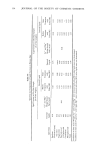
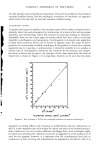
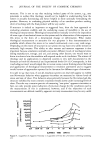
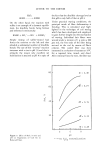
HAIR OILINESS 341 Thus each object can be characterized as a point in a plane formed by the coordinates y• and Y2, in which areas of different oiliness are marked by boundary lines (Figure 2). The effect of an increase of the 4 variables can be gathered from the direction of the corresponding arrow in the centre of Figure 2. Thus -- an increasing wax ester content in the lipid -- or a decreasing ratio of saturated/unsaturated free fatty acids -- or an increasing quantity of monoglycerides on the hair -- or a decreasing cholesterol ester content in the lipid are leading to increased hair oiliness when all other parameters are kept constant at the same time. In the case of our 20 test persons there is no strict correlation for each of the 4 single parameters (ref. Tables III, IV, IV) because their influence is weakened or even overcompensated by one or several of the other factors. The general validity of these results should be considered with due care since they were obtained from persons with similar hair type and because a number of 20 test persons may be inadequate for attaining a broad generalization. It may well be that the compositional peculiarities of dry and oily sebum are only of minor importance compared to other factors such as fibre cross-section or hair structure (e.g., curliness) which were, as far as possible, kept constant in our panel. There are, however, some hints in literature which support the following conclusions: -- It is common knowledge that an increasing content of unsaturated FFA or TG in fat decreases its melting point and, accordingly, Korolev (44) found significant differences of the degree of unsaturation of sebum between cases of seborrhea sicca and seborrhea oleosa. Therefore, one might expect a more oily appearance of hair lipid with an increasing proportion of unsaturated:saturated fatty acids. -- The fatty acids and alcohols forming the wax esters originate from fatty acid source in the body other than those of the triglycerides (45), and contain more unsaturated and branched chain fatty acids, which are also known to decrease the melting point of sebum as observed in case of the rump lipids of aquatic birds (46). -- Monoglycerides are surface active agents, which could accelerate the distribution of sebum on hair and thus increase its quantity. It is interesting to note that neither the total quantity of lipids nor the degree of triglyceride hydrolysis, both of which are commonly believed to play a major role in hair oiliness, were identified as main factors of influence. Although it is obvious that there must be a correlation between the amount of sebum and hair oiliness, the chemical composition often seems to be the overriding factor. The discriminant analysis did not reveal the lipid quantity G in the washing solutions (determined by CHC13-extraction ) as variable of major relevance, although the results, compiled in Table VIII (column C), indicate a rather close relationship with hair oiliness. However, this correlation is probably accidental, since the procedure of extraction and determination yielded rather erratic results compared to those calculated from the difference between the 2 ether extracts A and H, which can be considered as reliable. The fact that for the majority of samples the quantity of extract G is

342 JOURNAL OF THE SOCIETY OF COSMETIC CHEMISTS significantly higher than that of A minus H indicates that coextraction of some lauryl-alcohol remaining in the detergent despite the previous purification, is possibly one of the reasons. REFERENCES (1) S. Rothman, A.M. Smiljanic, and A. W. Weitkamp, The spontaneous cure of rinea capiris in puberty, j. Invest. Dermatol., 8, 81 (1947). (2) E. O. Butcher and J.P. Parnell, Sebaceous secretion on the human head,J. Invest. DermatoL, 9, 67 (1947). (3) N. Nicolaides and S. Rothman, Studies on the chemical composition of human hair fat I. The squalene-cholesterol relationship in children and adults,J. Invest. DermatoL, 19, 389 (1952). (4) R. E. Bloom, S. Woods, and N. Nicolaides, Hair fat composition in early male pattern alopecia, J. Invest. Dermatol., 24, 97 (1955). (5) B. K. Krotoszynski, L. L. Gershbein, and S. B. Needleman, Properties of hair fat from adult males according to race and hair condition,J. Invest. DermatoL, 26, 311 (1956). (6) N. Nicolaides and S. Rothman, Studies on the chemical composition of human hair fat II. The overall composition with regard to age, sex and race,J. Invest. DermatoL, 21, 9 (1953). (7) N. Nicolaides and R. C. Foster, Esters in human hair fat,J. Am. Oil Chem. Soc., 33,404 (1956). (8) G. Peter, W. Ritter, F. SchriSpl, and R. Peter, Gaschromatographische Untersuchungen der Talgdriisenlipide II. Zusammensetzung der Talgdriisenlipide im Altersablauf, Arch. DermatoL Forsch., 241, 22 (1971). (9) K. Okamoto, Studies on the quantity and chemical composition of surface lipids of human scalp and hair, J. DermatoL, 7, 85 (1980). (10) G. Peter, F. SchriSpl, R. Lippross, and G. Wei•8, Gaschromatographische Untersuchungen der Talgdriisenlipide I. Bestimmung der Gesamtlipide, Arch. Klin. Exp. DermatoL, 239, 12 (1970). (11) F. W. Houghen, The constitution of the aliphatic alcohols in human sebum, Blochem. J., 59, 302 (1955). (12) E.J. Singh and L. L. Gershbein, High molecular weight alcohols of human hair lipids,J. Chrom., 29, 229 (1967). (13) E.J. Singh and L. L. Gershbein, Phospholipids of human hair lipids,J. Chrom., 31, 20 (1967). (14) L. L. Gershbein, B. K. Krotoszynski, and E.J. Singh, Fractionation of hydrocarbons of human hair lipids by chromatographic and thermal diffusion methods,J. Chrom., 27,431 (1967). (15) A. W. Weitkamp, A.M. Smiljanic, and S. Rothman, The free fatty acids of human hair fat, J. Am. Chem. $oc., 69, 1936 (1947). (16) M. Gloor, Determination and analysis of sebum on skin and hairs, Cosmet. $ci., 1,217 (1978). (17) G. W. Beveridge and E. W. Powell, Sebum changes in ache vulgaris treated with tetracycline, Br.J. Dermatol., 81,525 (1969). (18) M. Gloor, U. Graumann, M. Kionke, I. Wiegand, and H. C. Friederich, Menge und Zusammenset- zung der Hautoberfliichenlipide bei Patienten mit Acne vulgaris and gesunden Vergleichspersonen I, Arch. Dermatol. Forsch., 242, 316 (1972). (19) M. Gloor, U. Schulz, G. Wieland, and J. Wiegand, Untersuchungen iiber einen Zusammenhang zwischen Menge und Zusammensetzung der Hautoberfliichenlipide, Fortschr. Med., 90, 325 (1972). (20) D. T. Downing, Lipids, in: Densitometry in Thin Layer Chromatography, J. C. Touchstone, J. Sherma, Eds., (Wiley, New York, 1979). (21) M. Gloor,J. Rietk&ter, and H. C. Friederich, Entfettung und Nachfetten der Kopfhaut und der Haare nach Kopfwiische mit verschiedenen Tensiden, Fette, $eifen, Anstrichm., 75,200 (1973). (22) B. Boughton and V. R. Wheatley, The fatty acid composition of the skin surface fat (sebum) of normal human subjects,J. Invest. DermatoL, 33, 49 (1959). (23) W. M. Coon, V. R. Wheatley, F. Herrmann, and L. Mandol., Free fatty acids of the skin surface and barrier zone in normal and abnormal keratinizati.9n, J. Invest. Dermatol., 41,259 (1963). (24) M. Gloor, M. Kionke, and H. C. Friederich, Uber Menge und Zusammensetzung der Hautober- fli/chenlipide bei Patlenten mit Ache vulgaris und gesunden Vergleichspersonen. Gaschromatogra- phische Analysen der Zusammensetzung der freien Fettsliuren, Z. Hautkr., 48, 987 (1973). (25) G. Peter, F. SchriSpl, H. G. Feisel, and W. Thiirauf, Gaschromatographic investigations of free and esterified fatty acids in human eccrine sweat, Arch. Klin. Exp. Dermatol., 238, 154 (1970).
Purchased for the exclusive use of nofirst nolast (unknown)
From: SCC Media Library & Resource Center (library.scconline.org)