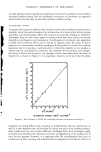
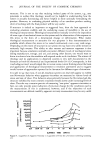
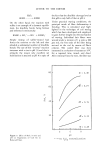
366 JOURNAL OF THE SOCIETY OF COSMETIC CHEMISTS released in water for 30 minutes at 35øC. The set was calculated as the percentage fraction of turns in the set fiber relative to that originally imparted (hair 9 inches long forms --•70 coils). Figure 3 summarizes the setting results on hair fibers which, prior to coiling, had been reduced with thioglycollic acid (pH 5.0 at 35øC) to yield different levels (o 0 of disulfide bond cleavage. Confirming lon- gitudinal data, no set is attained without the bond-rebuilding oxidation step. At any given cleavage level, a rise in pH leads to set enhancement. As the oxidation of combined cysteine to cystine is virtually pH independent, the higher setting effi- cacy is most likely a reflection of the increased pliability of reduced hair at higher pH values. Sulfite diffuses into hair at a much slower rate than thioglycolate at comparable pH, and Figure 4 stresses the importance of time in waving with sulfite. This is partic- ularly true under alkaline conditions where a combination of low S-S cleavage levels and the negative charge on the fiber effectively restricts the diffusion into the hair of strongly anionic SO3= moiety. In absolute terms, the 30 minute longitudinal setting seems more effective than coil setting, but this is probably due to the fact that the reactivity of-S-S- bonds in hair is greatly enhanced by stretching of fibers (3). It is also important to stress that at low cleavage levels, sulfite appears to be a much more effective setting (waving) agent than thioglycolate, clearly reflecting 5O 40 2O 2O 10 60 min. ! P • I 5 6 7 8 9 pH Figure 4. Effect of Time and pH on Coil Set in Sulfite.

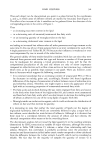
LETTER TO THE EDITOR 367 TABLE I Effect of Oxidative Neutralization on Coil Setting in Sulfite Setting Condition Set % Rinse Only Rinse & Oxidant pH 7 50 63 pH 8 35 57 pH 10 21 38 the dynamic equilibrium nature of the reaction. Although the cleavage efficacy of sulfite is optimal under acidic conditions (Figure I), it is difficult to fully exploit this feature because: (a) the reversal reaction leading to disulfide bond reformation is much faster at pH 7, and (b) the downward pH shift is counter-productive to hair pliability (Figure 3). Rebuilding of disulfide cross-links via oxidation of combined cysteine residues is a critical and necessary step in thiogly- colate waving. In sulfite systems, the oxi- dative neutralization complements the "reversal" reaction and at the same time destroys potentially harmful sulfite moiety that is a byproduct of such rever- sal. Both of these result in improved setting efficacy (Table I). REFERENCES 1. L. j. Wolfram and D. L. Underwood, The Equilibrium Between the Disulfide Linkage in Hair Keratin and Sulfite or Mercaptan, Textile Res. J. 36, 947 (1966). 2. j. B. Speakman, J. L. Stoves and H. Bradbury, The Reactivity of the Sulfur Linkage in Animal Fibers, J. Soc. Dyers O CoL 57, 73 (1941). 3. L.J. Wolfram, Reactivity of Disulfide Bonds in Strained Keratin, Nature 206, 304 (1965). Linda Albrecht LeszekJ. Wolfram Clairol Incorporated
Purchased for the exclusive use of nofirst nolast (unknown)
From: SCC Media Library & Resource Center (library.scconline.org)