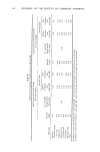
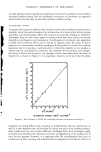
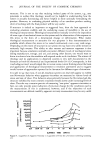
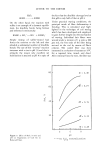
364 JOURNAL OF THE SOCIETY OF COSMETIC CHEMISTS ences in the chemical nature of the reac- tants and in the pH profile of the cleavage step [(1), Figure 1] imply system-specific mechanisms for the rebuilding of disul- fide bonds. Longitudinal setting of hair serves as an informative guide to the physicochemical phenomena occurring in the fiber in the course of its conformational change. In particular, owing to the inherently high stresses favoring the length recovery of the fiber, this technique is a sensitive measure of the formation of stabilizing cross-links. Hair fibers, mounted in setting frames (2), were extended by 40 percent of their original length, treated in a setting solu- tion for 30 minutes at 35øC, rinsed, then released in water (30 minutes at 35øC). Imparted length change, calculated as a fraction of original extension, is expressed as percent set. The results (Figure 2) indicate a profound difference between sulfite and thioglycolate in the mecha- nism of stabilization which is a direct consequence of the chemistry involved. Thus, reduction of disulfide bonds (KSSK) in hair by thioglycolate (RSH) produces cysteine residues (KSH) incapa- ble on their own of reforming disulfide bonds: KSSK + 2RSH • 2KSH + RSSR The latter can, of course, be readily gener- ated by oxidation: % Set 6O 4O 2O Thioglycolate ,,, I I I i I 6 5 6 7 8 9 pH Figure 2. Setting of Hair in Sulfite and Thioglycolate.

I,ETTER TO THE EDITOR 365 H202 2KSH .... KSSK On the other hand, the reaction with sulfite is an example of a dynamic equilib- rium, the disulfide bonds being broken and reformed continuously: KSSK + SO5= -• KS- + KSSO 3- Simple rinsing of sulfite-treated hair forces the reaction to the left and thus rebuilds a substantial number of disulfide bonds. The rate of this "reversal" reaction increases with a rise in pH (1) and this is primarily the reason why excellent set stabilization is attained at pH 8 in spite of the fact that the disulfide cleavage level at this pH is only half of that at pH 4. Under practical waving conditions, the principal mode of fiber deformatio!• is bending. This is simulated and high- lighted in the technique of coil setting which has been developed and employed to gain further insight into the mechanism of waving. Individual hair fibers were wound under a tension of 1 g onto a 900 /am rod, the free ends of the fiber being secured to the rod by means of Duco cement. The coiled fiber was then immersed in a solution of reactant at 35øC for a required time, rinsed, and dried. After removal from the wire, the fiber was Figure 3. Effect of H202 (5 min) and pH on Impartation of Coil Set to Reduced Fibers. 8O 6O 4O 2O • = 0.38 0.27 0.15 = 0.10 •= 0.38 3 6 9 pH .... no H202 neutralization
Purchased for the exclusive use of nofirst nolast (unknown)
From: SCC Media Library & Resource Center (library.scconline.org)