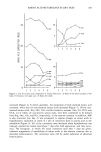
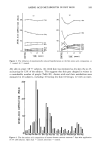
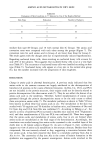
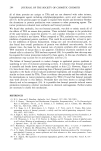
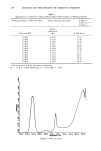
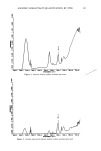
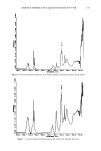
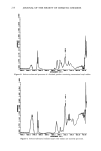
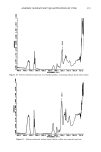
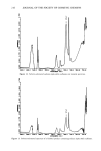
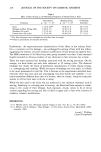
ANIONIC SURFACTANT QUANTITATION BY FTIR 217 were found to contain minor spectral interferences corresponding to ca. 1-2% surfac- rant assay value. At this point, it was assumed that these interferences could be min- imized or eliminated through the inherent capability of the spectral subtraction system. This topic is addressed further later in this paper. Table II1 lists the samples analyzed along with their corresponding wavenumbers of maximum absorbance of the peaks used for quantitation. Note that even though the peak of interest is due to SO 3 in each case, there is some shifting of the position of that peak as evidenced by the wavenumbers listed. Table III Samples Analyzed and Their Wavenumbers of Maximum SO 3 Absorbance RM = Raw material FP = Finished product shampoo containing the indicated raw material Sample Wavenumber of max Abs (cm-•) Sodium dodecyl sulfate STD Sodium lauryl sulfate RM FP with sodium lauryl sulfate Ammonium lauryl sulfate RM FP with ammonium lauryl sulfate Sodium lauryl ether sulfate RM FP with sodium lauryl ether sulfate Sodium lauryl diether sulfate RM Alpha olefin sulfonate RM FP with alpha olefin sulfonate 1211.4 1211.4 1211.4 1205.6 1205.6 1215.2 1215.2 1215.2 1174.7 1174.7 Since the only primary standard available was the SDS, an attempt was made to quan- tirate several classes of anionic surfactants (including ethoxylated sulfates and olefin sulfonates) using SDS as a model compound. Samples of each raw material and finished product were quantitated against an SDS standard via FTIR and were also given to two analysts for assay by the mixed indicator titration method. The results of all of the analyses are presented in Table IV. A comparison of the FTIR results to the titration results shows good agreement for the SLS raw material and finished product but un- satisfactory agreement for the other types of anionic samples. These results are not entirely unexpected the shifting of the SO 3 peak provided an indication that quanti- tation using the SDS might not be feasible for the other types of anionics. Since shifting of an absorbance band is due to changes in the structural features of a molecule (9), it would seem to follow that the degree to which a molecule absorbs radiation would also be affected. A more valid method for quantitating samples other than SLS would be to use standards of each corresponding surfactant. However, the only primary standard grade surfactant which is generally available is SDS. Certainly, no high purity AOS is available and pure cuts of ethoxylated surfactants are difficult to obtain. The most acceptable solution to this problem seemed to be the adoption of carefully assayed samples as standards for each type of anionic surfactant. This method would also minimize any possible matrix effects in the absorptions of the finished product samples as were previously evidenced by the blank formulation spectra. The use of assayed samples as standards would provide

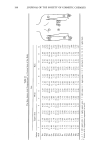
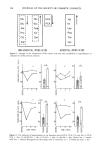
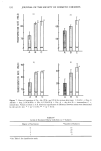
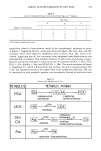
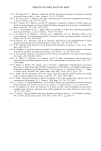
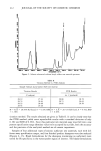
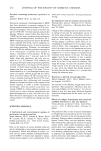
218 JOURNAL OF THE SOCIETY OF COSMETIC CHEMISTS Table IV Comparison of Results for All Samples Analyzed [FTIR Quantitation vs. Sodium Dodecyl Sulfate (SDS) Standard] RM = Raw material FP = Finished product shampoo containing the indicated raw material Titration Sample Analyst # 1 Analyst #2 FTIR Sodium lauryl sulfate RM FP with sodium lauryl sulfate Ammonium lauryl sulfate RM FP with ammonium lauryl sulfate Sodium lauryl ether sulfate RM FP with sodium lauryl ether sulfate Sodium lauryl diether sulfate Alpha olefin sulfonate RM FP with alpha olefin sulfonate 29.3 12.58 13.69 12.21 13.68 28.0 6.9 7.0 24.65 11.44 14.94 14.84 -- 41.0 12.00 12.31 12.65 13.15 28.00 28.03 13.18 13.16 12.91 28.26 27.68 7.0 8.02 24.91 21.23 21.05 14.35 14.26 24.80 21.10 2O.96 39.O8 37.64 12.37 13.49 the same degree of matrix interference in both sample and standard, thereby effectively cancelling out any effects. The "assayed-sample standard" raw materials were carefully assayed using the mixed indicator titration method and these results were taken as the standard values. One sample of each anionic raw material was then quantitated versus the corresponding "assayed-sample standard" by FTIR the results are presented in Table V along with the analogous titration method assays. In this case, the FTIR results show good agree- ment with the titration assays. Also, as expected, the results show that there is no need to use any type of FTIR subtraction since both the "standard" and the sample contain essentially the same concentration of active and matrix. The same experiment was performed with a finished product containing SLES-lEO. This time four samples were quantitated against the "assayed-sample standard" finished product. The results (Table VI) show excellent agreement between FTIR and titration method assay values. The method of quantitation proposed here is simple, accurate, and precise. A sample is poured directly into the CIRCLE without prior treatment of any type. The total analysis time takes about 2.5 minutes. The cell must be cleaned after each analysis however, this is easily accomplished with running water followed by a rinse with acetone and brief air-drying. It should also be noted that while one sample is being scanned into an instrument file, previously acquired sample file information may be plotted and calculations performed.
Purchased for the exclusive use of nofirst nolast (unknown)
From: SCC Media Library & Resource Center (library.scconline.org)