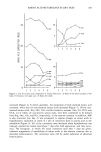
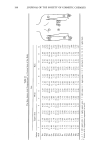
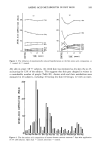
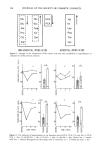
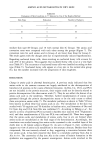
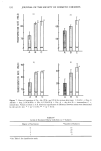
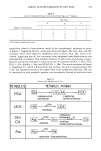
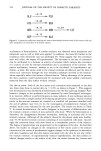
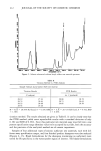
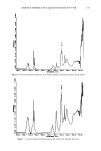
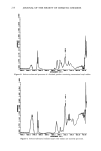
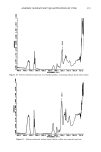
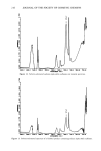
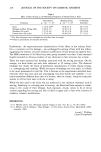
AMINO ACID METABOLITES IN DRY SKIN 187 30 20 10 Gly lO Cit Arg Orn I 2 3 4 5 6 lO Ala His Asp 5 Glu Pro I I I I I I 0 I 2 3 4 5 6 ..._o----o Thr Val Lys Ty r Leu Phe I 2 3 4 5 6 Figure 2. The free amino acid composition at various body sites. (1) Palm of the hand (2) Back of the hand (3) Forearm (4) Upper arm (5) Back (6) Cheek. increased (Figure 4). In brief, generally, the proportion of each essential amine acid increased, while that for non-essential amine acids decreased (Figure 5). Of the non- essential amine acids, Asp, Orn, Glu, and His tended to increase. Orn, Cit, PCA, and UCA, all of which are non-protein amine acids, have been considered to be formed from Arg, Orn, Glu, and His, respectively, in the stratum cerneum. In addition, ASP is also converted into Ala. It was attempted to express changes in amine acids in hyperkeratetic epidermis in terms of a rate of conversion from an amine acid to the metabolite (Figure 6). All of the conversion rates decreased when hyperkeratesis was induced, reached the lowest level about 7 days after LAS application, and then recov- ered. The histogram, in which the mean conversion rates after 7 days are given, indicates suppression of metabolism of amine acids in the stratum cerneum due to abnormal keratinizatien. The conversion rates will be useful indicators of abnormal keratinizatien.

188 JOURNAL OF THE SOCIETY OF COSMETIC CHEMISTS -. --%o •)
Purchased for the exclusive use of nofirst nolast (unknown)
From: SCC Media Library & Resource Center (library.scconline.org)