j. Soc. Cosmet. Chem., 35, 221-228 (July 1984) The dependence of low-pressure indentation, slackness, and surface pH on age in forehead skin of women SHABTAY DIKSTEIN, ABRAHAM HARTZSHTARK, and PNINA BERCOVICI, Unit of Cell Pharmacology, School of Pharmacy, P.O. Box 12065, 91 120Jerusalem, Israel. Received February 28, 1983. Synopsis Low pressure indentation, elastic recovery, levarometry and skin surface pH measurements were carried out on the forehead skin of women aged 20-70. Statistical analysis showed statistically significant age dependence of these parameters. The calculated mean values at the ages of 20 and 70, respectively, were: low pressure indentation: 0.043-0.054 cm elastic recovery: 80.5%-65.5% levarometry (slackness): 0.037-0.068 cm and skin surface pH: 5.25-5.61. The correlation coefficient was low but significant at p 0.05 for indentometry, elastic recovery and skin surface pH (0.21, 0.32, 0.16) and good for levarometry (0.57). INTRODUCTION In order to define the normal values of any measurement, we have to study its variation in the population according to age, sex, etc. We wish to present the normal biological variation and the age dependency of the following parameters on the forehead skin of women: Indentation, as measured by low-pressure indentometry (1) Elastic recovery (re- bound), as measured by low-pressure indentometry (1) Skin slackness, as measured by levarometry (1) and Skin surfacepH, as measured by a pH meter equipped with a planar surface electrode. METHODS Low-pressure indentometry and levarometry measurements were carried out as previ- ously described (1,2). They were based on low-pressure procedures. A brief description of the techniques follows: INDENTOMETRY A light metal measuring rod is counterbalanced so that the net pressure of the system is less than 1 g/cm 2. A circular plate at the end of the rod, having a surface area of 221

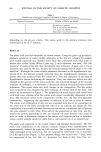
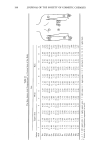
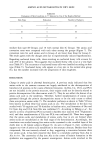
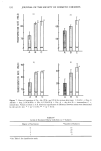
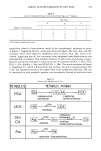
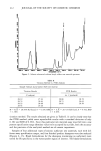
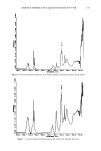
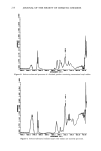
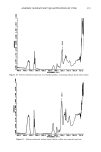
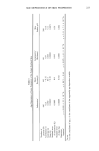
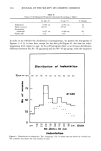
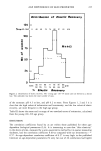
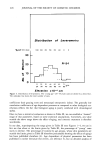
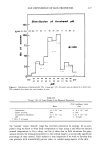
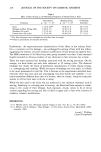
222 JOURNAL OF THE SOCIETY OF COSMETIC CHEMISTS 0.2 cm 2, serves as the contact 'area with the skin. The total weight of the system (including the counterbalance) is 6 g. The measuring rod can be loaded with specially constructed weights, thereby increasing the pressure from the starting pressure to any desired value. The routine final pressure used in our laboratory for in vivo measurements on humans is 10 g/cm 2. The rod is connected to a linear •variable•:.differential transformer (LVDT), the output of which is graphically recorded. The routine paper velocity used by us is 6 cm/min. The sensitivity of the measurements is ___ 0.01 mm. For many reasons (3), the routine measurements are-performed on the 'forehead skin. The patient lies on her back with eyes closed, her head resting on a wooden plate to prevent recording of breathing and heart beats. The measuring rod is adjusted so that the plate is in contact with the forehead skin, and the electronic system is zeroed (starting pressure = 1 g/cm2). The recorder is started and the base line is recorded for about 10-15 sec. The standard weight is now suddenly applied, with the resultant indentation recorded for 10 sec. The weight is then removed and the rebound phase ("elastic recovery") of the skin is recorded for a further 10 sec. For comparison, total indentation is recorded for 10 sec. and the percentage of elastic recovery after 6 sec. SLACKNESS AS MEASURED BY LEVAROMETRY The instrument we use is a modified form of the one described above. The following modifications were introduced: (1) The measuring probe head was made hollow, permitting the application of vacuum to "glue" the skin to the probe. (2) The measuring weight was applied to the counterbalance and not to the measuring rod, thereby inducing a standard perpendicular pull. The final pull is 12.5 g/cm 2. Other experimental details were exactly as described above. SURFACE pH-METRY Skin surface pH was measured using the Planar Dura Probe electrode of L. G. Nester Co., Millville, N.J. All patients were female, aged 20-70 years. All measurements were carried out on three different sites of the forehead and their mean taken as the representative value for that person. The number of subjects (N) is indicated in Table I. RESULTS Table I summarizes the results and their statistical evaluation. It can be seen that significant correlation and regression exists between all the parameters measured, and age. We can therefore present a regression equation as presented in Table I. Table II shows the change between the parameters at age 20 and at age 70 as a percentage of the mean value at the age of 20. It can be seen that from the practical point of view the skin surface pH is not age-dependent. This is in line with another finding from our laboratory (4) showing that on forehead, cheeks, neck and back of hand the untreated skin surface pH is practically constant up to the age of 70 but then rises significantly above the mean value of the "below 70" age group.
Purchased for the exclusive use of nofirst nolast (unknown)
From: SCC Media Library & Resource Center (library.scconline.org)