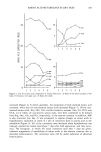
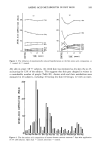
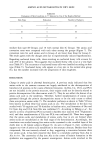
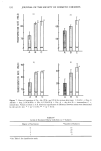
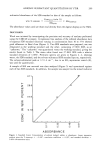
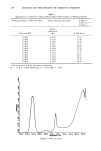
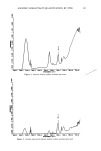
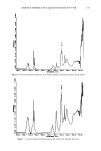
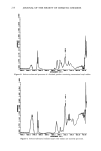
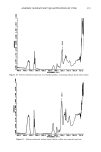
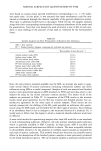
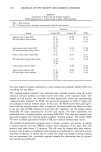
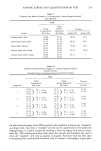
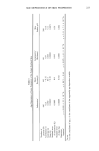
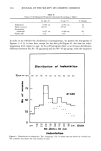
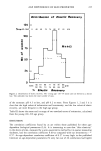
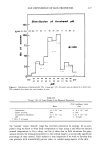
AGE DEPENDENCE OF SKIN PROPERTIES 225 125 ø•Age 20- 39Y: lOO istribution 0 40 49 73 75 50 25 of Elastic Recovery 74 82 91 81 100 ...[ 55 56 61 66 71 76 81 86 91 -- 60 65 70 75 80 85 90 -- N = 443 % Elastic Recovery Figure 2. Distribution of elastic recovery. The "young age" (20-39 years) cases are shown by a dotted line. The unbroken line shows the total number of cases. of the extremes: pH 4.3 or less, and pH 6.2 or more. From Figures 1, 2 and 3 it is clear that the high values of indentation and levarometry, and the low values of elastic recovery, are more frequent in the high age group. Table III shows the mean and its range of two standard errors of estimation, calculated from the young (20-39) age group. DISCUSSION The correlation coefficients found by us are within those published for other age- dependent biological parameters (5,6). It is interesting to note that "skin elasticity" in the above articles, measured by a semi-quantitative method but in essence measuring slackness, had the correlation coefficient 0.60 as compared with our levarometry r = 0.57. An age-dependent correlation coefficient of 0.57 is very high: in the published literature on age-dependent parameters (5) only two out of 26 correlations had higher

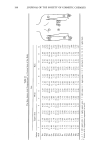
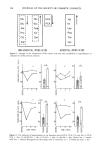
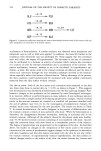
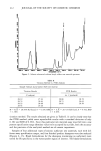
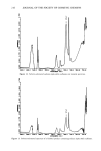
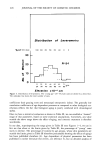
226 JOURNAL OF THE SOCIETY OF COSMETIC CHEMISTS Distribution of Levarometry ø•Age 20-39 Y 30 E 20 o 100 88 82 84 63 40 0 0 N:84 11 21 31 41 51 61 71 - -• 81 20 30 40 50 60 70 80 -- Elevation x 10 -3 cm Figure 3. Distribution of levarometry. The "young age" (20-39 years) cases are shown by a dotted line. The unbroken line shows the total number of cases. coefficients (hair graying score and metacarpal osteoporotic index). The generally low correlation coefficients of age-dependent processes as compared to other biological cor- relations reflects the fact that biological aging is poorly correlated with chronological aging. Once we have a statistical evaluation as shown in Table III, we can establish a "desired" range of that parameter, based on some statistical assumptions. Conversely, any value outside the above range shows the effect of aging, and cosmetic treatment is therefore worthwhile. In our data, superimposing the range given in Table III onto Figures 1-4, we can in fact see that about at the limits given by Table III, the percentage of "young" cases starts to decline. The percentage of women by age groups, whose skin parameters are outside the limits given in Table III (therefore presumably showing the effects of aging) has been published elsewhere (4). Age dependence of physical parameters has been published in earlier literature (for review, see reference 3), but no detailed analysis of
Purchased for the exclusive use of nofirst nolast (unknown)
From: SCC Media Library & Resource Center (library.scconline.org)