J. Soc. Cosmet. Chem., 35, 229-230 (July 1984) Letter to the Editor TO THE EDITOR: Over the years, numerous studies of the effect of heat on keratin (primarily wool) have been carried out [see informative reviews by Menefee and Yee (1965) and McLaren and Milligan (1981)]. The results, not surprisingly, indicate progressive changes in the chemical structure and indeed, evidence of physical degradation of the fiber at elevated temperatures. Hydrothermal treatments have been found much more damaging than dry heat but even in the case of the latter, prolonged exposures (24 hours) at temper- atures 100øC are required to bring about discoloration and weakening of fibers. Heat setting of hair is a convenient technique for style impartation and is readily accomplished by the use of heated rollers. A legitimate question arises as to the potential for heat damage to hair with frequent use of such appliances. In heated rollers the initial surface temperature rarely, if ever, exceeds 120øC, falling precipitously upon contact with the hair that is being wound on. The setting process is completed within 5-15 minutes and, depending on the brand of the appliance, the final temperature of the hair is between 30-50øC. While a reasonable argument could be made that the heat damage to hair under such conditions is likely to be trivial, the experimental evidence (supportive or otherwise) is lacking. A need for the latter is exemplified by the fact that the spectre of "heat damage" associated with heat appliances has acquired a material existence in the minds of many and has been exploited as a credible and useful tool in frequent advertising campaigns. To generate information regarding the effect of heat on hair under conditions relevant to users of heat setters, tresses of hair were set repeatedly (50 setting cycles) on Kindness Deluxe and Custom Care hair setters. Each of the setting cycles was carried out in the following manner: 12 hair tresses (intact DeMeo hair, 61/2" long, 2 g each) were sham- pooed (single lathering) with a commercial shampoo product for 1 minute, rinsed for 30 seconds, and then combed out and blow dried. After 5 minutes rest at room temperature and 50% R.H., the tresses (four tresses per appliance) were set on medium size rollers for 15 minutes, removed from the rollers, combed out, and after an addi- tional 30 minutes, shampooed again prior to the next setting cycle. Two tresses served as no-treatment controls and another two underwent 50 shampoo-blow drying cycles with no hot roller setting. At the conclusion of the experiment, 20 fibers were selected at random from each test group, their bottom segments mounted on tabs and stretched in H20 to break on a table model Instron. The results of those tests, given in Table I, provide no evidence of any weakening of hair by repetitive use of hot rollers. 229

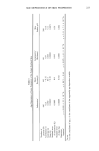
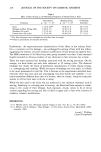
230 JOURNAL OF THE SOCIETY OF COSMETIC CHEMISTS Table I Effect of Heat Setting on the Mechanical Properties of Human Hair in H20 Yield Stress* Breaking Stress % Breaking Treatment g ß cm -2 x 10 5 g ß cm -2 x 10 5 Extension None 5.10 (0.43)** 19.80 (2.1) 58.5 (3.6) Shampoo & Blow Drying Only 4.99 (0.37) 19.84 (1.4) 58.0 (3.7) Kindness (50 cycles) 5.27 (0.34) 20.10 (2.4) 58.2 (4.0) Custom Care (50 cycles) 5.27 (0.38) 19.98 (2.6) 57.7 (3.5) * The fiber diameters were calculated for each fiber from its weight. ** Values in parentheses are standard deviations. Furthermore, the supercontraction characteristics of hair fibers in hot sodium bisul- fite--a sensitive test for damage--are unchanged by setting of hair with hot rollers, suggesting the absence of latent chemical modification of hair keratin by applied heat. The SEM evaluation of 10 fibers from each group (scanned over their 5-mm mounted length) revealed no obvious evidence of any alteration in hair structure due to heat. There was some minimal hair breakage associated with the setting procedure. On the average, six hairs broke per each tress subjected to 50 setting cycles. The observed breakage was clearly the result of mechanical manipulation of tresses during setting, i.e. unwrapping and combing. While the extent of breakage was very small, it is likely to be more pronounced in real life. This is because in the experiments described here, relatively short hair was used and unwrapping was done slowly and carefully--a sit- uation somewhat different from that of a woman, often in a hurry, using her scalp pain sensors to tell her how neat a job she is doing. While the hair used in the study was not subjected to any chemical treatment such as waving, bleaching, or coloring prior to heating, the fibers had been exposed to weath- ering in the course of their lifespan. Such exposure, clearly, seems to be of trivial concern regarding hot setting and this is likely to apply also to hair with a history of oxidative cosmetic modification. REFERENCES (1) E. Menefee and G. Yee, Thermally induced changes in wool. Text. Res. J., 35, 801 (1965). (2) J. McLaren and B. Milligan, "Heat Damage," in Wool Science, (Science Press, Marrickville, NSW, Australia, 1980). Leszek J. Wolfram Clairol Incorporated
Purchased for the exclusive use of nofirst nolast (unknown)
From: SCC Media Library & Resource Center (library.scconline.org)