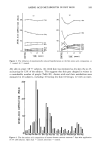
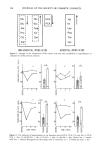
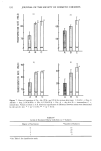
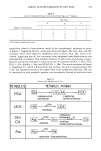
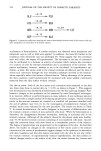
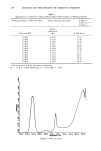
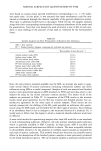
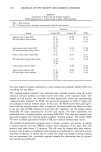
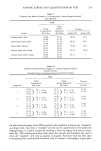
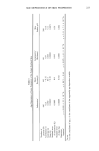
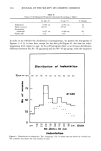
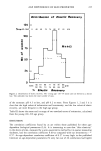
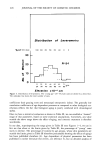
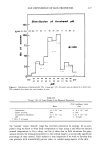
AGE DEPENDENCE OF SKIN PROPERTIES 227 Distribution of forehead pH. 125 - Age 20-39y: 100 100 76 •: 100 - 75 t 5o 25 69 71 77 74 86 27 90 70 80 ß ß N: 500 I ee eee 4.2 4.4 4.6 4.8 5.0 5.2 5.4 5.6 5.8 6.0 4.3 4.5 4.7 Figure 4. Distribution of forehead pH. The "young age" (20-39 years) cases are shown by a dotted line. The unbroken line shows the total number of cases. Table III "Young" (20-39 Years) Range of the Measured Parameters 95% Confidence Limit Mean (20') Indentation 41 x 10 -3 cm -+ 8 x 10 -3 cm* Elastic recovery 78% _+ 10% Levarometry (slackness) 41 x 10 -3 cm +- 25 x 10 -3 cm pH pH 5.3 +- 0.8pH * 24.6 -+ 4.8 units the "normal" versus "desired" range has ever been presented. In analogy, for an anti- pyretic drug we know at what body temperature to start using it and what the desired normal temperature is. For a drug, one has to show that in field situations the prep- aration restores the measured parameter to the normal range in a statistically significant percentage of cases treated. Such analysis is very important if we wish to develop skin care products with scientifically proven value, to combat aging aspects of the skin.

228 JOURNAL OF THE SOCIETY OF COSMETIC CHEMISTS A basic problem in the cosmetic R & D policy today is the fact that whereas the aging process affecting the elastic property of the skin consists mainly of changes occurring in the dermis (7), agents claimed to be active on the dermis are not, according to the present laws, cosmetic preparations but drugs. Three of our parameters (indentation, elastic recovery, slackness) are connected with the behavior of the dermis (3,8,9) and show significant age-dependent changes--presumably deterioration. If we can develop locally acting agents capable of changing an individual measurement which is outside the limits described in Table III into a value which is within those limits, then we have--scientifically speaking--an active ingredient (10). In principle this is a known possibility and it is done every day, e.g. by applying a preparation containing lactic acid to the forehead skin of a woman whose skin pH is more than 5.8 (2). Of course, the underlying assumption is that one knows the distribution and statistics of that parameter in that population. The statistical data presented by us represent, at best, women in Israel people with colored skin might or might not have different values. The point we wish to make is that the distribution of a given skin parameter in the population should be measured first, and those data should be the basis for any claim to a cosmetic skin-improving effect for the same population. We believe that such an approach would bring cosmetic skin care products nearer to the realm of pharmacology. ACKNOWLEDGEMENT The authors wish to thank Mrs. A. Orgad, 81 Dizengoff Street, Tel-Aviv, for carrying out the pH and indentometric measurements. REFERENCES (1) (2) (3) (4) (5) (6) (7) (8) (9) (10) S. Dikstein and A. Hartzshtark, "In Vivo Measurement of Some Elastic Properties of Human Skin," in Bioengineering and the Skin, R. Marks, Ed. (M.T.P. Press, Lancaster, 1981), pp 45-53. S. Dikstein and A. Hartzshtark, The performance of a medicocosmetic consultation unit, Artz. Kosmetol., 12, 280-286 (1982). A. Hartzshtark and S. Dikstein, Mechanical testing of human skin in vivo. Rev. Pure Appl. Pharmacol. Sci., 3, 83-122 (1982). A. Shoen, The Skin Surface pH as a Function of Age. M. Pharm. Thesis, Hebrew University (1982). J. W. Hollingsworth, A. Hashizume, and S. JabIon, Correlations between tests of aging in Hiroshima subjects--an attempt to define "physiological age," YaleJ. BioL Med., 38, 11-26 (1965). A. Comfort, Measuring the human aging rate, Mech. Aging and Development, 1, 101-110 (1972). F. J. G. Ebling, Physiological background to skin aging, Int. J. Cosm. Sci., 4, 103-110 (1982). S. Dikstein and A. Hartzshtark, What does low-pressure indentometry measure? Artz. Kosmetol. (In press, 1983). S. Dikstein and A. Hartzshtark, Effect of intradermal hyaluronidase on indentometry, Bioeng. Skin, 4, 48-51 (1982). S. Dikstein and A. Hartzshtark, Cyclic nucleotides and second generation skin cosmetics as revealed by indentometry. Experientia, in press.
Purchased for the exclusive use of nofirst nolast (unknown)
From: SCC Media Library & Resource Center (library.scconline.org)