AXILLARY ODOR EVALUATION 295 REFERENCES (1) A. A. Gee and I. L. Seidenberg, Evaluation of germicidal soaps, Soap and Chem. Spec., 30, 42-48 (1954). (2) H. S. Whitehouse and R. Owen Carter, Evaluation of deodorant toilet bars, Proc. Scientific Sect., Toilet Goods Assoc., 48, 31-37 (December 1967). (3) F. B. Carabello, Guidelines for the clinical study of antiperspirant and deodorant efficacy, Cosmetics and Toiletries, 95, 33-40 (July 1980). (4) P.M. Baxter and J. U. Reed, The evaluation of underarm deodorants, Internat. J. Cosmetic Sci., 5, 85-95 (1983).

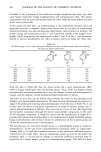
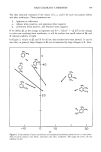
j. Soc. Cosmet. Chem., 35, 297-310 (September/October 1984) Chemistry of hair colorant processesScience as an aid to formulation and development JOHN F. CORBETT, Clairol Incorporated, 2 Blachley Road, Stamford CT 06922 Received April 9, 1984. Presented at Society of Cosmetic Chemists Annual Seminar, Anaheim, CA, May 10-11, 1984. Synopsis The chemistry of color formation in permanent hair colorants is discussed with particular reference to the in-fiber production of blue, red, and yellow dyes and to the effect of pH on the relative rates of formation of these dyes. The formulation of semipermanent (direct) colorants requires consideration of molecular size, wash fastness, light fastness, and color of the dyes used. These aspects of dye selection are considered, and some interesting correlations between molecular structure and the color and light fastness of nitro dyes are presented. PERMANENT HAIR COLORANTS Permanent hair coloring involves the in-fiber formation of indoodyes, from colorless low molecular weight precursors, by oxidation with hydrogen peroxide under alkaline conditions. The resulting dyeing is fast to shampooing and undergoes little fading during the six-week period before recoloring is necessitated by the new hair growth. The use of hydrogen peroxide to develop the color also allows for bleaching of the natural pigment by one or two shades--say, from light brown to medium blond--at the same time as the synthetic color is being formed. Thus, by appropriate adjustment of dye precursor and peroxide proportions, permanent colorants can be employed to color hair to lighter or darker shades or to cover gray (mixed pigmented and white fibers) without darkening the color of any pigmented fibers in the gray. This versatility undoubtedly accounts for the dominant share of the market held by the permanent hair colorants, not only in the United States, but throughout the world. Permanent hair colorants are marketed as two component kits. One component contains the dye precursors in an alkaline soap or syndet base, and the other is a stabilized solution of hydrogen peroxide. The two components are mixed immediately prior to use and applied to the hair. The precursors and peroxide diffuse into the hair shaft where color formation takes place. Table I lists the major precursors currently used in permanent colorants in the United States. The primary intermediates are p-phenylenediamines or p-aminophenols which are oxidized by hydrogen peroxide to p-benzoquinone imines (II) and (XI), which have 297
Purchased for the exclusive use of nofirst nolast (unknown)
From: SCC Media Library & Resource Center (library.scconline.org)