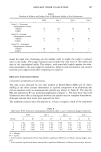
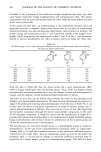
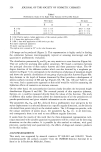
306 JOURNAL OF THE SOCIETY OF COSMETIC CHEMISTS advisable to use a mixture of low molecular weight (single benzene ring) dyes with some higher molecular weight (diphenylamine and anthraquinone) dyes. The former can penetrate and are quite well retained near the roots, while the latter behave similarly at the more porous ends. In the search for new dyes, an understanding of the relationship between color and molecular structure is valuable. Studies have shown that in any series of nitrobenzene derivatives bearing two electron-donating substituents, such as amino or hydroxy, the isomer having the substituents in the 2- and 5-positions absorbs at the longest wave- length, while those having the substituents in the 2- and 4- or the 3- and 4-positions absorb at shorter wavelengths (4). This is shown clearly in Table III. Note also, Table III The Wavelength of the Visible Absorption Maxima for a Series of Nitrobenzene Derivatives Bearing Two Electron Donor Substituents D D' NH 2 NH 2 474 408 389 OH NH 2 446 394 394 NH 2 OH 454 370 394 NH 2 CH• 443 370 395 OH CH 3 393 342 360 OH OH 407 349 368 D from the data in Table III, that the amino group has a more bathochromic effect (shift to longer wavelength) than the hydroxy group. Thus, while the deepest colored unsubstituted nitrophenylenediamine is red, the deepest colored nitroaminophenol is orange, and the deepest colored hydroxymethoxynitrobenzene is yellow. The color of nitro dyes can be shifted more towards the violet by the introduction of N-alkyl or N-hydroxyalkyl substituents. We have recently determined the spectra of a range of N-substituted 2-nitro-p-phenylenediamines. From the data in Table IV, it can be seen that the effect of successive introduction of single N-methyl groups into 2- nitro-p-phenylenediamine is additive. This gives rise to a series of dyes that range from the red parent compound, through the mauve mono-methyl compounds, to the violet N•,N4-dimethyl compound. It should be noted that the introduction of single N-(2- hydroxyethyl) groups has a similar effect to the introduction of single N-methyl groups, being a bathochromic shift of about 26 nm for substitution on the m-amino group and 20 nm for substitution on the 0-amino group. The introduction of a second N-methyl group to a methylamino groups is, however, nonproductive. In the case of the 0-dimethylamino compound, there is a large hypso- chromic shift ( - 50 nm) and a marked reduction in the extinction coefficient which is characteristic of a steric effect. Such an explanation cannot account for the small hyp- sochromic shift (--10 nm) and no change in extinction coefficient resulting from in- troduction of a second methyl group to a m-methylamino group. This lack of a bath-

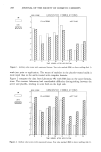
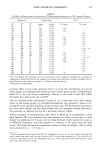
HAIR COLORANT CHEMISTRY 307 Table IV The Effect of Substituents on the Spectra of 2-Nitro-p-phenylenediamines in 95% Aqueous Ethanol Substituent Visible Band A K* N • N 4 N 4 Kmax (log ½) N•-subst. N4-subst. H H H 471 (3.65) - - Me H H 497 (3.67) + 26 - he? H H 495 (3.67) +24 - H Me H 492 (3.56) - + 21 H he H 490 (3.56) - + 19 Me Me H 515 (3.60) + 23 + 18 Me he H 520 (3.66) + 30 +23 he Me H 518 (3.56) + 26 + 23 he he H 513 (3.62) +23 + 18 H Me Me 480 (3.55) - - 12 H Me he 500 (3.47) - + 10 H he he 510 (3.50) - +20 Me Me Me 506 (3.53) + 26 - 9 he Me Me 505 (3.52) +25 - 13 Me Me he 528 (3.50) + 28 + 8 Me he he 536 (3.61) + 26 + 16 he he he 536 (3.59) + 26 + 23 Me Pr H 523 (3.54) - +26 Me Pr Pr 542 (3.52) - + 19 Me Et H 517 (3.61) - + 20 Me Et Et 532 (3.52) - + 15 Me2 H H 442 (2.95) - 55 - +8 +13 * The wavelength shift resulting from the introduction of the indicated N-substituent, obtained by comparison of Kmax with that for the compound not having that substituent. Ordinary numbers relate to alkyl substituents and italicized numbers to 2-hydroxyethyl substituents. ? Represents 2-hydroxyethyl. ochromic effect is even more suprising when it is noted that introduction of a second ethyl, propyl, or 2-hydroxyethyl group onto the m-amino group results in bathochromic shifts of 14, 19, and 20 nm, respectively. Clearly, in the series of dyes (XIV)-(XV) the choice for a blue-violet dye is (XIV). The use of hydroxyethyl substituents in place of, or in conjuction with, alkyl substit- uents on the amino groups of nitrophenylenediamines also provides a means of af- fecting the water and lipid solubility of the resultant dyes. The hydroxyethyl derivatives are more water-soluble and less lipid-soluble than the analogous methyl derivatives, thus assisting in tailoring the dye for a particular delivery system. Another property of semipermanent dyes which is deserving of consideration is their light fastness. We have examined the light fastness of a series of nitro dyes on wool flannel 2 by irradiation for 8 hours with an Atlas Enclosed Violet Carbon Arc lamp in an FDA-RC Fadometer, with the samples at a distance of 10 inches from the light source. This lamp has spec. tral components similar to those of sunlight, with no short wave ultraviolet (i.e., 275 nm.). 2 Pieces of standard worsted wool cloth (S/523), measuring 60 cm by 14 cm, were washed with soap and water, rinsed with water, and dyed for 20 min at 30øC in a dye bath comprised of 0.1 g of the dye, 45 ml water, 5 ml ethanol, and 0.1 g of Standapol 7023 conc. © The cloth was removed from the bath, rinsed with water, and allowed to air dry.
Purchased for the exclusive use of nofirst nolast (unknown)
From: SCC Media Library & Resource Center (library.scconline.org)