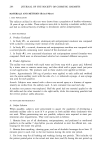
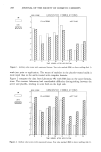
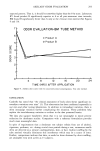
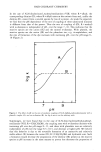
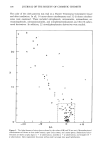
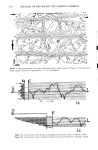
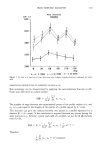
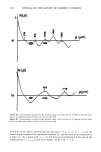
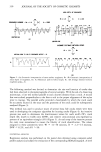
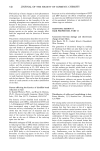
300 JOURNAL OF THE SOCIETY OF COSMETIC CHEMISTS _ \\B "... \\\ '"... O --- - 7 g 11 pH Figure 1. The effect of pH on the rate of oxidative coupling ofp-phenylenediamine with m-aminophenol (A), an m-diamine (B), o•-naphthol (C), and resorcinol (D). By contrast, phenolic couplers react, at pH above 8, exclusively as the phenoxide ion. Since the phenolic couplers used in oxidative dyeing have pKa's of about 10, the proporation existing in the reactive anionic form will be increasing about tenfold with each unit rise of pH, over the pH range 7-9. Consequently, the rate of formation of the indoaniline dye (VI) will be almost independent of pH between about pH 7 to 9 and then decrease rapidly with increasing pH. The pH dependence of the rate of formation of the 2-aminoindoaniline dye (VII) from m-aminophenol is similar to that of o•-naphthol (Figure 1). The curve for resorcinol (Figure 1) is somewhat more complex because both the mono-anion and the di-anion are reactive species (2). In a typical oxidation dye composition containing #-phenylenediamine, resorcinol, m- aminophenol, and a m-diamine, it can be seen, from Figure 1, that the three couplers react at about the same rate at pH 9.0-9.95. However, if the pH of the reaction mixture were reduced to 8, reaction of the diimine with the m-diamine would be greatly favored over reaction with the phenolic couplers. On the other hand, increasing the pH of the mixture to 10 would favor reaction of the diimine with resorcinol. It is thus evident that different colors would be expe'cted to be produced from the use of the same composition to dye at different pH's. This is found to be the case in practice, and predictions made from a knowledge of the reaction rates are, at least, qualitatively correct.

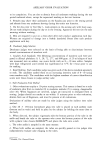
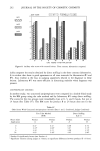
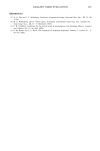
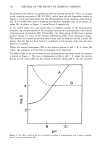
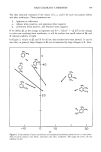
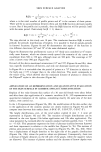
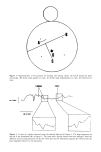
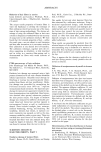
HAIR COLORANT CHEMISTRY 301 In the case of N,N-disubstituted p-phenylenediamines (VIII where R=alkyl), the corresponding diimine (IX where R = alkyl) exists as the cationic form and, unlike the diimine (II), cannot form a neutral species by loss of a proton. As would be expected, we find that the pH dependence of the rate of coupling of these substituted diimines is different from that of the parent. Thus the rate of coupling of (IX R=methyl) with m-diamines is independent of pH, over the range 7-10. This indicates that the reactive species are the cation (IX) and the neutral m-diamine. With phenols, the reactive species are the cation (IX) and the phenolate ion, e.g. o•-naphtholate, and the rate of formation of the dye increases with increasing pH, over the pH range 8- 10 (Figure 2). I I I 7 9 pH Figure 2. The effect of pH on the rate of oxidative coupling of N,N-dialkyl-p-phenylenediamine with a phenolic coupler (A), and an m-diamine (B) the log k axis is on the arbitrary scale. Surprisingly, we have found that in the case of N,N-bis(2-hydroxyethyl)-p-phenyl- enediamine (VIII R = CH2CH2OH), the coupling rates with m-diamines decrease with increasing pH over the pH range 8-11, and those with phenolate ions are relatively independent of pH over the range 8.5- 10.5, and decrease at higher pH. We believe that this behavior is due to the reversible formation of an unreactive and relatively stable adduct (X) between the cation (IX R = CH2CH2OH) and hydroxide ions. Such a formation would decrease the proporation of the diimine (IX) present as the reactive species as pH increases in the same manner as proton loss decreases the proportion of
Purchased for the exclusive use of nofirst nolast (unknown)
From: SCC Media Library & Resource Center (library.scconline.org)