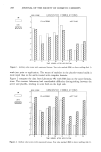
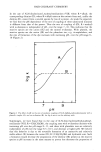
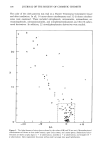
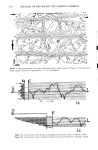
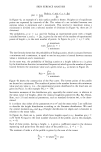
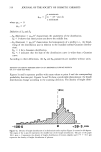
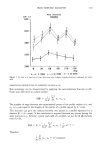
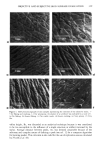
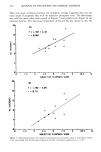
OBJECTIVE AND SUBJECTIVE SKIN SURFACE EVALUATION 335 20 lB 1.13X + 5.132 0.659 + 3 4.5 6 7.5 9 SUBJECTIVE PLUHPNE55 5CORE 10.5 16 (B) ¾ = 1.46X - 01.72 r = 01. 626 O! 1.5 3 4.5 6 7.5 9 101.5 12 SUBJECT!VE PLUHPNESS SCORE Figure 8. Relationship between the subjective plumpness score and the Rz value of traces taken normal to (A) and parallel with (B) the major furrows of the skin. Correlation significant at p 0.02. slopes of the lines were not significantly affected by the direction of the trace. The y- intercepts, however, were significantly (p = 0.0002) higher for traces taken perpen- dicularly to the principal furrows. This result is consistent with those of Cook et al. (12) who reported that several roughness parameters had a large dependence on the

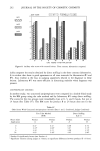
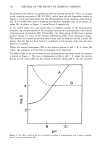
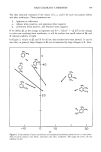
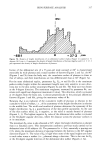
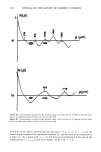
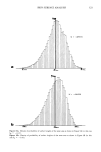
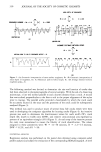
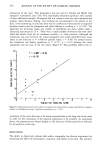
336 JOURNAL OF THE SOCIETY OF COSMETIC CHEMISTS orientation of the trace. This dependence was not seen by Nicolls and Marks who measured "surfometric area" (18). This relationship remained significant after analysis of three additional samples. Plumpness did not correlate with any other mathematical analysis. Since flatness, flaking, and cracking are all presumed to be related to dry skin, it was interesting to note that there was no correlation (either positive or negative) between visual scores for plumpness and either flaking or cracking (r = 0.1125). The algorithm for detecting cracks was capable of identifying all cracks visible under a dissecting microscope at 25 X. There were a small number of features that were iden- tified but which could not be confirmed visually, i.e., false positives. Although the correlation was poor between the visual assessment and cracks identified from traces taken in one direction (r = 0.400 for parallel traces r = 0.467 for normal traces), the correlation was highly significant (r = 0.757, p 0.01) between the visual assessment and the sum of the two traces (Figure 9). This probably reflects the re- 15. a:: 6 ltl 6 7 8 Y = 2. BSX + B.94 r = B.757 + + I 2 3 4 5 SUBJECTIVE ERREKING SCORE Figure 9. Relationship between the subjective evaluation of cracks and the number identified by computer analysis of surfanalysis tracings. Correlation significant at p 0.01. quirement of the trace direction to be nearly perpendicular to the long axis of the crack in order for the constraints of the physical parameters to be satisfied. As mentioned above, the parameters are biased slightly in the direction of false positives as reflected by the positive y-intercept. DISCUSSION The ability to objectively evaluate skin surface topography has obvious importance for examining the effects of environment, cosmetics, and disease on the skin. The ultimate
Purchased for the exclusive use of nofirst nolast (unknown)
From: SCC Media Library & Resource Center (library.scconline.org)