AXILLARY ODOR EVALUATION 285 to its completion. You are also to abstain from all underarm washing during the test period indicated above, except for supervised washing at the test location. 4. Females may shave their underarms on the Sunday just prior to the testing period and abstain from any underarm shaving during the entire test duration. 5. On the day prior to Test Day 1, wash armpits in the morning only with Ivory soap. Do not wash armpits during the day or in the evening. Appear at the test site the next morning without washing. 6. Men are required to put on a clean shirt after each product application each day. Women are required to change into a freshly laundered blouse after each product application each day. B. Deodorant Judge Selection Deodorant judges were selected on the basis of being able to discriminate between several concentrations of isovaleric acid. 1. Isovaleric Acid Standards. The following concentrations of isovaleric acid were pre- pared in dibutyl phthalate: 0, 5, 20, 72, 277, and 600 ppm. A 25-ml aliquot of each was measured into an amber, one ounce bottle with an 8--10 mm orifice. Samples were kept refrigerated until needed but equilibrated at 37øC for 1 hour prior to use for ranking. 2. Rank Ordering. Each candidate judge was given each of the above standards separately to rank. The candidate ranked them on an increasing intensity scale of 0-10 (using even numbers only). The candidates with the highest numbers of correct identification scores were those chosen to judge axillary odor. C. Odor Evaluation-Tube Method 1. Odor evaluations employ a 10~point scoring system. This system is based on a scale of underarm odor from no malodor (0) to moderate malodor (5) to strong, disagreeable odor (10). When fragrances are involved, judges are instructed to disregard them in scoring. Judges should not smoke or eat within 15 minutes prior to odor evaluation, abstain from use of fragrances, and must be present at all evaluations. Evaluations of axillary odor are made by odor judges using the indirect (test tube) method. a. One 20 x 150-mm borosilicate glass test tube is placed in each axillary vault (bottom end in vault) and held in place by the subject by holding the arms close to the body. b. When directed, the subject vigorously rubs the bottom portion of the tube in the axilla and hands the tube to the operator who covers the bottom portion of the tube with a plastic tube closure (KIMKAP ©) and places the tube onto a rack. c. The other axilla is sampled in the same manner. d. When both axillae are sampled, the tubes are quickly passed to two judges who independently evaluate odor clinging to the tubes. © Kimble, Div. Owens-Illinois.

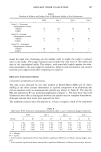
286 JOURNAL OF THE SOCIETY OF COSMETIC CHEMISTS e. If there are more than two judges, a second axillary sampling is obtained using fresh tubes. f. If sufficient sample is obtained, as indicated by the judges, the subject is released until the next sampling period. If not, additional samples are taken. g. Judges evaluate panelists at approximately one to one-and-one-half-minute intervals. 2. Each evaluation is entered on a record sheet which does not show subjects' l•roduct assignments or any previous odor scores. After each judging period, the investigator collects all record sheets and distributes new ones for the next odor evaluation. D. Test Schedule 1. Three-Day Test (2 Test Material Applications) a. Day 1. Final subject selection is made at this time those subjects that achieve a prewash score of at least 4 (on a 0-10 scale) in both axillae (by no less than half the judges) are selected. The score of the selected subjects represents the initial reading (base-line score) and is entered on a record sheet. Then, (1) axillae are washed with tepid water and Ivory soap (with the aid of a gauze pad or washcloth), followed by a water rinse to remove excess soap, and then dried with a paper towel (2) the amount of designated product is applied to the axillae (3) subjects are instructed to report back for additional odor evaluations at specific intervals (normally 3, 6, and 24 hours). All instructions for subsequent days of testing are reviewed thoroughly with subjects. Subjects are again reminded not to wash axillae that evening and the following morning. b. Day 2. (1) The first 24-hour post-treatment evaluation is made at this time (2) axillae are then washed with Ivory soap and the same procedure as in Day 1 is followed. c. Day 3. Subjects report for 24-hour odor evaluations, and the test is terminated. IV. STATISTICAL ANALYSIS/DATA HANDLING The data are analyzed to compare the effectiveness of test formulations. The statistical analysis utilizes a repeated measures design. The odor scores between the two test materials are compared at each time period. Factors used in the analysis are panelists, treatments, test days, and judges. In addition, the number of subjects experiencing superior performance with each treatment are tabulated and treatment differences are tested by the Wilcoxon signed rank test. If analysis indicates product differences from day to day and/or judge to judge, separate analyses are made for each day and/or judge. The first day (pretreatment) odor scores are used for two purposes: (1) to permit screening out subjects with low levels of odor, and (2) to ascertain whether there are sufficient left/right differences to require using the first day scores as a covariate in the analysis of post-treatment data to adjust for side bias. MATERIALS AND METHODS (Contract Laboratories) The basic methodology used in the three contract laboratories was similar to that described in the preceding section. However, in Study #3, 41 subjects and four judges were used in the contract laboratory (Table I). In the direct sniffing procedure, each subject positioned himself in front of a judge and
Purchased for the exclusive use of nofirst nolast (unknown)
From: SCC Media Library & Resource Center (library.scconline.org)