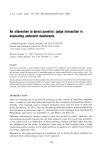
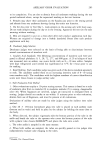
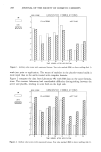
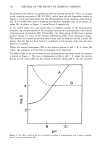
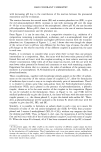
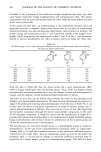
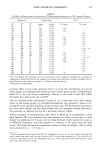
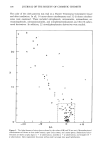
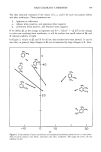
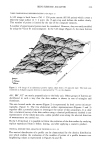
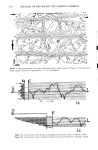
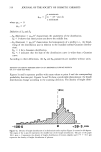
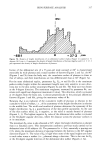
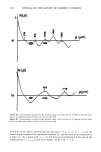
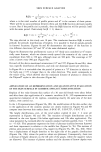
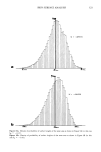
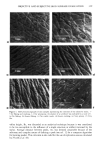
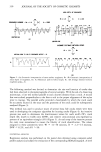
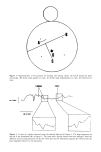
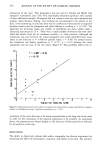
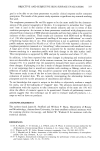
Figure 3. Representation of the protocol for locating and tracing cracks. (A) Crack located by light microscopy. (B) Scribe mark parallel to crack. (C) Scribe mark perpendicular to crack. (D) Direction of trace. Figure 4. A trace of a replica obtained using the method depicted in Figure 3. The large depression on the left is the benchmark (B) in Figure 3. The crack and a typical furrow have been enlarged. Note the different cross-sectional geometry of the two. Note also that for illustrative purposes the vertical scale has been magnified relative to the horizontal.

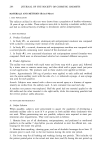
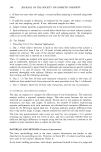
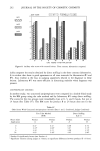
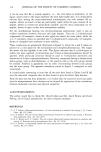
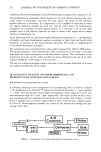
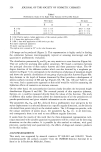
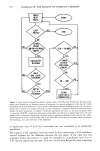
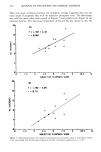
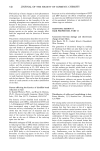
332 JOURNAL OF THE SOCIETY OF COSMETIC CHEMISTS •/ INPUT NEXT POINT NO NO YES ERLEULRTE HINIHUH NO D/W • B. BB2f YES WITHIN PREVIOUS NO RZ • 9Bf YES STORE LOERTION & PRRRHETER5 Figure 5. Flow chart of computer program to detect cracks. The following describes the decision points which were derived by an iterative process of adjusting the various parameters such that all visibly identifiable cracks were detected: (1) Level point--determines if there is a following point 30-50 microns distant that is within 0.75 micron vertically, (2) local minimum--eliminates areas with hills and valleys within the above boundaries, (3) depth--eliminates depressions less than 2.2 microns and greater than 4.4 microns, (4) D/W--eliminates depressions whose depth-to-width ratio is greater than 8.2%, (5) crack within crack--eliminates depressions contained within a previously identified crack, and (6) A%--elim- inates depressions whose cross-sectional area is less than 90% of the area of a triangle whose vertices are the beginning, end, and minimum of the depression. of significance of p • 0.05 for a two-tailed test was considered to be statistically significant. The equality of the regression lines was tested by first constructing a 95% confidence interval estimate for the difference between the two slopes. If the value zero was contained within this interval, it could be concluded at a significance level of p = 0.05 that the slopes were the same. This was true for both Ra and Rz when comparing
Purchased for the exclusive use of nofirst nolast (unknown)
From: SCC Media Library & Resource Center (library.scconline.org)