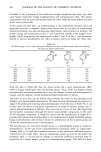
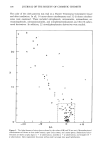
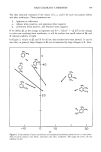
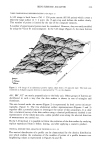
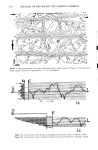
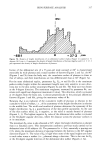
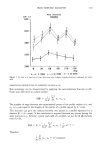
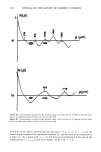
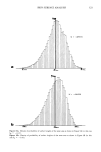
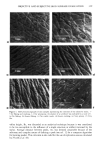
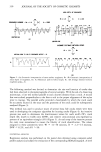
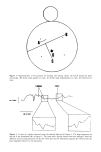
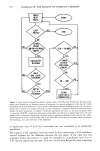
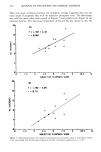
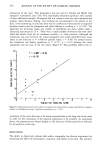
324 JOURNAL OF THE SOCIETY OF COSMETIC CHEMISTS Table I Profilometric Study of the Right Volar Forearm (30-Year-Old Female) Rtm ([xm) Sm X sd X sd R 1 (A) 81.3 -+ 8.4 384.7 -+ 34.8 R 2 72.3 + 7.6 407.5 + 72.4 R3(B) 63.0 + 5.1 442.9 + 17.4 R 1 (A): Positive replica, before application of the cosmetic product (00). R 2:3 hours after application of (00). R 3 (B): 3 days after application of (00) (twice per day). Rtm ([xm): amplitude parameter. Sm ([xm): spacing parameter. The replicas were scanned at 90 ø to the volar forearm axis. 3-D image can be produced (Figure 2). This representation is highly useful in finding the correlation between microtopography (optical or scanning microscopy) and the quantitative profilometric evaluation. The distribution parameters SK and EK are very sensitive to scan direction (Figure 6a). They are useful for studying skin surface anisotropy. We found a correlation between the principal direction of skin surface furrows and these parameter values. The 60- degree direction of the abdomen surface which was also detected by a roughness pa- rameter •.a (Figure 7) (4) corresponds to the distribution of plateaus of maximum length and shows the periodic distribution of one group of principal skin furrows (Figure 8b). Any decrease in the depth of furrows (measured by Rtm) provokes a development of plateau surfaces (increase of SM and SK) (Figures 9A, 9B, 10a, 10b and Table I), and vice versa. Such a quantitative approach to skin relief would be valid for measuring the hydration effects of cosmetics on stratum corneum. On the other hand, the autocorrelation function clearly describes the horizontal height distributions (Figures 8 and 8b). The eventual periods of skin asperities (plateaus, furrows, etc.) could be measured directly from the values of this function. The study of different skin surface directions allows the determination of all the periodicities (or pseudo-periodicities) and gives valuable information on the orientation of furrows. The parameters (SK, EK, and Rt), deduced from a profilometric trace and given by the stylus displacement in a selected distance (at a specific angular direction), can be directly calculated from points (z(x,y)) on the studied surface. The 3-D image can provide, with the unique statement of points z(x,y), the parameters SK, EK, etc. in all directions, and consequently there is no need to scan different angular directions. It seems from the results of this work that the three-dimensional representation tech- nique associated with suitable quantitative parameters will be a valid tool for detecting alterations on the skin surface. It is possible by this method to evaluate, with good precision, qualitatively and quantitatively, the effects of drugs and cosmetic products on the skin surface. ACKNOWLEDGEMENTS This study was supported by research contracts N ø 838-001 and 838-029: "Etude tridimensionnelle des surfaces cutan6es" from the INSERM (Institut National de la Sant• et de la Recherche M6dicale), France.

SKIN SURFACE ANALYSIS 325 The authors would like to thank G. Pannetton (Iconographie, Facult• de M6decine et de Pharmacie, Besangon) for his technical assistance. The authors would like to thank Vick International-Paris for their financial contribu- tion. REFERENCES (1) S. Makki, J. C. Barbenel, and P. Agache, A quantitative method for the assessment of the micro- topography of human skin. Acta Dermatovener. (Stockh), 59, 285-291 (1979). (2) T. H. Cook, Profilometry of skin. A useful tool for the substantiation of cosmetic efficacy. J. Soc. Cosmet. Chem., 31, 339-359 (1980). (3) S. Makki, P. Agache, J. C. Barbend, I. M. Nadvornik, et al., Quantitative assessment of skin aging through surface microtopography measurements. European Society for Dermatological Research (ESDR) Noorwijik, Holland, 24-27 May, 1981,J. Invest. Dermatol., 76, 428 (1981). (4) S. Makki, P. Agache, J. C. Barbend, I. iV[. Nadvornik, et al., Specific roughness parameters and optimum scanning direction in quantitative evaluation of the human skin microtopography. Third International Symposium of the Bioengineering and the Skin, Philadelphia (USA), 22-24 July, 1981. (5) U. Hoppe, Topologie der Hautoberflache. J. Soc. Cosmet. Chem., 30, 213-239 (1979). (6) P. Agache, S. Makki, D. Blanc, et al., Skin care in childhood. Current Medical Research and Opinion, 7 (Suppl 2), 15-22 (1982). (7) S. Makki, J. Mignot, and P. Agache, Statistical analysis of human skin microtopography profiles. 12th Congress of the International Federation of Societies of Cosmetic Chemists (Paris), 13-17th September, 1982. (8) T. H. Cook, T.J. Craft, R. L. Brunell, et al., Quantification of the skin's topography by skin profilometry. Int. J. Cosmet. Sc., 4, 195-205 (1982). (9) M. S. Longuet-Higgins, Statistical properties of an isotropic random surface. Phil. Trans. of the Royal Soc., 250 Serie A, 157-174 (1957). (10) J. B. Williamson, Interdisciplinary approach to friction and wear. Proceedings NASA. 23-30 No- vember, 1967, San Antonio (USA) P.M. Ku Ed. (11) R. C. Spragg, and D. J. Whitehouse, An average wavelength parameter for surface metrology. Revue M. Mgcanique, 20, 293-300, (1974). (12) D.J. Whitehouse, and J. F. Archard, The properties of random surfaces of significance in their contact. Proc. Roy. Soc., A-316, 97-121 (1970). (13) R. Bazin, S. Makki, M. Baud, and P. Agache, Selection of human skin microtopography quantitative parameters by principal components analysis. Med. & Biol. Eng. & Cornput., 21, 179-185 (1983).
Purchased for the exclusive use of nofirst nolast (unknown)
From: SCC Media Library & Resource Center (library.scconline.org)