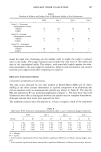
286 JOURNAL OF THE SOCIETY OF COSMETIC CHEMISTS e. If there are more than two judges, a second axillary sampling is obtained using fresh tubes. f. If sufficient sample is obtained, as indicated by the judges, the subject is released until the next sampling period. If not, additional samples are taken. g. Judges evaluate panelists at approximately one to one-and-one-half-minute intervals. 2. Each evaluation is entered on a record sheet which does not show subjects' l•roduct assignments or any previous odor scores. After each judging period, the investigator collects all record sheets and distributes new ones for the next odor evaluation. D. Test Schedule 1. Three-Day Test (2 Test Material Applications) a. Day 1. Final subject selection is made at this time those subjects that achieve a prewash score of at least 4 (on a 0-10 scale) in both axillae (by no less than half the judges) are selected. The score of the selected subjects represents the initial reading (base-line score) and is entered on a record sheet. Then, (1) axillae are washed with tepid water and Ivory soap (with the aid of a gauze pad or washcloth), followed by a water rinse to remove excess soap, and then dried with a paper towel (2) the amount of designated product is applied to the axillae (3) subjects are instructed to report back for additional odor evaluations at specific intervals (normally 3, 6, and 24 hours). All instructions for subsequent days of testing are reviewed thoroughly with subjects. Subjects are again reminded not to wash axillae that evening and the following morning. b. Day 2. (1) The first 24-hour post-treatment evaluation is made at this time (2) axillae are then washed with Ivory soap and the same procedure as in Day 1 is followed. c. Day 3. Subjects report for 24-hour odor evaluations, and the test is terminated. IV. STATISTICAL ANALYSIS/DATA HANDLING The data are analyzed to compare the effectiveness of test formulations. The statistical analysis utilizes a repeated measures design. The odor scores between the two test materials are compared at each time period. Factors used in the analysis are panelists, treatments, test days, and judges. In addition, the number of subjects experiencing superior performance with each treatment are tabulated and treatment differences are tested by the Wilcoxon signed rank test. If analysis indicates product differences from day to day and/or judge to judge, separate analyses are made for each day and/or judge. The first day (pretreatment) odor scores are used for two purposes: (1) to permit screening out subjects with low levels of odor, and (2) to ascertain whether there are sufficient left/right differences to require using the first day scores as a covariate in the analysis of post-treatment data to adjust for side bias. MATERIALS AND METHODS (Contract Laboratories) The basic methodology used in the three contract laboratories was similar to that described in the preceding section. However, in Study #3, 41 subjects and four judges were used in the contract laboratory (Table I). In the direct sniffing procedure, each subject positioned himself in front of a judge and

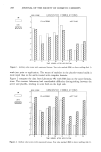
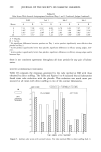
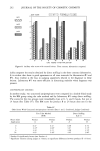
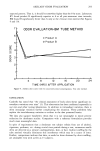
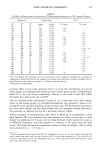
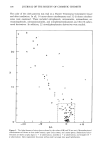
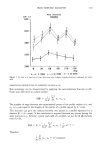
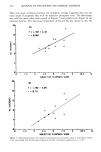
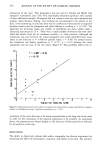
AXILLARY ODOR EVALUATION 287 Table I Numbers of Subjects and Judges Used in Deodorant Studies in Four Laboratories B-M Lab 1 Lab 2 Lab 3 Study I--Unscented Antiperspirant Lotions Subjects 15 20 20 20 Judges 3 3 3 3 Study II--Scented Antiperspirant Lotions Subjects 13 20 20 20 Judges 3 3 3 3 Study III--Unscented Antiperspirant Aerosols Subjects 19 41 Judges 3 4 raised his right arm, flattening out the axillary vault to enable the judge to evaluate odor in the axilla. The judge evaluated and recorded the odor level of that axilla and then of the contralateral axilla. The subject, with arms held tightly against his sides, then proceeded to the next judge for evaluation. Subjects were evaluated at one-minute intervals and judges rested after evaluating ten subjects. RESULTS AND DISCUSSION UNSCENTED ANTIPERSPIRANT EMULSIONS The odor scores obtained by the tube method at Bristol-Myers (BM) and by direct sniffing at the three contract laboratories in a paired comparison of an aluminum salt roll-on emulsion with an aluminum-free placebo are shown in Table II. The data for BM and Laboratory # 1 are presented graphically in Figure 1. The data show that both laboratories were able to distinguish between the placebo and the complete formulation, although reduced odor levels were reported for both. The markedly reduced odor with placebo at 3 hours is largely a result of the soap/water Table II Odor Scores With Unscented Antiperspirant Emulsions (Days 1 and 2 Combined Judges Combined) B-M Lab 1 Lab 2 Lab 3 Hours A B A B A B A B 0 5.82 6.45 5.67 5.50 6.98 6.95 7.02 7.02 3 4.50 a 1.85 • 3.00 • 1.95 • 4.22 3.48 3.02 2.65 6 4.87 • 1.82 a 4.18 2.98 5.24 4.31 4.56 4.13 24 5.06 2.88 4.52 3.43 7.03 b 6.38 •' 7.05 7.06 A = Placebo. B = Active. • Active product significantly better than placebo significant differences in efficacy among judges, how- ever. b Active product significantly better than placebo significant differences in efficacy between days, however.
Purchased for the exclusive use of nofirst nolast (unknown)
From: SCC Media Library & Resource Center (library.scconline.org)