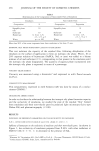
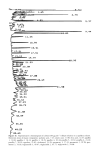
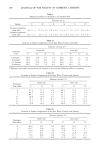
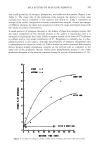
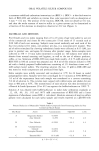
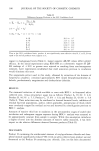
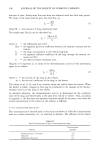
ORAL VOLATILE SULFUR COMPOUNDS 299 a resonance-stabilized carbonium immonium ion (BDC + ). BDC + is the thiol-reactive form of BDC-OH and exhibits an intense blue color associated with an absorption at • max = 612 nm. The product of the reaction, BDC-SR, does not absorb at 612 nm, and thus the molar amount of reactive sulfur in a given system can be determined as a function of the decrease in absorption observed at 612 nm (Figure 1). MATERIALS AND METHODS Five females and two males ranging from 22 to 45 years of age were asked to use one of the commercial oral rinses for two consecutive 15-ml rinses of 15 seconds each at 9:00 AM of each test morning. Subjects were tested randomly and used each of the four test products five times, one product per day, in a nonconsecutive manner. Two ml of saliva stimulated by chewing orthodontic bands were collected at 8:15 AM, just prior to product use, and again 60 minutes after product usage. Saliva samples were collected in 150 X 15-mm tubes immersed in cracked ice. All subjects were asked to abstain from normal morning oral hygiene, as well as the use of tobacco products, coffee, or tea. Solutions of BDC-OH were made fresh weekly. A 0.75-ram solution of BDC-OH in 100 ml acetone was prepared and 10.0 ml of this solution diluted to 500 ml with a freshly prepared buffer/surfactant consisting of 3% disodium citrate and 7 mM sodium lauryl sulfate. The resulting solution (A) was 15 •M in BDC-OH and was stored at room temperature and protected from light. Saliva samples were mildly sonicated and incubated at 37øC for 24 hours in sealed polypropylene tubes. Samples were then centrifuged for 15 minutes at 4950 RPM and 1.0 ml of the supernatant from each sample was transferred to a cuvette containing 5.0 ml of solution A. The cuvettes were capped with rubber septa and shaken for one hour at 400 rpm at 40øC. The transmittance of each solution was then determined on a Bausch & Lomb Spectronic 20 at 612 nm against the buffer/surfactant as 100% T. Solution A was diluted with buffer/surfactant to make daily calibration standards at .12, .09, .06, .03, .015 and .0075 mM concentrations of BDC-OH and a linear regression of absorbance versus BDC + calculated. Absolute amounts of reactive sulfurs present were calculated for each saliva sample and results reported as a AR-SH with Table I Percent Reduction of Measurable Volatile Sulfur Compounds from Fermenting Saliva by Four Commercial Mouth Rinses Oral Rinse Active Concentration %AR-SH -+ S.E. A Sanguinaria Extract 0.030% Zinc Chloride 0.20% - 65.4 4.0 B Zinc Chloride 0.220% - 44.5 4.4 D Cetylpyridinium Chloride 0.045 % Domiphen Bromide 0.005 % - 43.9 5.8 C "Essential Oils" 16.4 mM - 15.6 6.0 AB•DC

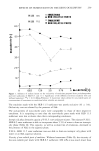
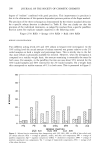
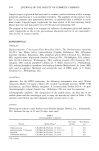
300 JOURNAL OF THE SOCIETY OF COSMETIC CHEMISTS Table II Differences between Products at the 99% Confidence Level __ __ /NA + NB l) X A - X•---ts ¾ •-N• 2) S = •SA 2 "• SB 2 3)(NA + NB -- 2) = 12---• t = 3.06 A-B A-D A-C B-D B-C D-C 20.9 ñ 9.7 21.5 ñ 11.5 49.8 ñ 11.8 0.60 + 11.9 28.9 + 12.2 28.3 ñ 13.7 Thus at the 99% confidence limit, product A was significantly more effective than B, C or D B was equal to D and all products were superior to C. respect to background levels (Table I). Larger negative AR-SH values reflect greater efficacy. In the initial experiments using BDC-OH as a colormetric reagent all AR- SH readings of + 10% or greater were rejected as resulting from non-homogenous mixtures. Later experiments established that mild sonication previous to incubation would eliminate this error. The sanguinaria extract used in this study, obtained by extraction of the rhizome of Sang•inaria canadensis, contained approximately 80% mixed benzophenanthridine al- kaloids, predominantly sanguinarine and chelerythrine chlorides. RESULTS The measured reduction of thiols available to react with BDC + in fermented saliva collected post- versus pre-product usage was as follows: Product A, 65.4% ___ 4.0 Product B, 44.5% + 5.5 Product C, 15.6% + 6.0 and Product D, 43.9% + 5.8 (Table I). These reductions may be attributed to lowered bacterial levels, inhibition of residual bacterial populations, and/or, where applicable, precipitation of thiols which were covalently trapped by residual actives and removed by centrifugation previous to BDC + analysis. Amounts of reactive thiol lost to oxidation in the pre-anaerobic stages of sealed tube incubation and subsequent oxygen exposure during BDC q- analysis were assumed to be approximately constant from sample to sample. While this assumption introduces a degree of error into the absolute amounts of reactive sulfur measured, it has little impact on the relative differences observed between products (Table II). DISCUSSION Product D containing the antibacterial mixture of cetylpyridinium chloride and dom- iphen bromide significantly reduced VSC levels in saliva collected post-product use and fermented as did Product B containing zinc chloride. Zinc ion has been documented
Purchased for the exclusive use of nofirst nolast (unknown)
From: SCC Media Library & Resource Center (library.scconline.org)