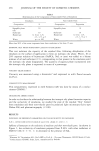
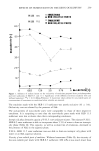
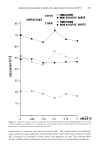
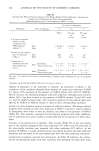
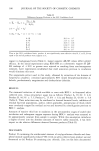
ORAL VOLATILE SULFUR COMPOUNDS 301 Ill R = H, Alkyl, Enzyme Figure 2. Reaction of sanguinarine with volatile sulfur compounds to affect neutralization. as an effective VSC control agent which appears to diminish VSC levels via the formation of insoluble zinc sulfides (2). Thus rinses capable of lowering populations of anaerobic VSC-producing bacteria or those capable of covalently trapping their metabolic by-product, VSC, were consistently effective. The most effective rinse in this screen, that which contained sanguinaria extract with zinc ion, combined the potential to act in a two-fold manner, both via antimicrobial activity and covalent thiol trapping (5,11 Figure 2). Sanguinaria extract has been demonstrated as having significant bacteriastatic potential and, like zinc ion, its alkaloidal constituents have been shown to be retained in the oral cavity for periods of several hours after product usage, most notably in dental plaque, salivary sediment, and on the surface of the tongue (7,11). In the iminium ion form, benzophenanthridine alkaloids of the sanguinarine type have been determined as covalently binding with reactive sulfhydryls (5). We postulate that residual zinc ion complemented by residual benzophenanthridine alkaloids could trap VSCs as they are generated or, more poignantly, tie up sulfur substrates rendering them metabolically unavailable for VSC production. The product containing "essential oils" with moderate bacteriastatic properties exhib- ited marginal effectiveness in this screen. REFERENCES (1) A. A. Rizzo, The possible role of hydrogen sulfide in human periodontal disease. Hydrogen sulfide production in periodontal products, Periodontics, 5(5), 223-236 (Sept/Oct 1967). (2) J. Tonzetich, Oral malodor: An indicator of health status and oral cleanliness, Int. Dent. J., 28, 308-319 (1978). (3) J. Tonzetich: Reaction of H2S and CH$SH with oral mucosa, J. Dent. Res., (Abstract #HS), 63, 163 (1984). (4) J. Tonzetich and P. W. Johnson: Irreversibility of CH3SH-induced inhibition of protein synthesis in fibroplasr cultures, J. Dent. Res., (Abstract #166), 63, 189 (1984). (5) D. Walterova, J. Ulrichova, V. Preininger, V. Simanek, J. Lenfeld, and J. Lasovsky: Inhibition of liver alanine aminotransferase activity by some benzophenanthridine alkaloids, J. Med, Chem. 24, 1100-1103 (1981).

302 JOURNAL OF THE SOCIETY OF COSMETIC CHEMISTS (6) M. S. Rohrbach, B. A. Humphries, F. J. Yost, W. G. Rhodes, S. Boatman, R. G. Hiskey, and J. H. Harrison: The reaction of 4,4'-bis(dimethylamino)diphenylcarbinol with the sulfi•ydryl group, Anal. Blochem., 52, 127-142 (1973). (7) G. L. Southard, R. T. Boulware, D. R. Walborn, W. J. Groznik, E. M. Thorne, and S. L. Yankell: Sanguinarine, a new antiplaque agent: Retention and plaque specificity, J. Am. Dent. Assoc., 108, 338-341 (1984). (8) J. Afseth: Some aspects of the dynamics of Cu and Zn retained in plaque as related to their effect on plaque pH, Scand. J. Dent. Res., 91, 169- 174 (1983). (9) C. A. 98:50019g (1983) Color indicator for bad breath: Kao Soap Co., Ltd., Japan, Kokai to Kkyo Koho. JP 57,135,360 (82,135,360) (C1.GOIN33/50) 20 Aug 1982, appl. 81/21,278, 16 Feb 1981. (10) H. Cerna, S. Fiala, and E. Lenfeld: Isoquinoline alkaloids in local periodontal disease therapy. Acta Universitatis Palackianae Olomucensis TOM, 107 Facultatis Med., 159, 161 (1984). (11) S.S. Socransky and J. L. Dzink: Comparative in vitro activity against oral microbial isolates, Antimic Agents & Chemo., 27:663-665 (1985).
Purchased for the exclusive use of nofirst nolast (unknown)
From: SCC Media Library & Resource Center (library.scconline.org)