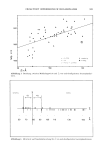
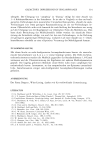
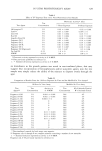
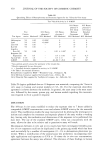
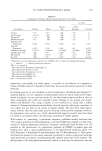
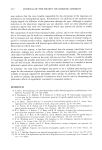
OLFACTORY IMPRESSIONS OF ISOCAMPHANES 391 tibergeht. Der l•bergang von "camphrig" in "blumig" erfolgt bei einer Anzahl yon 3-4 Kohlenstoffatomen in der Seitenkette. Es ist also in ¾ergleich zu den exo-konfi- gurierten ¾erbindungen kein wesentlicher Unterschied festzustellen, obwohl die endo- Verbindungen eine etwas geringere Raumausdehnung als die exo-Verbindungen be- sitzen. Offensichtlich wirkt sich demnach die endo-Stellung der Seitenkette nur wenig auf den 13bergang yon der Kugelgestalt zur elliptischen Form des Moleki_ils aus. Dies kann durch Betrachtung der Moleki51modelle erkNrt werden: die riiumliche Orien- tierung der Seitenkette erfolgt, wie auch bei den exo-¾erbindungen, in die Richtung der geringsten gegenseitigen Behinderung, wodurch es ab einer Anzahl yon 3-4 Koh- lenstoffatomen ebenfalls zu einer elliptischen Verzerrung der Molektilgestalt kommt. ZUSAMMENFASSUNG Mir dieser Studie an endo-konfigurierten Isocamphanderivaten konnte die stereoche- mische Geruchstheorie yon A m o o r e erneut bestiitigt wetden. Mir Hilfe des Schat- tenkorrelationstestes wurden die Molektile gegenCtber der Standardsubstanz 1,8-Cineol vermessen und die l•bereinstimmung der Ergebnisse mir anderen Molektilparametern gepriift. Die kugelig geformten Molekale dieser Reihe rufen einen camphrigen Ge- ruchseindruck hervor. Interessante, zu den entsprechenden exo-Epimeren unterschied- fiche, Geruchsnuancen einiger endo-konfigurierter Isocamphanverbindungen wurden gefunden. ANERKENNUNG Der Firma Dragoco, Wien-Liesing, danken wir ftir wohlwollende UnterstiStzung. LITERATUR (1) (2) (3) (4) (5) (6) (7) (8) (9) (10) (12) (13) (14) G. Buchbauer und M. Wiltschko, J. Soc. Cosmet. Chem. 29, 307 (1978). J. E. Arnoore, Molecular Basis of Odor (Charles C. Thomas Publ., Springfield, 1970). Cavalli-Sforza: Biometrie, Grundztige biolog. reed. Statistik (G. Fischer Verlag, Stuttgart, 1972). G. Buchbauer, R. Vitek, M. C. Hirsch, Ch. Kurz, B. Cech, und E. M. Vas, Monatsh. Chem., 113, 1433 (1982). R. Vitek und G. Buchbauer, Monatsh. Chem., M6, 801 (1985). H. Reckhard, Erdb'lundKohle, 11, 234 (1958). S. Nametkin, Ann. Chem., 438, 185 (1924). G. W. Hana, Dissertation, Universitiit Wien, 1971. S. Beckmann und B. Geiger, Chem. Ber. 94, 1910 (1961). G. Buchbauer, Monatsh. Chem., 109, 3 (1978). W. Ipatiev, Ber. dtsch. chem. Ges., 45, 3206 (1912). G. Komppa, Ann. Chem., 366, 75 (1909). O. Aschan, Ber, dtsch. chem. Ges., 41, 1092 (1908). J. E. Arnoore und D. J. Venstrom, FoodSci., 31, 118 (1966).

j. Soc. Cosmet. Chem., 36, 393-411 (November/December 1985) Physical stability of suspensions JOEL L. ZATZ, Rutgers College of Pharmacy, P.O. Box 789, Piscataway, NJ 08854. Received June 25, 1985. Presented at Scientific Session I, "Suspension Technology," Annual Scientific Seminar, Society of Cosmetic Chemists, May 9, 1985. Synopsis Because of their inherent lack of stability in a thermodynamic sense, the "stability" of suspensions must be described in terms of a time frame and the properties of greatest importance. Thorough wetting and particle dispersion are important first steps in the formation of uniform suspension systems. The critical surface tension of the solid provides guidance in the selection of surfactants used to promote wetting. Contact angles on powders may be measured by several techniques that overcome the problems of surface roughness and particle dissolution. Particle size, density difference between particles and medium, and rheology of the medium are important factors in sedimentation. Viscosity can be adjusted within wide limits so as to modify the sedimentation rate. However, the type of flow behavior is of utmost importance. Materials chosen as suspending agents must provide resistance to sedimentation while still permitting high shear operations such as shaking and pouring. Particle flocculation affects sedimentation rate as well as the degree of compaction that takes place within the sediment. In general, coarse deflocculated systems settle as individual particles to form a "caked" sediment, one which is extremely difficult or impossible to resus- pend. Caking may be prevented by designing suspensions with a structured network that supports the particles and keeps them from entering a close-packed array. The network may consist of suspending agent (structured vehicle), the particles themselves (flocculated), or a combination of the two. INTRODUCTION Most cosmetic suspensions are coarse dispersions with particles in the micrometer range. The existence of an interface between the dispersed and continuous phases raises the free energy relative to that of the separate phases. Since disperse systems in general, and suspensions in particular, are therefore unstable in the thermodynamic sense, we must understand that the word "stability" as used in the title of this paper refers to a situation in which critical suspension properties do not change measurably over some arbitrary period of time. As various products differ in nature, intended application, and use conditions, the properties that are of greatest importance must be identified. Thus we can talk about stability with relation to, as examples, sedimentation or flocculation or caking. It is best to be specific otherwise confusion may result. Because of the complexity of suspensions, many changes can take place during and 393
Purchased for the exclusive use of nofirst nolast (unknown)
From: SCC Media Library & Resource Center (library.scconline.org)