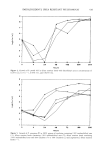
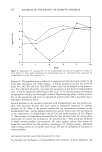
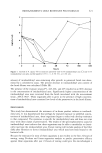
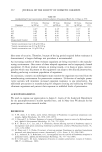
j. Soc. Cosmet, Chem,, 36, 413-423 (November/December 1985) Resistance of Pseudomonas strains to imidazolidinyl urea PATRICIA I. BOWMAN and SUSAN M. LINDSTROM, Avon Products, I.c., Suffer., NY 10901. Received August 21, 1985. Presented at the Annual Scientific Seminar of the Society of Cosmetic Chemists, May 1985, St. Louis, MO. Synopsis Five strains of Pseudomonas, isolated from cosmetic products, demonstrated resistance to high concentrations of imidazolidinyl urea. The resistance of the organisms to various concentrations of the preservative was tested by dissolving the compound in 0.1% nutrient broth. After a 24-hour lag period, all product isolates survived and grew in at least 2.0% imidazolidinyl urea. Two strains grew well in 6% imidazolidinyl urea. Similar growth patterns were demonstrated in simple oil-in-water emulsions, preserved with imidazoli- dinyl urea. The addition of the emulsion only slightly enhanced the growth of the organisms in the presence of imidazolidinyl urea. Pre-incubation of the organisms in broth or the emulsion containing the preservative eliminated the 24-48 hour lag phase before growth occurred. The non-resistant strain, Pseu- domonas aeruginosa ATCC 9027, could not be adapted to grow in the presence of the preservative. After 21 days of incubation, the imidazolidinyl urea content of the broth inoculated with the resistant strains decreased by at least 80%. The decrease of imidazolidinyl urea in inoculated broth was chemically deter- mined through a spectrophotometric assay after degrading the imidazolidinyl urea to formaldehyde and converting the formaldehyde to a UV-absorbing lutidine derivative. It is hypothesized that the resistant organisms are able to metabolize or chemically bind imidazolidinyl urea. INTRODUCTION It has been well documented that Pseudomonas species are able to develop resistance to antimicrobials either by natural selection or mutation. For example, Pseudomonas has demonstrated resistance to quaternary ammonium compounds (1), p-hydroxybenzoic acid esters (2) mercurials (3,4), and iodophors (5). Orth and Lutes (6) and Borovian (7) demonstrated the adaptability of P. aeruginosa and P. cepacia to several commonly used cosmetic preservatives. Pseudomonas species continue to be encountered as contaminants in cosmetic products (8). Therefore, it is imperative that cosmetic preservatives demon- strate activity against these ubiquitous organisms. One cosmetic preservative, ranked by the FDA as the third most frequently used, is imidazolidinyl urea (9). This broad spectrum compound has been shown to be effective against several types of microorga- nisms, including Pseudomonads (10, 11). However, in this laboratory we have encoun- tered strains of Pseudomonas which survive and grow in cosmetic formulations preserved with imidazolidinyl urea. Examination of an isolate resistant to imidazolidinyl urea began in this laboratory during the development cycle of a moisturizer preserved with imidazolidinyl urea (0.3%) and methyl paraben (0.3%). A challenge test organism, Pseudomonas aeruginosa, was recovered from the product after eight weeks of incubation. The organism had not 413

414 JOURNAL OF THE SOCIETY OF COSMETIC CHEMISTS been recovered from the product during any of the previous seven weeks of incubation and sampling. The minimum inhibitory concentration (MIC) of imidazolidinyl urea was determined for the organism taken directly from the product and compared to the MIC for the same organism after it was routinely maintained on a laboratory medium. The laboratory grown strain was killed by a 2% solution of imidazolidinyl urea, while the same organism, taken directly from the product, required 4% imidazolidinyl urea to be killed. In addition, both strains demonstrated a lag time of 72 hours before growing at the subcidal concentrations. Several product isolates from our culture collection were subsequently examined to as- sess their resistance to imidazolidinyl urea. Kill rate studies with six typical Pseudomonas strains produced a variety of resistance patterns. The study was extended to examine growth patterns in simple cosmetic emulsions preserved with imidazolidinyl urea. Ana- lytical methods for the detection of imidazolidinyl urea in growth media were used to support the hypotheseis that the resistant Pseudomonads were able to metabolize or chemically bind the imidazolidinyl urea compounds, thereby allowing the organisms to reproduce in the presence of the preservative. METHODS Pseudomonas aeruginosa (ATCC 9027) and five product isolates Pseudomonas putida (P6), Pseudomonas aeruginosa (P5), Pseudomonas cepacia (445), Pseudomonas putida (495), and Pseudomonas cepacia (RC) were selected for these studies. Stock cultures were maintained on nutrient agar slants at 25øC or 4øC. The inoculum for each study was prepared by growing the cultures for 18-24 hours in Brain Heart Infusion broth at 35øC. The cell suspensions were centrifuged, washed, and resuspended in 0.85% saline and adjusted to the proper optical density using a Bausch & Lomb Spectronic 20 Colorimeter. The inoculum levels were reconfirmed with a total plate count using nutrient agar. In all studies, the assay diluent was dilute (1/10 strength) nutrient broth and the plating medium was nutrient agar containing 2% Tween 80. MINIMUM INHIBITORY CONCENTRATION TEST (MIC) All test organisms were first screened for resistance to imidazolidinyl urea using a modi- fication of the phenol coefficient test, similar to that described by Berke & Rosen (11). Solutions containing from 0.25% to 8% imidazolidinyl urea in dilute nutrient broth were challenged with 105 cfu/ml. These inoculated solutions were incubated at 35øC and examined for turbidity at 2, 7, and 14 days after inoculation. Additionally, at each test interval, a loopful of the test solutions was transferred into AOAC letbeen broth which was incubated for two weeks at 35øC and examined for turbidity at 24-hour intervals for 14 days. Additional MIC tests were performed with other cosmetic preservatives including: dia- zolidinyl urea (0.05, 0.1, 0.2, 0.5%), formalin (0.05, 0.1, 0.2, 0.4%), quaternium 15 (0.05, 0.1, 0.2, 0.5%), and chlorhexidine gluconate (0.05, 0.1, 0.2, 0.4, 0.8%). GROWTH PATTERNS IN IMIDAZOLIDINYL UREA BROTH Imidazolidinyl urea solutions, at concentrations of 0.5, 1.0, 2.0, 4.0, and 6.0% were
Purchased for the exclusive use of nofirst nolast (unknown)
From: SCC Media Library & Resource Center (library.scconline.org)