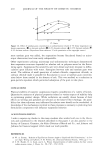
398 JOURNAL OF THE SOCIETY OF COSMETIC CHEMISTS particles and medium. The steady state sedimentation velocity (v) for noninteracting spherical particles is given by Stokes' equation (Eq. 3). 2R2 (P - Po)g v = (Eq. 3) 18 qq In this equation, R is particle radius, p and Po are the particle and medium densities, respectively, and g is the gravitational constant. In most practical coarse dispersions the particles are not spherical and, more importantly, collisions and charge interactions between particles result in interference with free settling. Consequently, Stokes' equa- tion does not usually predict actual sedimentation rates. Nevertheless, the factors men- tioned in Eq. 3, i.e. particle size, difference in density between particle and medium, and viscosity, are relevant. DENSITY MATCHING If the densities of liquid and solid could somehow be made equal, there should be no sedimentation at all since both phases in the suspension would be affected by gravity to the same extent. Once the solid is selected, its density cannot be altered. However, it is possible to increase liquid density by dissolving certain adjuvants in the medium and thereby bringing the liquid density closer to, or perhaps equal to, that of the dispersed solid. Polyols, such as sorbitol, are used for this purpose. While sedimentation rate may be reduced, it is seldom possible to prevent sedimentation altogether, either because too much polyol would be required or because the particle density is too high for density matching to be accomplished. PARTICLE EFFECTS As sedimentation velocity is proportional to particle diameter raised to a power, reduc- tion of particle size may be expected to slow sedimentation considerably. In practice, it is difficult to produce particles much below one micrometer. Typical suspension products may have mean particle sizes of about 1 to 20 micrometers. Stokes' equation applies to a single particle and is thus relevant to very dilute suspen- sions. In suspensions with an internal phase concentration greater than about 1%, sedi- menting particles may be held back by others that are falling at a slower rate. This process, referred to as hindered settling, results in an overall reduction in the rate of sedimentation. Another complication is flocculation of particles within a suspension to form larger clusters which settle much more rapidly than the primary particles of which they are composed. Flocculation as a means of preventing caking is discussed more fully below. RHEOLOGY While density matching and particle size adjustment have their place in suspension design, manipulation of rheological characteristics probably furnishes the formulator with the means of exercising the greatest control over sedimentation. The choice of product rheology and of bodying agent depends to a large extent on the type of medium and its intended application.

SUSPENSION STABILITY 399 If the suspension medium is composed principally of a viscous material such as glycerin, additional materials to augment resistance to flow may not be necessary. If the medium is a nonviscous liquid such as water, different bodying agents may be selected de- pending on the desired application characteristics. For example, a skin lotion should be sufficiently fluid to permit adequate shaking of the container and good pourability yet it should also provide sufficient resistance to sedimentation while the product is standing. This combination of desired properties makes Newtonian additives, in- cluding glycerin, unsuitable as principal ¾iscosity builders because a concentration high enough to affect sedimentation significantly would make the product too viscous at the high shear generated by shaking or pouring. It is best in such cases to choose agents which confer non-Newtonian characteristics to the medium. This gives us high viscosity and structural resistance to sedimentation under the low shear conditions found in a suspension at rest, coupled with a much lower viscosity under high shear conditions. Useful types of flow behavior include pseudo- plastic, plastic and, with qualification, thixotropic. PSEUDOPLASTICITY The viscosity of pseudoplastic liquids is inversely related to shear rate. At very low and very high shear rates, the viscosity may reach limiting values (7). Apparent viscosity of a pseudoplastic fluid (shear stress divided by shear rate) may often be described by the power law equation (7): 'qA = qqs ø"• • (Eq. 4) In Equation 4, qq^ is apparent viscosity, qqs is the viscosity at a shear rate of 1 s-•, and o' is shear rate. Other equations for viscosity of pseudoplastic systems have been pro- posed (7,8). Stokes' equation was derived with the assumption that the medium has a constant viscosity (in other words, the medium is Newtonian). For pseudoplastic media, Charm and McComis (9) substituted the apparent viscosity for the viscosity term in the Stokes equation. The shear rate in a suspension of particles that are settling depends on the sedimentation rate apparent viscosity is a function of shear rate sedimentation rate is inversely proportional to apparent viscosity. Thus, by repetitively solving three equa- tions, it was possible to calculate a rate of sedimentation. A similar idea was utilized by Torrest (10) who used sedimentation measurements to calculate the viscosity of hydroxy- ethyl cellulose at low shear. The maximum shear rate for a sedimenting sphere is given by Eq. 5 (11): 3v {r -- (Eq. 5) 2R Assuming that we have a power law liquid and combining Eq. 3-5 leads to Eq. 6: 2 R (n+ •) (p - po)gl•/• v = - (Eq. 6) 9 Xls 3 (n- •) This equation was previously derived by Daneshy (12). According to Eq. 6, for a power law liquid, sedimentation velocity is not proportional simply to the difference in den-
Purchased for the exclusive use of nofirst nolast (unknown)
From: SCC Media Library & Resource Center (library.scconline.org)