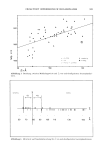
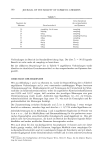
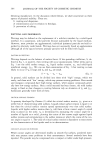
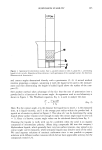
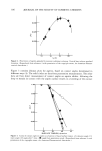
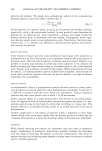
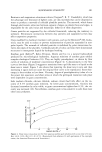
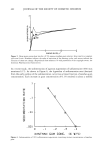
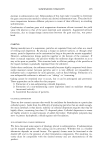
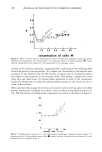
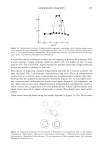
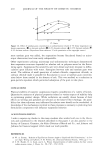
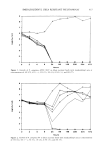
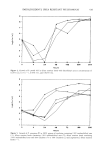
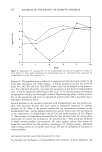
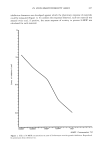
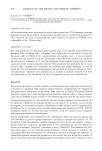
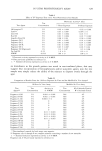
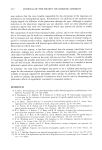
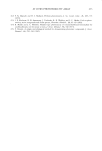
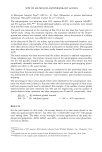
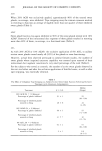
IMIDAZOLIDINYL UREA RESISTANT PSEUDOMONAS 419 8 • 3 2 0 4 24 48 168 336 50, Hours Figure 4. Growth of P, putida 495 in dilute nutrient broth with diazolidinyl urea at concentrations of: 0.25% ([•), 0.1% (--), 0.05% (¸), and 0.025% (A). 8 - 7- 6- 5 3 2- 1 I I I I I 0 4 24 48 72 168 336 Hours Figure 5. Growth of P. aerugino•a P5 in 100% peanut oil emulsion containing 2.0% imidazolidinyl urea (x), dilute nutrient broth containing 2.0% imidazolidinyl urea ([•), dilute nutrient broth containing 2.0% imidazolidinyl urea and 10% emulsion (¸) or 30% emulsion (/•) and unpreserved, dilute nutrient broth (--).

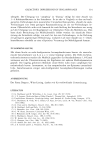
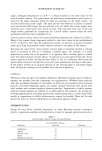
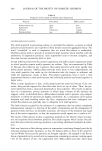
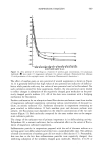
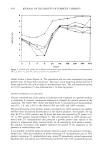
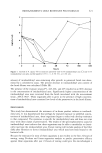
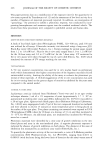
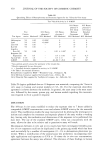
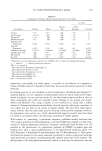
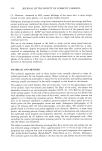
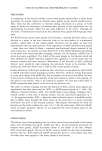
420 JOURNAL OF THE SOCIETY OF COSMETIC CHEMISTS 8 7 6 5 4 '• I I I I 0 1 2 ,3 7 Days Figure 6. Adaptation of P, aeruginosa P5 to 2.0% imidazolidinyl urea after pre-incubation in dilute nu- trient broth (V•), dilute broth containing 1% irnidazolidinyl urea (+), and dilute broth containing 1% imidazolidinyl urea and 105• emulsion (0). (Figure 6). The population pre-incubated in unpreserved broth decreased rapidly for 48 hours after inoculation into 100% product. A similar adaptation pattern was noted for strain 495, RC, P6, and 445. The ATCC strain could not be adapted to the preserva- tive. The cells died off rapidly, even after pre-incubation in low levels of imidazolidinyl urea. A similar adaptation phenomenon may occur in the manufacturing environment on equipment which is not thoroughly cleaned. Organisms may adapt to dilute product left on the equipment and enter an exponential growth phase when inoculated into a subsequent production batch. Growth patterns in the emulsion preserved with imidazolidinyl urea and methyl par- aben were measured because this dual system is frequently employed in cosmetic products (6, 10). Most of the product isolates did not demonstrate resistance to the imidazolidinyl urea, methyl paraben preservative system. Only strain 445 was resistant to the combination of imidazolidinyl urea (0.5%) and methyl paraben (0.3%) (Figure 7). The resistant cell population decreased for the first 48 hours from 104 cfu/ml down to less than 10 cfu/ml, but increased to 105 cfu/ml by day 7. This strain was inhibited at higher methyl paraben concentrations. All other product isolates died within 24 hours after inoculation into the products containing 0.3% methyl paraben. Additional work is being carried out to further study strain 445 and its mechanism of resistance to methyl paraben. SPECTROPHOTOMETRIC ASSAY FOR IMIDAZOLIDINYL UREA To elucidate the mechanism of imidazolidinyl urea resistance in these organisms, the
Purchased for the exclusive use of nofirst nolast (unknown)
From: SCC Media Library & Resource Center (library.scconline.org)