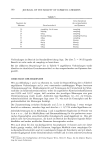
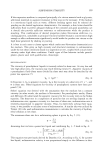
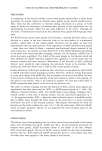
394 JOURNAL OF THE SOCIETY OF COSMETIC CHEMISTS following manufacture. In the discussion which follows, we shall concentrate on three aspects of physical stability. These are: 1) wetting and dispersion. 2) sedimentation and its relation to rheology. 3) prevention of caking. WETTING AND DISPERSION Wetting may be defined as the replacement of a solid-air interface by a solid-liquid interface. In a suspension, solid particles become surrounded by the liquid medium. However, most powders are agglomerated individual (primary) particles are held to- gether by relatively weak bonds. Wetting does not necessarily break up agglomerates although all of the spaces between primary particles will be filled with liquid. FACTORS IN WETTING Wetting depends on the balance of surface forces. If the spreading coefficient, S, de- fined in Eq. 1, is positive, then wetting will occur spontaneously. Other terms used in Eq. 1 are the solid surface energy, 'Ys, liquid surface tension, 'y•., and solid-liquid interfacial energy, 'YL/S- We can see from examination of Eq. 1 that wetting is more likely to occur if 'Ys is large and % and %/s are small. S = Ys - YL -- %/S (Eq. 1) In general, solid surfaces can be divided into those with "high" energy, which wet easily, and those with "low" energy, which may present wetting problems. Most metals and inorganic compounds have high energy surfaces, while organic compounds gener- ally have low energy surfaces. Once a solid material has been chosen, the solid surface energy is fixed so that changes in wetting behavior rely on alteration of % and 'YL/s. Surfactants generally lower both of these. CRITICAL SURFACE TENSION A quantity developed by Zisman (1) called the critical surface tension, 'Yc, gives us a useful way of characterizing solid surfaces. Liquids whose surface tension is equal to or less than the critical surface tension spread spontaneously over that solid surface. Liquids with higher surface tension than 'Yc will form a finite contact angle if a small drop is placed on the solid. 'Yc is determined by measuring the contact angle for a number of liquids on a solid, plotting the cosine of the contact angle against liquid surface tension and extrapolating to the surface tension at which the cosine of the con- tact angle is equal to 1. The value of critical surface tension is dependent to some extent on the characteristics of the liquids used in its determination. CONTACT ANGLES ON POWDERS While contact angles are determined readily on smooth fiat surfaces, powdered mate- rials may present some problems in their measurement. Several methods have been reported. The powder may be compressed into a compact or tablet under high pressure,

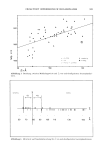
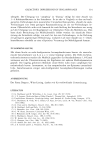
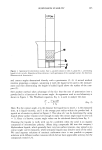
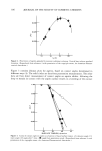
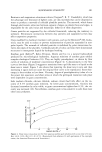
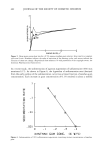
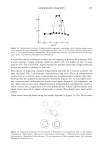
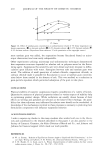
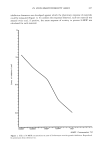
SUSPENSION STABILITY 395 -1.9CM 4 Figure 1. Apparatus for penetration studies. Key: a, packed column in tube b, glass flit c, penetrating liquid d, slit in tube. (Reproduced from reference 4 with permission of the copyright owner, the American Pharmaceutical Association.) and contact angles determined directly with a goniometer (2-4). A second method involves preparing a compact, saturating it with the liquid to be used in the measure- ment and then determining the height of added liquid above the surface of the com- pact (5). Still another method takes advantage of the fact that the rate of penetration into a powder bed is a function of the contact angle. An apparatus used in our laboratory is shown in Figure 1. The Washburn equation, Eq. 2, is used to analyze the data: d 2 F •/LCOSO -- t 2'q (Eq. 2) Here, 0 is the contact angle, d is the distance the liquid has to travel, t is the measured time, v I is liquid viscosity, and • is the average pore radius within the powder bed. A typical set of results is plotted in Figure 2. The value of r can be determined by using liquids whose surface tension is low enough to make the contact angle equal to zero (cos = 1). Once r is known, contact angle values can be calculated directly from Eq. 2. Choosing the liquids to work with can be a problem when the solid is an organic compound of intermediate polarity. (Many drug compounds fall into this category.) Hydrocarbon liquids, which generally have very low surface tensions, may spread so no contact angle can be measured, while semipolar liquids may dissolve some of the solid. We used aqueous solutions of nonionic surfactants since it was possible to prepare solutions with different surface tensions which did not have appreciable solvency for the compounds tested (3,4).
Purchased for the exclusive use of nofirst nolast (unknown)
From: SCC Media Library & Resource Center (library.scconline.org)