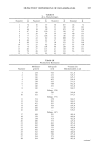
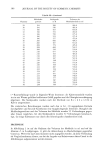
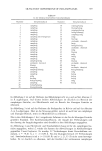
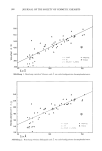
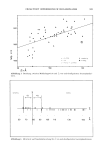
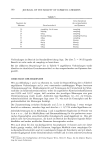
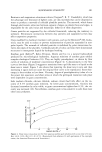
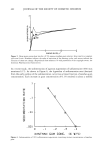
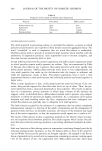
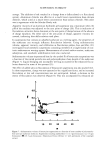
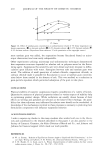
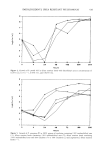
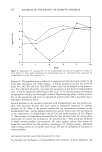
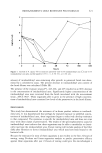
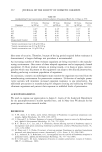
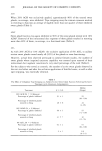
SITE OF ALUMINUM ANTIPERSPIRANT ACTION 439 DISCUSSION A comparison of the data for axillary eccrine sweat glands reported here to those found previously for similar studies on forearm sweat glands reveals several notable points. First, there was less uniformity in response among individuals in a group. A wider range of values for restoration of sweating after removal of the intracorneal duct by tapestripping was found. There was also some difference in the extent, although not the order, of restoration to function for the inhibited sweat glands following tape strip- ping. For ACH-treated eccrine sweat glands on the forearm, sweating had been shown to be blocked at a point in the duct relatively close to the skin surface in a substantial number--about half--of the treated glands. However, for the axilla, we have now demonstrated that the major portion of the population of ACH-inhibited sweat glands --more than two thirds of them--remained non-functional despite removal of the intracorneal duct. In contrast, less than half (41%) of the AZAP-inhibited sweat glands in the axilla were reactivated after stripping, whereas, for the forearm, AZAP's site of action was quite superficial. Two thirds of the sweat glands on the forearm which had been inhibited by AZAP treatment regained their capability to excrete sweat after the stratum corneum had been removed. Restoration of the function of A1Cl•-inhibited forearm sweat glands by tape stripping was previously found to be minimal. That finding has now been shown also to hold for the eccrine glands of axilla. Further definition of the depth within the duct of axillary eccrine glands to which ACH or AZAP penetrated awaits histological studies. However, ACH on average functioned not only more deeply than AZAP did, but its primary site of action was below the level of the stratum corneum in the majority of the sweat glands to which it was applied. At this point in our studies, there is no evidence to support the view that either ACH or AZAP penetrated these glands to the level of the secretory coil. The extent to which stripping restored the function of A1Cl•-treated sweat glands was significantly less than that found for ACH- or AZAP-treated glands (p .001). The difference observed between ACH- and AZAP-treated sweat glands, although direc- tionally similar to that seen in forearm studies, was not statistically significant (p ß 2). As suggested earlier, A1C13, a relatively small molecular species, is probably readily able to diffuse down through the distal region of the sweat duct to a point invariably well below the level of the stratum corneum. Histological observations for both the forearm and the axilla confirm this view (3,6,7). On the other hand, ACH and AZAP, which are larger polymeric species, do not penetrate the more proximal region of the sweat glands as readily. CONCLUSIONS The relative sites of antiperspirant activity within the eccrine sweat glands of the human axilla were determined for ACH, AZAP and A1CI•. As demonstrated previously for forearm sweat glands, AZAP functioned closest to the surface of the skin, whereas A1C13 acted most deeply. The site of ACH's activity within the duct was intermediate between the two. Both ACH and AZAP blocked the ducts at a level deeper than they did when they were applied to the sweat glands of the forearm.

440 JOURNAL OF THE SOCIETY OF COSMETIC CHEMISTS ACKNOWLEDGMENTS Gratitude is expressed to George Korkis for his contribution to the photography aspects of these studies. REFERENCES (1) R. P. Quatrale, A. H. Waldman, J. G. Rogers, and C. B. Felger, The mechanism ofantiperspirant action by aluminum salts. I. The effect of cellophane tape stripping on aluminum-salt inhibited eccrine sweat glands,J. Soc. Cosmet. Chem., 32, 67-73 (1981). (2) H. H. Relier and W. L. Luedders, Pharmacologic and toxicologic effects of topically applied agents on the eccrine sweat glands. Part II. Mechanisms of action of metal salt antiperspirants, Adv. Mod. Tox., 4, 18-54 (1977). (3) E. Holzle and A.M. Kligman, Mechanism antiperspirant action of aluminum salts, J. Soc. Cosmet. Chem., 30, 279-295 (1979). (4) R. P. Quatrale, D. W. Coble, K. L. Stoner, C. B. Felger, The mechanism of antiperspirant action by aluminum salts. II. Histological observations of human eccrine sweat glands inhibited by alu- minum chlorohydrate, J. Soc. Cosmet. Chem., 32, 107-136 (1981). (5) Ibid. III. Histological observations of human eccrine sweat glands inhibited by aluminum zirconium chlorohydrate glycine complex, J. Soc. Cosmet. Chem., 32, 195-221 (1981). (6) Ibid. Unpublished observations on the site of action of A1Cl•-inhibited sweat glands. (7) E. Holzle and O. Braun-Falco, Structural changes in axillary eccrine glands following long-term treatment with aluminum chloride hexahydrate solution, Brit. J. Derre., 110, 399-403 (1984).
Purchased for the exclusive use of nofirst nolast (unknown)
From: SCC Media Library & Resource Center (library.scconline.org)