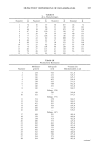
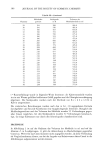
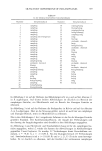
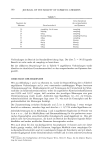
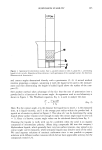
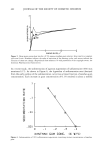
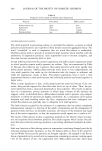
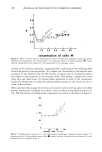
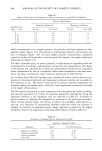
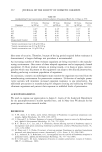
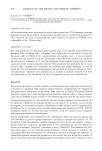
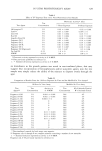
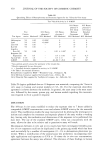
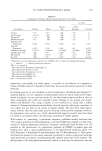
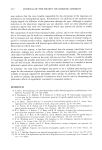
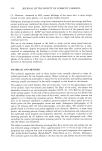
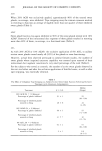
408 JOURNAL OF THE SOCIETY OF COSMETIC CHEMISTS Table III Degree of Flocculation of Suspensions in Water Containing 5 g of Solid/100 ml Medium Degree of Flocculation Aluminum Hydroxide Magnesium Carbonate Xanthan Gum (Conc., % w/v) No Salt 0.9% NaCI No Salt 0.9% NaC1 0 3.6 4.6 1.4 1.4 0.03 5.7 4.8 2.0 1.7 0.10 6.4 5.6 2.1 1.9 0.15 6.4 6.5 2.1 - 0.20 6.8 6.3 2.2 2.7 small concentrations or no polymer present, the particles were kept separate by their negative charge (Figure 1 la). Flocculation at intermediate polymer concentrations was due to bridging (Figure l lb). At much higher polymer concentrations, adsorption caused the surface of the particles to become positively charged, once again resulting in defiocculation (Figure 1 lc). The effect of xanthan gum, an anionic polymer, on flocculation of suspended solids was investigated by microscopy, sedimentation, and particle size measurements. The degree of flocculation was calculated by dividing the sedimentation volume for the suspension under consideration by that of a completely deflocculated suspension of the same mate- rial at the same concentration. Some values are reproduced in Table lit (30). As is evident from Table ttt, xanthan gum increased the extent of flocculation in sus- pensions of aluminum hydroxide and magnesium carbonate whether salt was added to the suspension or not. The extent of flocculation of calcium carbonate suspensions was increased slightly by xanthan gum, while zinc oxide suspensions experienced a decrease in the degree of flocculation. The flocculation mechanism in these suspensions was investigated by studies of adsorp- tion an d zeta potential (31). Values of saturation adsorption, obtained by fitting the Langmtiir isotherm to the adsorption data are collected in Table IV. A number of factors combine to influence the adsorption of polymers at the solid-liquid interface. These include polymer shape, the amount of surface area available, solid-polymer at- traction, and repulsion of neighboring adsorbed molecules when the polymer is charged. A reduction in polymer-polymer charge repulsion accounted for the higher adsorption observed in suspensions containing added sodium chloride (Table IV). Table IV Adsorption of Xanthan Gum by Pharmaceutical Solids Substance Saturation Adsorption, mg/g Water 0.9% NaC1 Solution Magnesium carbonate Aluminum hydroxide Calcium carbonate Zinc oxide 6.67 16.6 3.59 4.55 9.83 22.6 11.1 7.30

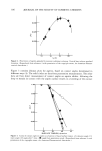
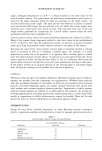
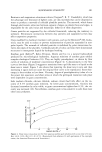
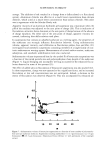
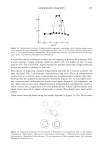
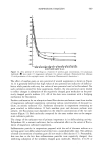
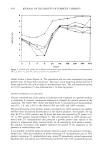
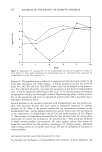
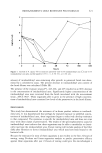
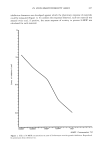
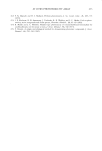
SUSPENSION STABILITY 409 30 20 • •o --30 0 0 I I I I I • ! I ! I 0,02 0.04 0.06 0,08 0.1 0.12 0.14 0.16 0.!8 0.20 XANTHAN GUM, % w/v Figure 12. Zeta potential of solid drugs as a function of xanthan gum concentration. ([•) aluminum hydroxide (O) zince oxide (¸) magnesium carbonate (/•) calcium carbonate. (Reproduced from reference 31 with permission of the copyright owner, the American Pharmaceutical Association.) The effect of xanthan gum on zeta potential of several suspensions is shown in Figure 12. It is generally believed that high values of zeta potential are indicative of defloccu- lation while particles with very low values of zeta potential tend to be flocculated. No such correlation existed for these suspensions. Rather, the zeta potential curves tended to reflect changes in adsorption of the negatively charged gum molecules on the posi- tively charged particle surfaces (31). All of the data were consistent with a bridging mechanism for flocculation. Further confirmation for an adsorption-based fiocculation mechanism came from studies of magnesium carbonate suspensions containing various concentrations of docusate so- dium, an anionic surfactant (32). Surfactant adsorption in suspensions containing no gum resulted in deflocculation. If both xanthan gum and docusate sodium were present, the flocculation state depended on the relative concentrations of the two sub- stances (Figure 13). Both molecules competed for the same surface sites on the magne- sium carbonate particles. The charge of the surfactant was of primary importance in its deflocculating activity. Polysorbate 40, a nonionic surfactant, had no substantial effect on the extent of floccu- lation of magnesium carbonate suspensions. Sulfamerazine particles in suspensions prepared with the aid of docusate sodium as a wetting agent were deflocculated and settled into a nonredispersible cake. The addition of small concentrations of xanthan gum did not result in flocculation (17). Presumably, this was due to the fact that sulfamerazine particles were negatively charged, thus inhibiting adsorption of the similarly charged gum molecules. However, if 0.2% or
Purchased for the exclusive use of nofirst nolast (unknown)
From: SCC Media Library & Resource Center (library.scconline.org)