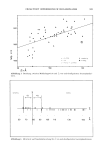
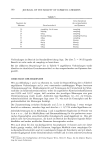
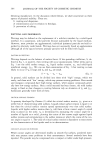
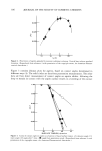
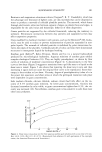
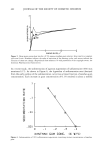
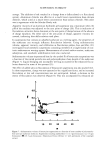
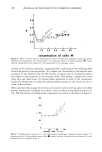
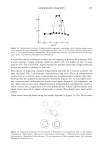
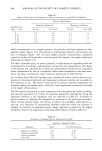
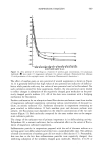
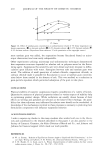
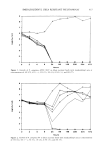
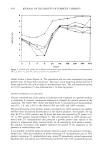
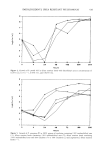
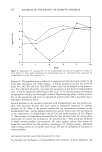
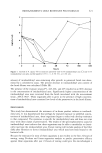
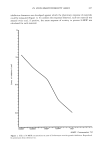
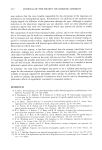
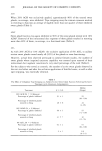
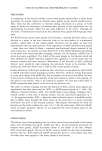
SUSPENSION STABILITY 409 30 20 • •o --30 0 0 I I I I I • ! I ! I 0,02 0.04 0.06 0,08 0.1 0.12 0.14 0.16 0.!8 0.20 XANTHAN GUM, % w/v Figure 12. Zeta potential of solid drugs as a function of xanthan gum concentration. ([•) aluminum hydroxide (O) zince oxide (¸) magnesium carbonate (/•) calcium carbonate. (Reproduced from reference 31 with permission of the copyright owner, the American Pharmaceutical Association.) The effect of xanthan gum on zeta potential of several suspensions is shown in Figure 12. It is generally believed that high values of zeta potential are indicative of defloccu- lation while particles with very low values of zeta potential tend to be flocculated. No such correlation existed for these suspensions. Rather, the zeta potential curves tended to reflect changes in adsorption of the negatively charged gum molecules on the posi- tively charged particle surfaces (31). All of the data were consistent with a bridging mechanism for flocculation. Further confirmation for an adsorption-based fiocculation mechanism came from studies of magnesium carbonate suspensions containing various concentrations of docusate so- dium, an anionic surfactant (32). Surfactant adsorption in suspensions containing no gum resulted in deflocculation. If both xanthan gum and docusate sodium were present, the flocculation state depended on the relative concentrations of the two sub- stances (Figure 13). Both molecules competed for the same surface sites on the magne- sium carbonate particles. The charge of the surfactant was of primary importance in its deflocculating activity. Polysorbate 40, a nonionic surfactant, had no substantial effect on the extent of floccu- lation of magnesium carbonate suspensions. Sulfamerazine particles in suspensions prepared with the aid of docusate sodium as a wetting agent were deflocculated and settled into a nonredispersible cake. The addition of small concentrations of xanthan gum did not result in flocculation (17). Presumably, this was due to the fact that sulfamerazine particles were negatively charged, thus inhibiting adsorption of the similarly charged gum molecules. However, if 0.2% or

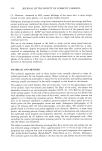
410 JOURNAL OF THE SOCIETY OF COSMETIC (:HEMISTS O. 4 LI,. 0.2 4 C, % w/v Figure 13. Effect of xanthan gum concentration on sedimentation volume of 5% heavy magnesium car- bonate suspensions. (O) no docusate sodium (I) 0.2% docusate sodium (') 0.25% docusate sodium (•') 0.3% docusate sodium. (Reproduced from reference 32 with permission of the copyright owner.) more xanthan gum was added, the suspensions became flocculated (based on micro- scopic observation) and were easily redispersible. Other experiments utilizing microscopy and sedimentation techniques demonstrated that suspension structure depended on whether salt or 'polymer served as the floccu- lating agent. Suspensions flocculated by salt were denser and more resistant to defloc- culation upon dilution with water. Synergism between salts and xanthan gum were noted. The addition of small quantities of sodium chloride, magnesium chloride, or calcium chloride made it possible for flocculation to occur at xanthan gum concentra- tions below those needed in the absence of salt. This was ascribed to a reduction in gum-particle repulsion which permitted adsorption of the gum to take place. CONCLUSIONS Physical stability of cosmetic suspensions requires consideration of a variety of factors. Quantitative measures of physical properties related to various aspects of stability help in optimizing product design. While surfactants are usually chosen because of their effects on wetting and polymers are selected on the basism-of their rheology, the possi- bility that these adjuvants may influence flocculation state should not be overlooked. A knowledge of the mechanisms involved in these processes is necessary in predicting how formulation components will influence suspension behavior. ACKNOWLEDGEMENTS I wish to express my thanks to the many students who worked with me in the labora- tory and contributed to the research described in this paper. I am also gratefhl to the Society of Cosmetic Chemists, the Kelco Division of Merck and Co., and Johnson and Johnson for financial support which made our work possible. REFERENCES (1) W. A. Zisman, "Relation of Equilibrium Contact AngLe to Liquid and Solid Constitution," in Co,- tact A,g/e, Wetti,g a,dAdhesio,, F. M. Fowkes, Ed. (American Chemical Society, 1964), pp 1-51. (2) S. W. Harder, D. A. Zuck, and J. A. Wood, Characterization of tablet surfaces by their critical surface-tension values. J. Pharm. Sd., 59, 1787- 1792 (1970).
Purchased for the exclusive use of nofirst nolast (unknown)
From: SCC Media Library & Resource Center (library.scconline.org)