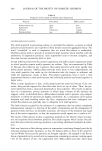
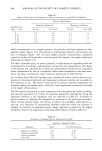
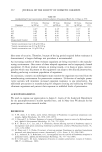
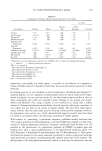
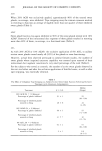
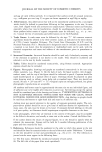
422 JOURNAL OF THE SOCIETY OF COSMETIC CHEMISTS Table III Imidazolidinyl Urea Concentration After Incubation of Inoculated Broth for 21 Days at 25øC IU Conc. Decrease IU Conc. Decrease IU Conc. Decrease Organism (g/100 g) (%) (g/100 g) (%) (g/100 g) (%) P5 0.07 • 85 0.11 b 88 0.27 c 85 445 0.09 81 0.08 91 0.11 94 495 0.07 85 0.12 87 0.29 84 RC 0.05 89 0.08 91 0.14 92 9027 0.42 12 0.74 19 1.6 11 Uninoculated Control 0.48 0 0.91 0 1.8 0 Initial concentration was 0.48 g IU/100 g. Initial concentration was 0.91 g IU/100 g. Initial concentration was 1.8 g IU/100 g. false sense of security. Therefore, because of the lag period required before resistance is demonstrated, a longer challenge test procedure is recommended. An increasing number of these resistant organisms are being recovered in the manufac- turing environment. One source of these adapted organisms can be improperly cleaned equipment. If dilute product remains on mixing vessels, or in hoses or pipes, microor- ganisms which may be present on the equipment can adapt to the diluted preservatives, thereby producing a resistant population of organisms. In conclusion, cosmetic microbiologists must monitor the organisms recovered from the manufacturing environment for preservative resistance. Utilization of multiple preser- vative systems will minimize increased organism resistance to one preservative, but additional precautions in manufacturing for adequate cleaning and sanitizing will help eliminate organisms and prevent their exposure to sublethal levels of preservative. ACKNOWLEDGEMENTS We wish to express our appreciation to James C. Garey of the Analytical Department for the spectrophotometric studies reported here, and to Mary Ann Wichmann for her participation in these research studies. REFERENCES (1) F. W. Adair, S. G. Geftic, and J. Gelzer, Resistance of Pseudomonas to quaternary ammonium com- pounds, Applied Microbiology, 21, 1058-1063 (1971). (2) J. Close and P. A. Nielson, Resistance of a strain of Pseudomonas cepacia to esters of p-Hydroxybenzoic acid, Applied & Environmental Microbiology, 31, 718-722 (1976). (3) B. T. Decicco, E. C. Lee, and J. V. Sorrentino, Factors affecting survival of Pseudomonas cepacia in decongestant nasal sprays containing thimerosal as preservative, Journal of Pharmaceutical Sciences, 71, 1231-1234 (1982). (4) H. Dixon and C. S. Dolan, Occurrence of mercury-resistant Pseudomonas in emulsion formulations preserved with phenylmercuric acetate, InternationalJ. of Cos. Science, 3, 261-266 (1981). (5) R. L. Anderson, R. L. Berkelman, et al., Investigations into the survival of Pseudomonas aeruginosa in poloxamer-iodine, Applied and Environmental Microbiology, 47, 757-762 (1984). (6) D. S. Orth and C. M. Lutes, Adaptation of bacteria to cosmetic preservatives. Cosmetics & Toiletries, 100, 57-64 (February, 1985).

IMIDAZOLIDINYL UREA RESISTANT PSEUDOMONAS 423 (7) G. E. Borovian, Pseudomonas cepacia.' Growth in and adaptability to increased preservative concentra- tions, J. Soc. Cosmet. Chem., 34, 197-203 (1983). (8) R. M. Baird, Microbial contamination of cosmetic products, J. Soc. Cosmet. Chem., 28, 17-20 (1977). (9) R. L. Decker, Frequency of preservative use in cosmetic formulas as disclosed to FDA-1984, Cosmetics & Toiletties, 100, 65-68 (February, 1985). (10) W. E. Rosen and P. A. Berke, Germall 115--A safe and effective modern cosmetic preservative, Cosmetics & Toiletties, 9, 88-89 (March, 1977). (11) P. A. Berke and W. E. Rosen, Imidazolidinyl urea activity against Pseudomonas, J. Soc. Cosmet. Chem., 29, 757-766 (1978). (12) J. J. O'Neill and C. A. Mead, The parabens: Bacterial adaptation and preservative capacity, J. Soc. Cosmet. Chem., 33, 75-84 (1982). (13) W. Horowitz, Ed., AOAC Methods of Analysis, 512-513 (1965). (14) J. F. Walker, Formaldehyde (Reinhold Publishing Company, New York, 1964), pp 355-356, 471, 472.
Purchased for the exclusive use of nofirst nolast (unknown)
From: SCC Media Library & Resource Center (library.scconline.org)