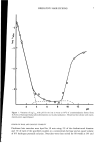
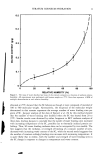
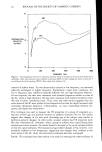
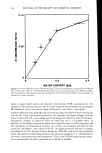
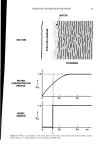
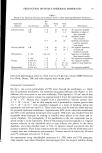
STRATUM CORNEUM HYDRATION 17 provide an estimate of barrier integrity. It is important to note, however, that TWL provides the rate of water loss. Additional information on the diffusion and partition coefficients and SC thickness are required to absolutely determine water concentration. VISCOELASTIC PROPERTIES Viscoelastic (VE) techniques measure the time-dependent response of the skin to me- chanical deformation. As the name suggests, there is a viscous component associated with energy loss (i.e. heat) and an elastic component associated with energy storage and subsequent release. The VE properties of human skin have been extensively measured in viva (see reference 44 for a review). Experimental results show that VE properties vary dramatically with water content of the sample (45). Only within the past few years, however, have non- invasive techniques been devised to study human skin in viva. Among the earliest at- tempts were those of Hargens and co-workers, who designed an electrodynamometer capable of imparting small amplitude, periodic oscillations in the surface of the skin (46,47). Using a device which displaced the skin a few millimeters parallel to the surface at low frequencies (about 1-5Hz), these investigators studied the effect of hydra- tion on VE properties. For both in vitro and in viva measurements, added moisture resulted in a decrease in the elastic component (i.e. softer tissue) and an increase in the viscous component. These moisture-dependent changes occurred within one-half minute, precluding the diffusion of water to the lower layers of the skin and, thus, suggesting that the technique was primarily sensitive to changes in the SC. Torgalkar utilized a vibrational device to impart small amplitude oscillation, normal to the skin surface ("ripple waves"), in the audible frequency range (about 700 Hz) (48). By scanning the frequency range, he was able to measure the resonant frequency of the combined skin-oscillator system. From the known vibrational characteristics of the oscillator device, the energy loss of the skin could be calculated. To test the effects of hydration, the forearm of a volunteer subject was occluded with a wrap for 14 hr. Immediately upon removal of the wrap, the energy loss was measured. Results showed a continuous decline in energy loss to a constant value within 10 min after the wrap was removed, suggesting that "softness" decreased with decreasing water content. While the rapid nature of these changes suggested that their origin was in the outer epidermal layers, no attempt was made to precisely localize the measured area. Furthermore, no evidence linking energy loss with skin "softness" was presented. More recently the author and co-workers devised a method which utilizes aspects of each of these earlier techniques (49). Small amplitude vibrations propagating in the skin surface were analyzed over a broad frequency range from about 20 to 1000 Hz. Briefly, the device consisted of a vibrational stylus resting lightly on the skin surface and driven at constant amplitude over the entire frequency range. A second pick-up stylus was placed on the skin surface a few millimeters from the first. Using a spectrum analyzer, it was possible to determine the propagation time and amplitude decrease as shear waves traveled through the skin surface layers. Ultimately, the results were obtained as propa- gation velocity (Vp) and amplitude decrement as a function of frequency. This technique was utilized to investigate the effect of water immersion on the skin of volunteer subjects. As shown in Figure 2, following a 5-min immersion and subsequent

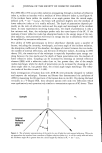
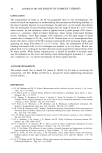
18 JOURNAL OF THE SOCIETY OF COSMETIC CHEMISTS 12 PROPAGATION 6 VELOCITY (m/•ec) DRY •ET I I I I 0 200 400 (300 800 1000 FREQUENCY (Hz) Figure 2. The propagation velocity vs. frequency for shear waves in the skin on the back of the hand of one individual. Data were obtained under ambient conditions (DRY) or after soaking the hand in water for 5 min followed by brief toweling (WET). Data taken from reference 50. removal of surface water, Vp was dramatically reduced at low frequency, yet remained relatively unchanged at higher frequency. Furthermore, under both conditions, the Vp-vs.-frequency data exhibited markedly different low and high frequency behavior. At low frequency the data were consistent with material properties similar to those of the SC, while at high frequency the data were consistent with material properties more like that of softer, underlying tissue. Thus, these and other results suggested that the outer layers of the SC were probed at low frequencies but that the depth increased with increasing vibrational frequency. Unfortunately, no exact relationship between fre- quency and depth was determined. This technique was used to measure the VE properties of a group of volunteers as a function of both age and seasonal variation in ambient moisture (50,51). The results suggest that changes in Vp seen with decreasing age of the subject were similar to hydration-induced changes. In other words, younger subjects had VE properties more like that of hydrated SC. Similarly, when a group of subjects were tested during both summer and winter months, the results showed a decrease in Vp in the summer similar to that seen upon hydration. The seasonal and age-related changes in Vp, however, were primarily confined to low frequencies, suggesting that changes were confined to the outer layers of the SC, while the lower layers remained relatively unchanged. Finally, VE techniques have been shown to be useful in assessing the relative efficacy of
Purchased for the exclusive use of nofirst nolast (unknown)
From: SCC Media Library & Resource Center (library.scconline.org)