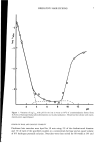
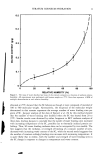
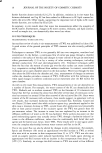
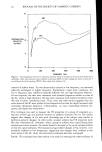
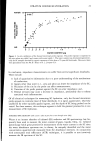
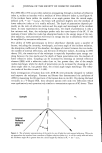
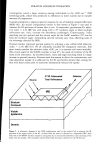
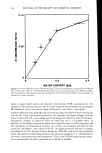
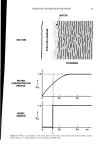
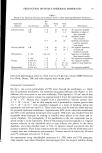
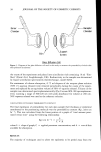
STRATUM CORNEUM HYDRATION 25 penetration depth is of the order of a few microns. In addition, we utilized an optical path completely enclosed within a dry nitrogen purge and employed a Fourier Trans- form IR (FTIR) spectrometer. The dry nitrogen purge was essential to remove absor- bances due to atmospheric gases (including water vapor), while the FTIR instrument allowed rapid data collection and analysis. Typically, high quality spectra were ob- tained in a matter of minutes. With this sensitive ATR-IR configuration, we were able to measure a minor absorbance band of water centered near 2100 cm-1. The significance of this band, which had gone undetected by others, lies in the fact that while it is weak compared to the OH stretching band near 3400 cm-•, it occurs in a region of the mid-IR where SC and most topical substances show no absorbance. Using SC sheets, in vitro ATR-IR spectra were obtained as a function of the water content of the sample. In vitro and in viva spectra were indistinguishable under similar experimental conditions. Furthermore, analysis of the in vitro spectra provided calibra- tion data relating the absorbance at 2100 cm-• to the water content of the SC (see Figure 6). From these calibration data, quantitative estimates of in viva water content in the upper layers of the SC could be made from the ATR-IR spectra. In addition, as with data obtained with the focused microwave probe (Figure 3), these data again point out the biphasic nature of water uptake by the SC. This technique has been utilized to investigate the SC water content of a group of test subjects. Results show that under normal laboratory conditions (21øC, 35% relative humidity), six subjects had an average (___SEM) water content of 0.12 + 0.01 g/cm 3. The test site was then occluded for five hours with petrolatum. Immediately following removal of this occlusive layer, the water content had increased to 0.22 ___ 0.02 g/cm 3 but returned to pretreatment values when remeasured 30 to 45 minutes later. These results show that an occlusive barrier can dramatically enhance the moisture of the underlying skin, a short-lived effect once the barrier is removed. In a similar manner, the kinetics and extent of water uptake due to treatment with various moisturizers can be assessed. A comparison of results obtained under similar conditions shows that the IR-derived in vivo results yield a slightly larger water content value than that obtained by in vitro gravimetric techniques (see Figure 1). Occlusion of the test site during measurement could be responsible for the larger in viva values. However, extrapolation of water con- tent vs. time data to zero-time consistently yields water content values greater than the corresponding in vitro results. Alternatively, these results suggest that the IR technique not only measures the water content of the surface but also takes into account deeper layers of greater water content. Interestingly, our value for normal hydration (0.12 + 0.01 g/cm 3) is identical, within error, to the value obtained by Jacques et al. (0.17 g/g, which when corrected for the density of dry SC of 1.5 g/cm 3 yields a water concentration of 0.11 g/cm 3) with a focused microwave probe of 3 ptm penetration depth (56). While the ATR-IR technique is one of the few non-invasive methods capable of yielding quantitative measurement of SC hydration, it is not without its drawbacks. In order to obtain high quality spectra, it is necessary to signal average during which time the skin site being studied is occluded. Thus, the water content changes as the measure- ment is made. This difficulty can be somewhat overcome by the use of FTIR instru- ments which substantially reduce data collection times. Still, the site is occluded for

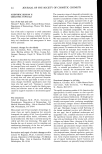
26 JOURNAL OF THE SOCIETY OF COSMETIC CHEMISTS 0.10 0.05 0 0 0.2 0.4 WATER CONTENT (g/g) Figure 6. In Vitro calibration of the ATR-IR technique. The ratio of absorbence to baseline for the IR peak due to water near 2100 cm-• and the gravimetric water content were determined at five different ambient relative humidities. The average values and standard error are plotted for three different human samples, all obtained by trypsin treatment. about a minute while spectra are obtained. Furthermore, FTIR instruments are very expensive. The ultimate solution may lie in the design of an instrument which measures IR absorbance over a very narrow range of frequency, and, hence, very rapidly. Another difficulty with ATR-IR arises from the fact that the depth-of-beam penetration into the SC varies with several parameters. For example, the depth changes with the water content of the SC, since added water will change the refractive index of the tissue. Fortunately, changes in refractive index are small and this is a secondary effect. In addition, as the depth increases the beam entry angle becomes critically important and the uncertainty in measurement increases. As a result, the technique provides the best results for the shallow, outer layers of the SC, the region primarily affected by changes in hydration (41,42). In spite of these drawbacks, ATR-IR is one of the few techniques where the theoretical relationship between the measured parameter (i.e., IR absorbance) and water concentration are well understood. Thus, with ATR-IR spectroscopy quanti- tative measurement of water concentration in the SC is possible.
Purchased for the exclusive use of nofirst nolast (unknown)
From: SCC Media Library & Resource Center (library.scconline.org)