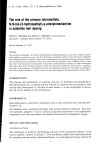
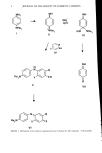
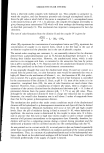
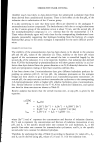
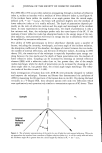
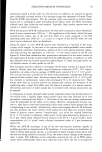
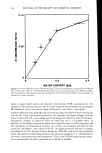
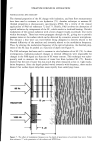
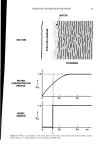
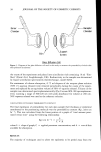
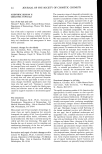
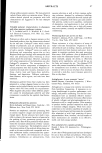
38 JOURNAL OF THE SOCIETY OF COSMETIC CHEMISTS Donor • Chamber / upport Skin Screen ,/ Receptor Chamber Glass Diffusion Cell Figure 1. Diagram of the glass diffusion cell used in this study to measure the permeability of whole skin and epidermal membranes. the course of the experiment and placed into scintillation vials containing 10 ml "Fiso- fluor" (Fison's Ltd, Loughborough, UK). Radioactivity in the samples was determined by liquid scintillation spectrometry (Intertechnique, model SL30). For assessment of toluene absorption, 0.75 ml aliquots of the receptor phase solution (50% v/v aqueous ethanol) were removed periodically during the course of the experi- ment and replaced by an equivalent volume of 50% v/v aqueous ethanol. Toluene in the samples was determined spectrophotometrically (Pye Unicam SP8-100 spectrophotom- eter), scanning a range of 300-220 nm with peak absorbance for toluene at 260 nm. 50% aqueous ethanol was used as the reference solution. CALCULATION OF THE SKIN PERMEABILITY CONSTANT The final expression of permeability for each skin sample (full thickness or epidermal membranes) to the penetrating molecule was the permeability constant (Kp, units cm hr-1). This was calculated from the linear portion of a graph of "total amount pene- trated versus time" using the following relationship: S Kp (cm hr-2) _ CXA where S = slope of graph C = applied penerrant concentration and A = area of skin available for absorption. RESULTS The majority of techniques used to allow the epidermis to be peeled away from the

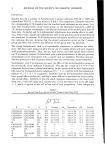
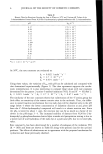
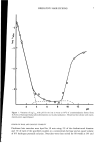
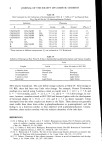
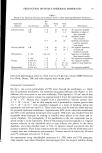
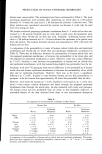
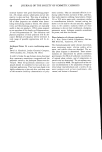
PRODUCTION OF INTACT EPIDERMAL MEMBRANES 39 dermis were unsuccessful. The techniques have been summarized in Table I. The most promising separations were possible after immersing rat whole skin in 2 M sodium bromide (4-5-week-old rats) and 0.1 M dithiotreitol solution (1-day-old rats). This latter solution was considered unsuited for routine use because it could only be used with very young rat skin. We further evaluated preparing epidermal membranes from 4-5-week-old rat skin im- mersed in 2 M sodium bromide and we were able to peel away the epidermis most successfully when 28-day-old rat skin was used. Similarly, immersing human whole skin in 2 M sodium bromide for 16-24 hours allowed the epidermis to be peeled away from the dermis. The sodium bromide solution was maintained at 20øC with both the human and rat skin. A comparison of the permeability to water of human cadaver whole skin and epidermal membranes and 28-day-old rat whole skin and epidermal membranes is presented in Table II. There was no difference between the permeability of human whole skin and the prepared epidermal membranes, or between the permeability of rat whole skin and the prepared rat epidermal membranes to water. However, there was a small difference (p 0.01, Student's t-test) between the permeability of human and rat (whole skin and epidermal membranes), with the human being slightly less permeable than the rat. Similarly, with the [•4C] paraquat there was no difference in the permeability of human whole skin and human epidermal membranes or between the permeability of rat whole skin and rat epidermal membranes. However, there was, as for water, a significant difference (p 0.001, Student's t-test) between human and rat skin permeability to paraquat, with the human skin approximately 40 times less permeable than rat skin. However, with both the human (p 0.01, Student's t-test) and rat (p 0.05, Stu- dent's t-test) tissues, toluene absorption was faster through the prepared epidermal membranes than through the whole skin. As also measured with water and paraquat, the human tissue was less permeable than rat tissue to this lipophilic molecule. A noticeable feature of the data obtained from these in vitro percutaneous absorption Table II A Comparison of the Permeability of Human and Rat Tissues Human Skin Rat Skin Epidermal Epidermal Whole Membrane Whole Membrane Water 0.78 0.84 1.39 1.39 [3Hi -4- 0.39 -+ 0.37 -+ 0.65 -+ 0.61 n = 21 n = 12 n = 43 n = 23 Toluene 0.15 1.18 0.31 1.78 neat -+ 0.04 -+ 0.57 -+ 0.12 -+ 1.37 liquid n = 6 n = 7 n = 6 n = 14 Paraquat 0.0073 0.0076 0.27 0.48 [•4C] -+ 0.0060 -+ 0.0010 -+ 0.20 -+ 0.23 n = 10 n = 11 n = 25 n = 8 A comparison of the permeability of human and rat (whole skin and epidermal membranes). The perme- ability has been expressed as a calculated permeability constant (units, X 10 -3 cm hr -•) --- standard deviation, and number of determinations (n).
Purchased for the exclusive use of nofirst nolast (unknown)
From: SCC Media Library & Resource Center (library.scconline.org)