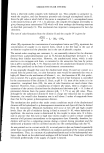
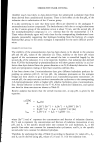
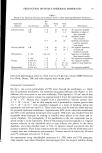
OXIDATIVE HAIR DYEING 5 therefore much less likely in dyes derived from the substituted p-diamine than from those derived from unsubstituted diamines. There is little effect on the first pK a of the indamine due to substitution of the 4'-amino group. It is also interesting to note that these same effects are observed in the analogous 4- monosubstituted amino compounds. The bathochromic shift due to a single substituent on the 4'-amino group of the indamine cation is about 70 nm, and the second pKa of the monohydroxyethyl compound is 2.7, whereas that for the monomethyl is 3.8. These values obviously agree well with those for the corresponding disubstituted com- pounds, presumably suggesting that hydrogen bonding from the hydroxy of a single hydroxyethyl group to the amino nitrogen is responsible for the more difficult proton- ation. STABILITY OF THE DYES The stability of the aminoindamine dyes has been shown to be related to the solution pH and the pK a values of the indamine (2). Thus, stability at the lower pH values typical of the environment within and around the hair is controlled largely by the second pKa of the indamine. It is to be expected, therefore, that indamine dyes derived from N,N-bis-hydroxyethyl-p-phenylenediamine will show greater stability in acid so- lution than dyes derived from the parent diamine or its N,N-dimethyl derivative. Stan- dard acid perspiration testing of dyed hair swatches confirms this. It has been shown that 2-aminoindamine dyes give different hydrolysis products de- pending on solution pH (2). At low pH, the indamine protonares on the nitrogen bridge and then cleaves to give p-diamine and 2-aminobenzoquinone monoimine. At neutral pH, the major reaction involves intramolecular cyclization to the corresponding 2,8-diaminophenazine while at higher pH, alkaline hydrolysis gives 2-aminoindoani- line. Similar behavior is shown by the 4'-N,N-bis substituted in&mines, and typical rate data for these reactions are shown in Table II. Kinetic analysis has shown that the overall reaction rate, at any pH, is given by the equation: -- d [In] dt kobs[In] = k•[H +] [In 2+] -t- k2[In +] -t- k3[OH-] [In +] = [k•[H + ] (x' -t- k20• -t- k3[OH-] 0•.1 [In] kob s = k•[H +]c•' + k2c• + k3[OH-]c•... (1) where [In 2+] and o•' represent the concentration and fraction of indamine dication, [In +] and o• represent the concentration and fraction of indamine monocation at any pH, and k• is the specific second-order rate constant for acid hydrolysis, k 2 is the specific first-order rate constant for intramolecular cyclization, and k 3 is the specific second-order rate constant for alkaline hydrolysis. Therefore, by analyzing the data of Table II according to Equation (1), values of k•, k2, and k 3 can be derived using pKa values of 2.6 and 11.1 for the indamine ions.

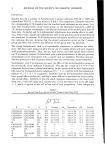
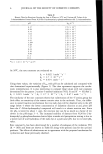
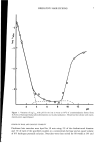
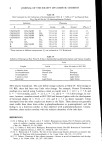
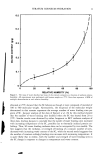
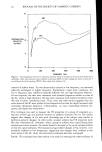
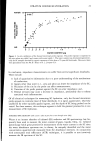
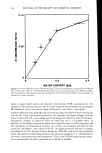
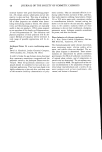
6 JOURNAL OF THE SOCIETY OF COSMETIC CHEMISTS Table II Kinetic Data for Reactions Causing the Loss in Water at 30øC and Various pH Values of the 2-Aminoindamine Formed From N,N-bis-2-hydroxyethyl-p-phenylenediamine and 2,4-toluenediamine pH ko•,s (s- •) 0.17 1.55 X 10 -2 0.28 1.09 X 10 -2 0.74 4.22 x 10 -3 1.02 1.96 x 10 -3 1.13 1.68 x 10 -3 3.74 5.79 x 10 -6 4.43 5.43 x 10 -6 5.38* 3.18 x 10 -6 6.48 2.58 x 10 -6 7.47 2.17 x 10 -6 8.24 2.08 x 10 -6 9.10 6.41 x 10 -6 9.90 2.01 x 10 -5 11.2 3.20 x 10 -4 13.0 6.05 x 10 -4 * k = 1.43 x 10 -4s -•at 67 ø . At 30øC, the rate constants are evaluated as: k• = 0.022 1 mole-• s-• k 2 = 2.7 X 10⁻⁶s -1 k• = 0.49 1 mole-•s-• Using these values, the variation of kob s with pH can be calculated and compared with that determined experimentally (Figure l). The clear agreement supports the mecha- nistic interpretation. It is also interesting to compare these values with rate constants determined for the parent 2-amino-5-methyl-indamine [VIII, R and R' = H] (Ref 2' k• = 0.021 1 mole -•s-• k 2 = 2.7 x 10 -6s-• k 3 = 0.67 1 mole -ls-•). The similarity of the rate constants shows that substitution of the 4'-amino group has little effect on reactivity of the remote reactive sites in the molecule. Thus, the differ- ence in overall reaction rate between the two indo dyes will be observed only in the pH range below 4 where the lower concentration of indamine dication at any given pH from the 4'-N-bis-hydroxyethyl compound will result in a slower reaction rate. Since the pK a is lower by about 1 unit, the reaction rate can be as much as a factor of ten slower in the pH range 3-4. The increased stability of dyeouts from N,N-bis-2-hy- droxyethyl-p-phenylenediamine-derived dyes towards acid perspiration testing is due to a slower rate of acid hydrolysis of the indo dye at a particular pH, due to its lower pK a value. Rate constant k 2 has been determined for a number of analogues of the indamine VIII (X = NH) and these are shown in Table III along with spectral data for the cyclized products. The effects of substituents are in agreement with the proposed mechanism for cyclization and those previously observed.
Purchased for the exclusive use of nofirst nolast (unknown)
From: SCC Media Library & Resource Center (library.scconline.org)