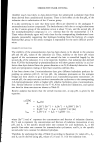
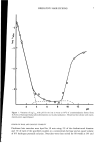
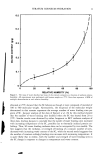
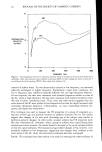
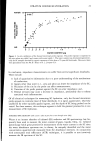
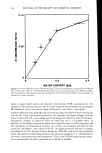
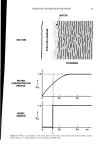
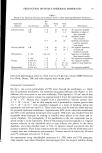
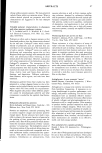
STRATUM CORNEUM HYDRATION 21 WATER 1.0 O•- AIR 0 B 55(• ß eooo ß ß ß eo ß ß ß ,.*** ß o o ß ß ß ß ß WATER CONTENT g/g Figure 3. In vitro calibration of the focused microware probe response. The probe response is expressed in lab units where air yields 0 and contact with water yields 1. The water content was determined gravimetri- cally for SC samples obtained by trypsin treatment of skin from a 55-year-old black male. Data were taken with permission from the Ph.D. Thesis ofS. L. Jacques (13). In conclusion, impedance measurements can suffer from several significant drawbacks. These include: 1) Lack of quantitative information due to a poor understanding of the mechanisms of conduction 2) Agents other than water (i.e., urea and salts) can lower the impedance of the SC 3) Occlusion of the site by the probe can affect measurements 4) Variation of the probe pressure against the SC can alter impedance and, 5) Dermal irritants may cause a decrease in impedance, presumably due to edema associated with inflammation. Of all electrical techniques for measuring SC hydradon, only the focused microwave probe appears to overcome most of these drawbacks. It is rapid, quantitative, relatively unaffected by other topically applied agents, and the depth of SC being probed can be varied. For these reasons, this technique appears to hold the greatest promise for in vivo measurement of SC hydradon. INFRARED SPECTROSCOPY [This section is taken in part from a more thorough review (58)] Water is an intense absorber of infrared (IR) radiation and IR spectroscopy has fre- quently been used to measure the water content of gases, liquids, films, etc. Infrared spectroscopy holds great promise for measurement of the water content in the SC since the water absorbance spectrum can, in theory, be uniquely identified and the water concentration quantitatively measured from the absorbance intensity. In conjunction with attentuated total reflectance (ATR) techniques, it is possible to non invasively measure the IR spectrum of the SC.

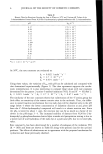
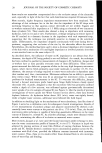
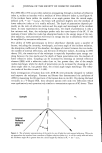
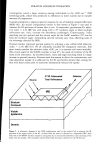
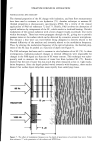
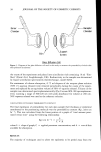
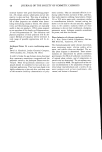
22 JOURNAL OF THE SOCIETY OF COSMETIC CHEMISTS The ATR effect (59) occurs when radiation propagating through a medium of refractive index n• strikes an interface with a medium of lower refractive index n 2 (see Figure 4). If the incident beam strikes the interface at an angle greater than the critical angle, defined as 0c = sin-• (n2/n•) , the beam will penetrate slightly into the medium of lower refractive index as it is totally reflected. The depth of penetration depends pri- marily on the ratio of refractive indices and the angle and wavelength of the incident beam. In most experiments involving human skin, the depth of penetration is only a few microns and, thus, the technique probes only the outer layers of the SC. If the medium of lower refractive index has absorption bands in the energy range of the inci- dent radiation, each penetration will result in energy loss due to absorbance which will be amplified by successive reflections. The ability of ATR spectroscopy to detect absorbance depends upon a number of factors, including the intensity, wavelength, and entry angle of the incident radiation, the absorption coefficient of the absorber, the degree of contact between the two media, the number of internal reflections, and the ratio of refractive indices. According to ATR theory (59), the sensitivity of the technique is especially dependent upon energy cou- pling between the two media and the depth of beam penetration into the medium of lower refractive index. Coupling can be increased by choosing an internal reflection element (IRE) with a refractive index close to, but greater than, that of the sample (index matching), while the depth of penetration can be increased by choosing an inci- dence angle close to, but greater than, the critical angle (angle matching). The refrac- tive index of the skin is near 1.6 (60). Early investigations of human skin with ATR-IR were primarily designed to validate and improve the technique. Puttnam and Baxter first demonstrated the usefulness of ATR by measuring the IR spectrum of the human skin in situ (61). By placing the hand vertically in a V-shaped IRE, they obtained spectra with only two reflections which were qualitatively and quantitatively similar to transmission spectra of SC sheets. These Sample I n2 Internal •/•/• n, Reflection Element (IRE) / Figure 4. The schematic representation of the path of a ray of light for total internal reflection. When the ray approaches the interface from a medium of higher refractive index (n•), it will be totally reflected when the incidence angle (0) is greater than the critical angle (0c) defined as 0c = sin-• n2/n •.
Purchased for the exclusive use of nofirst nolast (unknown)
From: SCC Media Library & Resource Center (library.scconline.org)